
she ate the whole thing
 but i get ahead of myself. like these women pictured here, i am likely older and fatter than you, though i never wear a full, long skirt, nor a cap nor a shawl -- and rarely an apron. i do however, upon occasion, wear an apron, but i only have blue ones. my hair is not black nor white, and neither is my cat. she's not green either.
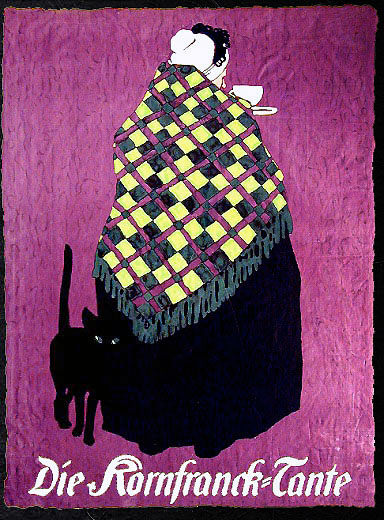 but a truism emerges nonetheless: a portly older woman has a cat. what could be truer than that? in the five and a half years we've spent together we've not always seen eye-to-eye, but we have a policy by which we stand: we always make up before we go to bed.
 something has happened this weekend, though, that threatens every bit of the simpatico wavelength we have forged: ruby caught and ate a tree-rat right in front of me. (we were outside.) (though tree-rats look like big mice with a long rat-like tail, i've gotten to know them pretty well over the years; they love the bird-feeder late at night, and they'll peel and sample lemons on the tree, placing the bits of rind carefully on a nearby leaf. though there are those who shudder at the mere thought of them, they're pretty harmless.)
 now ruby, like previous cats with whom i've shared a bed, has learned that birds are out-of-bounds. i understand the magnitude of sacrifice she makes for me in this, so i tread carefully with regards other possible prey. spare the butterfly, if possible, but allow the dragonfly, like that. and if she catches a mouse she's not allowed to bring it into the house. but a rat? i'm afraid we didn't have any rule for that.
 the first sign that something was about to happen was her uncharacteristically rushed and clumsy leap toward the side fence and into the morning glory vines which thicken towards the ground and back she came with the rat in her mouth, as it kicked and kicked, in its wholly ineffectual attempt to run away. she didn't seem sure where to drop it, and in case that had anything to do with me, sitting there, i half-heartedly congratulated her on her catch.
 she shook it several times in what appeared to be clearly an attempt to kill it, then dropped it on the cardboard port in front of my swing. it lay on its back, still kicking, and breathing hard. i could see its belly fill and deflate, fill and deflate. ruby played with it, but seemed more interested in dining than diddling.
and thus she began, taking the head first.
 she was quite masterly and efficient, and utterly serious. soon the head was only half there, bloody and fresh. the rest went down a bite at a time, though she had to work the gristle, or the intestines -- not sure what -- till they tore. very slightly, i could hear the crackle of the bones. it didn't take much time, as i sat there unclear of my role, if there was one. ruby neither rushed nor dawdled. i wondered if she would eat the tail, which was last, but she did.
 then all that was left was a very small puffy pile of swollen entrails, and one hand, er, paw, though it looked like a gloved hand that might reach for one's monocle. ruby, full and tired, crawled right into her bed and slept, even before she cleaned herself, though truthfully she had been very neat.
so who am i now? she is clearly no longer my "baby." or is she? i don't know how to treat her, though i'm struggling to stop myself from getting down on my knees and bowing down, we're not worthy, we're not worthy. my charming companion has shown her true face, and she has asked me, what does anyone really know?
Labels: cole phillips, gronowski, Johann baptist maier, max hertwig, ohara koson, oppenheim, otto baumberger, Sebastian Oesch
posted by lotusgreen at 11:27 AM
6 comments


