japonisme

26 June 2011

released

RELEASE

With rod and tackle box,
I'm slogging through soft sand,

a red sun going down in the surf,
swag-belly clouds drifting in

with Ray, only two months dead,
going on about girls that summer

we studied French in Québec and
guzzled Labatts at the Chien d'Or,

about how he'll marry again, keep
at it until he gets it right—
Pas vrai
?

Above the tide wrack, a woman
in a two-piece with half my years

kneels struggling in the sand
with a pillow of feathers,

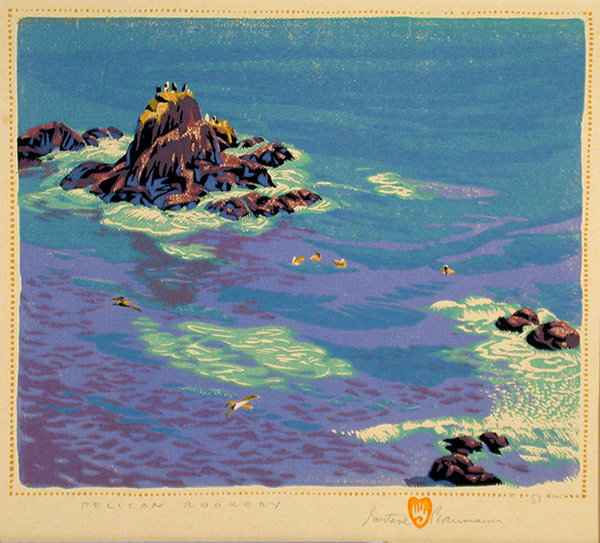
one wing flapping—a pelican
tangled in fish line, treble hook

in the bill pouch,
the other in its wing.
Ray says, Ask her out for a drink

but she says,
Could you give me a hand?
I drop the tackle and secure the wing

while she croons to calm him and
with one free hand
untangles the line.

With pliers from the tackle box,
I expose the barbs and carefully clip,

a total of six loud snaps.
Then I hold
the bird while she frees
the last tangle

and we step back,
join the onlookers,
a father explaining care to his kids.

The pelican now tests his wings, rowing
in place. He looks around and seems

to enjoy the attention, just as Ray did
in bars, buying drinks and telling jokes.

But this college boy with a can of Bud
is no joke and says they watched it flap


all afternoon
from that deck on the dune.
His buddy agrees with a belch

that buys a round
of frat boy laughter.
Ray tells me the kid needs his clock cleaned

just when the pelican waddles up
and puts his soft webbed foot on mine.

He tilts his head to
catch my look, then
flapping runs into the air,
tucks his feet,


and climbs, turning over our small circle,
before heading west. Dazzled and dumb,

I'm faintly aware of the woman,
then gone,
weightless and soaring over water, looking

down on myself slogging through sand,
certain that I'm being watched,


if only by another self
who will have to tell how it happened.

Peter Makuck

From Long Lens by Peter Makuck. Copyright © 2010 by Peter Makuck.

Labels: , , , , , , , , ,

24 June 2011

birds of a feather....

...can now
get married


in New York!

it just got better

Labels: , , ,

31 March 2011

the nest of rapture

RHAPSODY

No one says
it anymore,
my darling,
not to the green leaves
in March, not to the stars
backing up each night, certainly

not in the nest
of rapture, who
in the beginning was
an owl, rustling
just after silence, whose

very presence drew
a mob of birds--flickers,
finches, chickadees, five cardinals
to a tree--the way a word
excites its meanings. Who

cooks for you, it calls, Who looks
for you? Sheaf of feathers, chief
of bone, the owl stands
upon the branch, but does he
understand it, think my revel,
my banquet, my tumult,

delight? The Irish have a word
for what can't be
replaced: mavourneen, my
darling, second cousin once
removed of memory, what is not
forgotten, as truth was
defined by the Greeks.

It's the names
on the stones in the cemetery
that ring out like rungs
on a ladder or the past
tense of bells: Nathaniel Joy,
Elizabeth Joy, Amos
Joy and Wilder Joy,

and it all comes down
to the conclusion
of the cardinal: pretty, pretty, pretty
pretty--but pretty what?
In her strip search
of scripture, St. Teresa
was seized, my darling, rapt
amid the chatter
and flutter of well-coiffed

words, the owl
in the shagbark hickory,
and all the attending dangers
like physicians
of the heard.

Angie Estes


From Voice-Over by Angie Estes. Copyright © 2002 by Angie Estes.

so many love the bullfinch! a cross-cultural item of adoration. looks more like the grosbeak we have around here than any of our local finches, but still, who knew? this sweet little offering is dedicated to gerrie at his blog the linosaurus. his blog is the source for the top left image of this post, just part of the ongoing introductions to gerrie's finds in his tireless searches.

Labels: , , , , , , , , ,

01 March 2011

frogs sing, roosters sing

.蛙鳴き鶏なき東しらみけり
kawazu naki tori naki higashi shirami keri

frogs sing, roosters sing
the east
turns light

issa

as van gogh wrote to his brother, 'i think the drawing of the blade of glass and the carnation and the hokusai in *bing's reproductions are admirable... isn't it almost a true religion which these simple japanese teach us, who live in nature as though they themselves were flowers.'

what van gogh probably didn't know was that in japan 'precise rules had been laid down governing the drawing of animals and plants.' through a combination of historical documents and close observation, the artists were required to produce drawings that were 'accurate enough to satisfy a zoologist,' and in doing so revealed their closeness to nature, unlike the europeans who seemed to survey it from afar. 1

the japanese portrayal of animals and plants were true to life but not naturalistic. one found in them a deeper significance, a symbolic element beyond the artistic intent. as a part of historical religions in the area every living thing was both itself, and a representation of the essence it embodied.


in japan, the cock symbolized high esteem. it is also suggested that the bird acquired a religious significance as a representative of peace and the coming of dawn.


the tale of the rooster who made the sun come up is legend; the one with which i am most familiar is the story of chanticleer and the fox, which began with chaucer if not before. two rival inflated egos at the job of trickstering each other, to both the success and the failure of each.


to my eyes, the cock's greatest conceit is his beauty. how graphically dramatic is that bright red against the black or white of the rest of the bird. even in the more multi-colored birds the comb, the tail, and the attitude delight us, and make us laugh with bit of awe.

Is that a
rooster? He
thrashes in the snow
for a grain. Finds
it. Rips
it into
flames. Flaps. Crows.
Flames
bursting out of his brow.


How many nights must it take
one such as me to learn
that we aren’t, after all, made
from that bird that flies out of its ashes,
that for us
as we go up in flames, our one work

is
to open ourselves, to be
the flames?

Galway Kinnell

from Another Night in the Ruins from Three Books. Copyright © 2002 by Galway Kinnell. All rights reserved.

* Artistic Japan

Labels: , , , , , , , , , , , , , ,

24 November 2010

flipping the american bird

29 September 2010

the white-crowned sparrow sings


this is a photgraph from wikipedia that i played with. and regarding that song, the WCSs have regional dialects, sometimes drawing from a VERY small region, so in fact if you live anywhere other than my back yard, they might sound a little different.

also, regarding their coming and going, they don't actually go very far. they hang out all summer at the shore of the bay, where it never gets as warm as it occasionally can here only a mile inland.

Labels:

18 April 2010

a man for all seasons • 1915

02 April 2010

a man for all seasons: 1908

1i've changed my mind since yesterday. this project is too important to do in a half-assed manner. so, whenever i post a partial page i will do my best to replace it with a whole page as i can. i've finally found a bio for this artist, google-translated from the dutch. i'll try to catch all of the translating and "sense" problems, but if you find any i miss, please let me know!

HOIJTEMA, Theodoor van (1863-1917)

Hoijtema, Theodoor van (known as Theo van Hoytema), painter; draftsman and lithographer. Married 24/12/1891 to Martina Hogervorst. They had no children.

Theo van Hoytema, youngest in a family with eight children, lost his parents at an early age. Together with his brothers and sisters, Theo moved to Little City District where his eldest sister gave him his first drawing lessons. After having taken four classes at the Municipal Gymnasium in Leiden, he began working in the banking house of his two elder brothers in Delft.


Van Hoytema, however, with his cheerful nature and restless, artistic leanings and love of nature, was not at all suitable for such a job and, once it was possible, he left. In 1889 he moved from Delft to Leiden, where he spent some time with the family on his mother‘s side. Meanwhile, he followed courses in winter drawing and painting at the Hague Academy of Fine Arts (1887-1892) and drew stuffed animals in the Zoological Museum after school.

Through his uncle, business partner of the publishing and printing company Leiden Brill, Van Hoytema got his first assignments: scientific illustrations in biological works. In 1890 Van Hoytema established himself as an independent artist in his own studio Intrantibus Pax. That is where his lithographed book How the birds came to a king (Amsterdam, 1892) came into being. This was the first Dutch attempt to tie text and image to a single idea.

With the color lithographs in his next project, the ugly duckling (Amsterdam, 1893), a story with autobiographical elements to the tale of Hans Christian Anderson, Van Hoytema acquired some fame. He was married in 1891 and lived first in Loosduinen, later in Voorburg. His happiest and most productive years had begun. He painted the large canvas Return of the Stork (1893, Museum Boijmans-van Beuningen) and received orders for murals to decorate a room in the Museum Boijmans-van Beuningen (1893), and received orders for murals to decorate a room in the Society in Gorinchem (1894), and for a cruise boat of the company Fop Smit (1896).

Hoytema's subjects were almost without exception plants and animals, particularly after relocating to Hilversum in 1897. Chalk drawings dating from this period are Swans in a pond, and Face in a green- house, and such lithographs as the Rabbit and Egrets in the portfolio Animal studies. The architectural composition and technical mastery of these pieces bears witnesses to the skills Hoytema had acquired.

A difficult period for Van Hoytema began in 1902. His marriage broke up and he was worried about his health. Some years of wandering followed. He lived in Voorburg and Amsterdam, stayed with a sister in London and was nursed in a hospital (1904 - 1905), and in a sanatorium for nervous diseases in 1906. In 1907 he found a home with his sisters in The Hague, who lovingly cared for until his death.

Out of these stressful years grew the calendars for which Hoytema gained his greatest fame. The long series of color lithographs appeared only with great willpower, and the series was completed posthumously. The calendar for 1918 appeared in black and white.

Since 1970, the publication of his calendars and picture books has resumed in facsimile editions.

Van Hoytema did not belong to a particular artistic group or movement. His work reveals a number of typical characteristics of the period 1890-1900: the influence of English illustrators such as Walter Crane -- especially in the first two picture books, and the influence of Japanese prints. Art Nouveau styling elements, decorative and whimsical undulations, and distinct contours were employed, without losing sight of naturalism. By 1896 Hoytema had a great freedom in his work, and created a notably beautiful exhibition catalogue for the Rotterdam Art Circle, and a wonderful Monthly Scripture for Vercieringskunst.

Since 1892, Van Hoytema was a member of the 1893 Hague Art Circle and of Arti et Amicitiae in Amsterdam. He had many friends, including who even in his difficult years remained loyal and supportive. They described him as a friendly and cheerful despite everything, unpretentious man, full of idealism and hard work. 1

learning that hoytema suffered some years of despair didn't surprise me. there is something in the absolute tenderness with which he recreates his birds and animals that speaks, to me, of the sort of sensitive soul who may verge on that inexact edge between beauty and sadness.

he clearly loves these creatures, and devotes great care to represent both their beauties and their personalities. this is particularly observable in his work from this year, 1908. this is a year of solitary birds, close-ups, giving the viewer the sense that they can feel what the bird itself feels.

in upcoming posts we'll see how different years take on different moods and characters. and, as i said, the close-ups will be replaced with whole pages as i can, but i think, for this month in particular, the portraits will stay too.

Labels: , ,

older posts