japonisme

01 April 2012

don't believe a thing i say!

okay, april fools and all that, but i'm not completely kidding (and since i didn't finish this yesterday, it might not count anyway). sometimes in the mythologies i try to untangle for you i get some things seriously wrong for one main reason: i forget to check the dates. in fact i wouldn't be sur- prised if i haven't attributed some things to some artists that happened long before, or long after, they died. i hope you know what i mean!

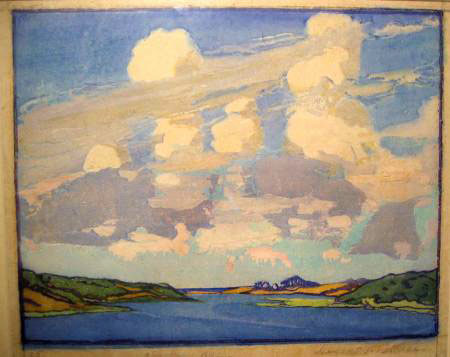
let us begin with, for example, gustave courbet who died at age 58, in 1877. he was born in 1819. obviously. see his example above right? very natural clouds. no outlines. (they really tend to not have any outlines; i have been checking.) and then we have hokusai: all outlines, nothing realistic about them. while he was born in 1760, he was producing artwork until his death in 1849. quite an overlap in lives, these two. the moment of japonisme would have passed hokusai by completely, while all of courbet's training and experience, and the way he saw, were set by the time of the invasion.

now to put these generational questions into some context, may i mention that hiroshige lived from 1797 to 1858 (getting closer to courbet, aren't we?) and monet lived from 1840 to 1926. monet, the impressionists, were the first artists to imbibe from the teacup of the japanese, but the next gener- ation made things extremely interesting. there were the cowboy painters, painers of the mesas of utah and arizona, dixon, cassidy, and borg: realistic clouds with outlines.

they were the next generation; they, these brilliant western painters, were of the same generation as some of the artists we have gotten to know well over the years: henri riviere, pierre bonnard, frances gearhart, and, only slightly younger, hiroshi yoshida. yoshida did not even begin to make prints (he had been a western-style painter, as they were called then) until he was in his 40s -- one year before arthur wesley dow died!

what this boils down to is that any illustration i have given you of influences yoshida may have had on dow are completely erroneous! arthur wesley dow's birth (1857 - 1922) occurred one year before hiroshige died! dow was more a contemporary of monet than the many proponents of japonisme with whom i have linked him; dow was, as was monet, the first wave -- the primogenitor of influences of japonisme, and not any part of the gang.

henri riviere, pierre bonnard, carl oscar borg, maynard dixon, and hiroshi yoshida all died within four years of my birth. these donors of legacy are no further in the past than is world war II. these artists are of the generation of my grandparents, or great-grandparents. in other words, we still swim in their stream. there was no flood diverting it.

so with regard to clouds (and we have discussed them before; just click on the 'clouds' tag to see the other discussions), we now have a much clearer line of inheritance: it is obvious that the japanese gave us outlines and we gave them perspective. they gave us simplicity and we gave them the multi-pigmented shades of color of which the world is built.

see here the same cloud, albeit different times of day, as offered by frances gearhart and hiroshi yoshida. many similarities. yoshida's work presents far more subtleties than does hokusai's, and gearhart's far more outlining and simplifying than courbet's. but who learned from whom? do they more accurately owe each other a debt as do artists working at the same time? i think they do.

Labels: , , , , , , , ,

29 July 2008

the birth of clouds

THE SENSE OF THE SLEIGHT-OF-HAND MAN

One’s grand flights,
one’s Sunday baths,
One’s tootings at the weddings of the soul
Occur as they occur.
So bluish clouds
Occurred above the empty house and the leaves
Of the rhododendrons
rattled their gold,
As if someone lived there.
Such floods of white
Came bursting from the clouds. So the wind
Threw its contorted strength around the sky.

Could you have said the bluejay suddenly
Would swoop to earth? It is a wheel, the rays
Around the sun. The wheel survives the myths.
The fire eye in the clouds survives the gods.
To think of a dove with an eye of grenadine
And pines that are comets, so it occurs,
And a little island full of geese and stars:
It may be that the ignorant man, alone,
Has any chance to mate his life with life
That is the sensual, pearly spouse, the life
That is fluent in even the wintriest bronze.

Wallace Stevens

“The Sense of the Sleight-of-hand Man” from Collected Poems.
Copyright 1923, 1951, 1954 by Wallace Stevens.
Reprinted with the permission of Alfred A. Knopf,
a division of Random House, Inc.
Source: Poetry (July 1939).

what a strange day.

at long last i noticed that japanese prints, in addition to only very rarely featuring shadows or reflections, as we've discussed before here and here and here, only rarely have clouds!, certainly never, until the shin hanga artists gave them birth, as sunset, billowing, nor multi-colored.

when clouds did appear, they were almost exclusively used to augment a painting of a mountain, an evidence of heights. the mountain were subject, and the clouds servants. certainly no images of clouds for the sake of the clouds, as one might often see waves for the sake of water.

so i found myself wondering: if shadows and reflections were not included because of their ephemeral nature, as we've read in several places now, then is perhaps the same true of clouds?


i could find nothing online nor in my books (what ever happened to indexing???!), so i decided to call "the experts." i tried tracing down curators of japanese prints at various museums, but when i found only dead ends, i started phoning dealers, some of whom are listed in the sidebar here, and essayists i know from online. and to a man (yes, deliberate usage) they said the same thing:

"its not true that there are few shadows or reflections in japanese prints!" "but but," i say, "what about the idea about excluding them because they're too ephemeral?" "where do you get these ideas?" (annoyed? angry?) "and then when shin hanga came along....," i struggled, clinging to straws. the final guy had the nerve to tell me i really needed to look at more than a basic ukiyo-e collection. had no idea whatsoever of what's online now,
not to mention on my bookshelves.

my index-less books, though, again were no help. which is why the gods invented the internet:

"Internal Light

"While van Gogh never specifically referred to optics, his remark that the Japanese "take reflections for granted" illustrates he was aware of the issue. The Sunflowers, Bridge at Arles, and the Harvest at La Crau, and the other images that painted that year all have something in common with each other and with the Japanese print. They convey a visual rather than an optical effect.

"What is the difference between them? As we saw, Van Gogh eliminated clair-obscure from his painting. Clair-obscure, of course, is the result of light, or, more specifically, light external to the picture. When he banned shadows from his paintings, and used flat, "artificial" colors, he also eliminated external light from the picture. The Sunflowers, just like the shadowless Japanese print, has neither a light source nor shadows. The light in the painting is "internal." By using color as an independent reality -- independent of optical perception -- it followed that the painting assumed an independent reality. The painting is no longer an optical facsimili of the visual world, it was a reality in its own right.

"The idea to treat a painting as a reality in its own right, of course, became the hallmark of the Modernist Revolution. The realization that a picture, before it is anything else, is an independent reality – a two-dimensional artifact – is still topical. Not only painting but contemporary electronic media are first and foremost two-dimensional, artificial media that are visually more expressive when treated as such. If contemporary Japanese imagery seems to have an unusually clarity, the reason is no doubt that the eye of the Japanese artists was never blurred, as it were, by the filter op naturalism. Esthetically speaking, Japan's traditional culture already possessed some eminently modern characteristics." 1

"Monet's early paintings show the influence of the flat planes of bold colour, asymmetric compositions, and telescoping of foreground and distant views with no middle distance – features characteristic of 19th-century Japanese woodblock prints.... Hiroshige's One Hundred Famous Views of Edo (1856-58) is characterised by its unusual viewpoints. Evening View of Saruwaka Street (1856) in the Kabuki theatre district of the city, with its European linear perspective and single vanishing point, is the most overtly realist view in the series. Its most unusual feature is Hiroshige's use of shadows, rarely seen in Japanese art, that produce an eerie quality." -- Colin Martin

"artists who worked the aforementioned style circa 1860, shows the integration of western stylistic elements, such as shadows and perspective, juxtaposed to the typical elements of the ukiyo-e." 2


so you tell me. what are these guys talking about?
like i said, the weirdest day!

Labels: , , , , , , , , , , , , ,

16 March 2008

japonisme in the land of the pueblo (etc.) VI

(click images to enlarge)

For a decade or more Winold Reiss dedicated his talents to creating a pictorial epic of the North American Indian which shall preserve the distinctive characteristics of these fast vanishing tribes. The Indians of the Northwest were his favorite subject for research and the large number of portraits and figure compositions in color and in line which he made of the Blackfeet Indians constitutes a veritable saga of the tribe.

Mr. Reiss brought to his task an unusual and paradoxical combination of talents...his interest in racial type and character and his unfailing eye for the decorative aspects of his subjects. Indianologists commended Mr. Reiss's studies of the aborigines for their ethnological accuracy and the knowledge of custom and folklore which they display; and those in search of decorative art which shall also have an authentic American note were very apt to commission Mr. Reiss for the carrying out of their ideas.

It is perhaps another paradox that a painter of German birth should have been a pathfinder in discovering the decorative possibilities of the North American Indian. Mr. Reiss was born in the Black Forest and received his training as an artist with his father, Fritz Reiss, well known genre painter specializing in the peasant types of the Black Forest, and with Franz von Stuck at the Royal Academy in Munich. 1

this story is not without debate nor without sadness, but there's another chapter or two to go through before we get to that.

for now let us just point out clouds and how they had become seen. winold reiss opened an art school in glacier natonal park where he taught tourists and some of the blackfoot indians who were most often their subjects. blue eagle studied with him privately. what the world had begun to incorporate into their design awareness was 'art deco,' and current awareness is the only thing that one can teach.

we can see it above in winold's magazine cover and fred's buffalo hunt, in nc's book cover and in my photo. clouds have always had linings upon occasion, but they were never painted quite like that until they saw the styles of the japanese.

(for some fascinating background, and perspective, check this out.)

Labels: , , , , , , ,

04 December 2006

letting in the light

i love these prints so much; i can't say why. the first on the right, here, is by margaret jordan patterson. she was a student of arthur wesley dow. i was fortunate enough to find a calendar a while back with this in it, so i've had it on my wall for many years. i could stare at it forever.

this one is actually a contemporary painting by a man named thomas paquette. it fascinates me that he never saw mjp's image, never even heard of her. his work is one of the only painter's work that i can see the influence of japanese prints in the technique, not necessarily the subject matter nor even the style, exactly. it's the distinctness of each color, as though, or actually, outlined. something about the ways he uses color, i've seen only in shin hanga before; the translucency of the colors, the transparency of solid objects -- that he achieves this with oil or gouache is amazing.

walter j phillips was an etcher who grew dissatisfied with working in black and white. in the studio, he read of the woodblock prints being distributed and done in europe, and decided to give it a try. a trip to europe several years later where he met with other printmakers, japanese and european, filled in some fine points for him, and taught him about japanese papers.

isn't it ironic that the shin hanga artists made prints the way they did at least in part due to the fact that it was what they knew they could sell, and in so doing went on to inspire generations of artists as to how a landscape could be.

Labels: , , ,

older posts