japonisme

26 June 2011

released

RELEASE

With rod and tackle box,
I'm slogging through soft sand,

a red sun going down in the surf,
swag-belly clouds drifting in

with Ray, only two months dead,
going on about girls that summer

we studied French in Québec and
guzzled Labatts at the Chien d'Or,

about how he'll marry again, keep
at it until he gets it right—
Pas vrai
?

Above the tide wrack, a woman
in a two-piece with half my years

kneels struggling in the sand
with a pillow of feathers,

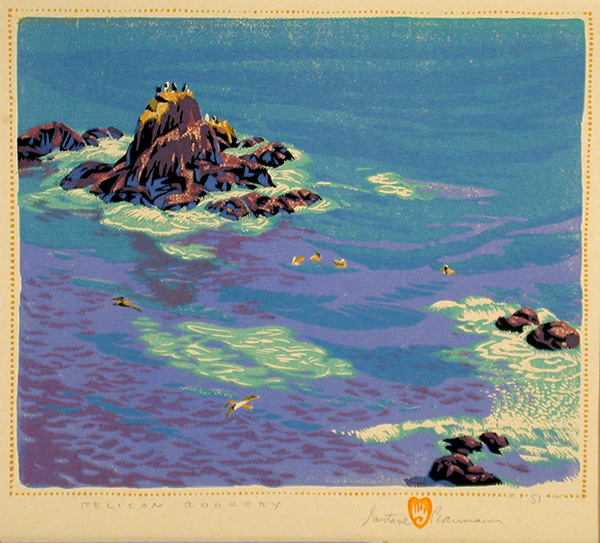
one wing flapping—a pelican
tangled in fish line, treble hook

in the bill pouch,
the other in its wing.
Ray says, Ask her out for a drink

but she says,
Could you give me a hand?
I drop the tackle and secure the wing

while she croons to calm him and
with one free hand
untangles the line.

With pliers from the tackle box,
I expose the barbs and carefully clip,

a total of six loud snaps.
Then I hold
the bird while she frees
the last tangle

and we step back,
join the onlookers,
a father explaining care to his kids.

The pelican now tests his wings, rowing
in place. He looks around and seems

to enjoy the attention, just as Ray did
in bars, buying drinks and telling jokes.

But this college boy with a can of Bud
is no joke and says they watched it flap


all afternoon
from that deck on the dune.
His buddy agrees with a belch

that buys a round
of frat boy laughter.
Ray tells me the kid needs his clock cleaned

just when the pelican waddles up
and puts his soft webbed foot on mine.

He tilts his head to
catch my look, then
flapping runs into the air,
tucks his feet,


and climbs, turning over our small circle,
before heading west. Dazzled and dumb,

I'm faintly aware of the woman,
then gone,
weightless and soaring over water, looking

down on myself slogging through sand,
certain that I'm being watched,


if only by another self
who will have to tell how it happened.

Peter Makuck

From Long Lens by Peter Makuck. Copyright © 2010 by Peter Makuck.

Labels: , , , , , , , , ,

24 November 2010

flipping the american bird

18 April 2010

a man for all seasons • 1915

02 April 2010

a man for all seasons: 1908

1i've changed my mind since yesterday. this project is too important to do in a half-assed manner. so, whenever i post a partial page i will do my best to replace it with a whole page as i can. i've finally found a bio for this artist, google-translated from the dutch. i'll try to catch all of the translating and "sense" problems, but if you find any i miss, please let me know!

HOIJTEMA, Theodoor van (1863-1917)

Hoijtema, Theodoor van (known as Theo van Hoytema), painter; draftsman and lithographer. Married 24/12/1891 to Martina Hogervorst. They had no children.

Theo van Hoytema, youngest in a family with eight children, lost his parents at an early age. Together with his brothers and sisters, Theo moved to Little City District where his eldest sister gave him his first drawing lessons. After having taken four classes at the Municipal Gymnasium in Leiden, he began working in the banking house of his two elder brothers in Delft.


Van Hoytema, however, with his cheerful nature and restless, artistic leanings and love of nature, was not at all suitable for such a job and, once it was possible, he left. In 1889 he moved from Delft to Leiden, where he spent some time with the family on his mother‘s side. Meanwhile, he followed courses in winter drawing and painting at the Hague Academy of Fine Arts (1887-1892) and drew stuffed animals in the Zoological Museum after school.

Through his uncle, business partner of the publishing and printing company Leiden Brill, Van Hoytema got his first assignments: scientific illustrations in biological works. In 1890 Van Hoytema established himself as an independent artist in his own studio Intrantibus Pax. That is where his lithographed book How the birds came to a king (Amsterdam, 1892) came into being. This was the first Dutch attempt to tie text and image to a single idea.

With the color lithographs in his next project, the ugly duckling (Amsterdam, 1893), a story with autobiographical elements to the tale of Hans Christian Anderson, Van Hoytema acquired some fame. He was married in 1891 and lived first in Loosduinen, later in Voorburg. His happiest and most productive years had begun. He painted the large canvas Return of the Stork (1893, Museum Boijmans-van Beuningen) and received orders for murals to decorate a room in the Museum Boijmans-van Beuningen (1893), and received orders for murals to decorate a room in the Society in Gorinchem (1894), and for a cruise boat of the company Fop Smit (1896).

Hoytema's subjects were almost without exception plants and animals, particularly after relocating to Hilversum in 1897. Chalk drawings dating from this period are Swans in a pond, and Face in a green- house, and such lithographs as the Rabbit and Egrets in the portfolio Animal studies. The architectural composition and technical mastery of these pieces bears witnesses to the skills Hoytema had acquired.

A difficult period for Van Hoytema began in 1902. His marriage broke up and he was worried about his health. Some years of wandering followed. He lived in Voorburg and Amsterdam, stayed with a sister in London and was nursed in a hospital (1904 - 1905), and in a sanatorium for nervous diseases in 1906. In 1907 he found a home with his sisters in The Hague, who lovingly cared for until his death.

Out of these stressful years grew the calendars for which Hoytema gained his greatest fame. The long series of color lithographs appeared only with great willpower, and the series was completed posthumously. The calendar for 1918 appeared in black and white.

Since 1970, the publication of his calendars and picture books has resumed in facsimile editions.

Van Hoytema did not belong to a particular artistic group or movement. His work reveals a number of typical characteristics of the period 1890-1900: the influence of English illustrators such as Walter Crane -- especially in the first two picture books, and the influence of Japanese prints. Art Nouveau styling elements, decorative and whimsical undulations, and distinct contours were employed, without losing sight of naturalism. By 1896 Hoytema had a great freedom in his work, and created a notably beautiful exhibition catalogue for the Rotterdam Art Circle, and a wonderful Monthly Scripture for Vercieringskunst.

Since 1892, Van Hoytema was a member of the 1893 Hague Art Circle and of Arti et Amicitiae in Amsterdam. He had many friends, including who even in his difficult years remained loyal and supportive. They described him as a friendly and cheerful despite everything, unpretentious man, full of idealism and hard work. 1

learning that hoytema suffered some years of despair didn't surprise me. there is something in the absolute tenderness with which he recreates his birds and animals that speaks, to me, of the sort of sensitive soul who may verge on that inexact edge between beauty and sadness.

he clearly loves these creatures, and devotes great care to represent both their beauties and their personalities. this is particularly observable in his work from this year, 1908. this is a year of solitary birds, close-ups, giving the viewer the sense that they can feel what the bird itself feels.

in upcoming posts we'll see how different years take on different moods and characters. and, as i said, the close-ups will be replaced with whole pages as i can, but i think, for this month in particular, the portraits will stay too.

Labels: , ,

25 March 2010

a man for all seasons: 1913

AFTER READING TU FU,
I GO OUTSIDE TO THE DWARF ORCHARD


East of me, west of me, full summer.

How deeper than elsewhere the dusk is in your own yard.

Birds fly back and forth across the lawn
looking for home
As night drifts up like a little boat.

Day after day, I become of less use to myself.

Like this mockingbird,
I flit from one thing to the next.

What do I have to look forward to at fifty-four?

Tomorrow is dark.

Day-after-tomorrow is darker still.

The sky dogs are whimpering.

Fireflies are dragging the hush of evening
up from the damp grass.

Into the world's tumult, into the chaos of every day,
Go quietly, quietly.

-- Charles Wright

From Chickamauga, published by Farrar, Straus & Giroux.
Copyright © 1995 by Charles Wright. All rights reserved.


I'm 62
Another day ignorant.
Here comes the sun anyway.
So beautiful I could just pee my pants.
Frost wore diapers after 70
his daughter told his biographer
he'd get so excited.
It doesn't get easier.
I just filleted a yellow perch
I caught an hour ago in the bay.
Its lone gut unfolded
like origami,
one sandshrimp after another.
You see what I mean?
I live alone to spare myself,
another, the intensity of feelings
even a little bird brings on
eating the bread crumbs
I put out the night before.

-- Tom Crawford
Orion Magazine

Labels: , , , , ,

15 March 2010

a man for all seasons: 1912


A LIST OF PRAISES

Give praise with psalms that tell the trees to sing,
Give praise with Gospel choirs in storefront churches,
Mad with the joy of the Sabbath,


Give praise with the babble of infants, who wake with the sun,
Give praise with children chanting their skip-rope rhymes,
A poetry not in books, a vagrant mischievous poetry
living wild on the Streets through generations of children.


Give praise with the sound of the milk-train far away
With its mutter of wheels and long-drawn-out sweet whistle
As it speeds through the fields of sleep at three in the morning,
Give praise with the immense and peaceful sigh
Of the wind in the pinewoods,
At night give praise with starry silences.


Give praise with the skirling of seagulls
And the rattle and flap of sails
And gongs of buoys rocked by the sea-swell
Out in the shipping-lanes beyond the harbor.
Give praise with the humpback whales,
Huge in the ocean they sing to one another.


Give praise with the rasp and sizzle of crickets, katydids and cicadas,
Give praise with hum of bees,
Give praise with the little peepers who live near water.
When they fill the marsh with a shimmer of bell-like cries
We know that the winter is over.


Give praise with mockingbirds, day's nightingales.
Hour by hour they sing in the crepe myrtle
And glossy tulip trees
On quiet side streets in southern towns.


Give praise with the rippling speech
Of the eider-duck and her ducklings
As they paddle their way downstream
In the red-gold morning
On Restiguche, their cold river,
Salmon river,
Wilderness river.


Give praise with the whitethroat sparrow.
Far, far from the cities,
Far even from the towns,
With piercing innocence
He sings in the spruce-tree tops,
Always four notes
And four notes only.


Give praise with water,
With storms of rain and thunder
And the small rains that sparkle as they dry,
And the faint floating ocean roar
That fills the seaside villages,
And the clear brooks that travel down the mountains


And with this poem, a leaf on the vast flood,
And with the angels in that other country.

Anne Porter


From Living Things by Anne Porter,
published by Zoland Books,
an imprint of Steerforth Press
of Hanover, New Hampshire.
Copyright © 2006 by Anne Porter.

Labels: , , , ,

older posts