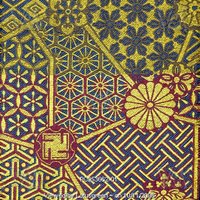
japonisme

23 December 2006

birds in our transitions

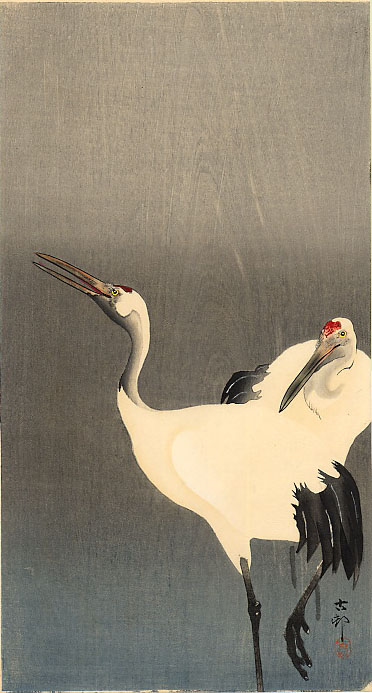
edward penfield (collier's cover here; plus many harper's covers), will bradley and louis rhead were illustrators, designers and poster makers at the turn of the century. their work was exhibited with the japanese prints that were being imported to the us, and the style of each became strongly influenced by the prints. we see the same flat expanses of color interceded by rich pattern, and the asymmetrical layouts.

speaking of penfield (though they could have been speaking of any of the three), publisher's weekly said,
"
The advertising poster has within recent years actually soared into the regions of art." Penfield is also credited with bringing abstraction to commercial art through his boldly simplified shapes. This and other stylistic trademarks resulted from a distillation of a number of influences, including the compositional precepts and casual poses found in Japanese prints, the hand-craftsmanship of the Arts and Crafts movement, the impressionistic approach of Parisian poster-making, and British poise and directness. "*

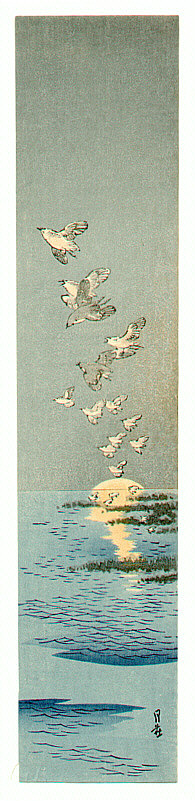
bairei kono was a printmaker/painter who lived and worked in kyoto during the meiji period. he was also an influential teacher.

his two main bodies of work for which he is remembered are the seasonal documenting of birds and flowers, and another, called 'one hundred flowering plants,' published after his death.

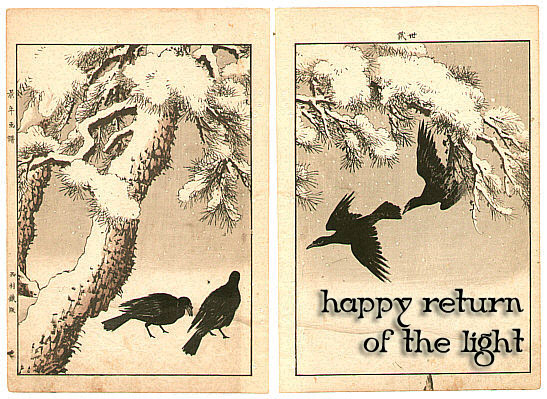
just as penfield was being influenced by bairei's magpie, bairei as well was being influenced by western art, or so i hear. personally, i don't find a shadow in sight.

Labels: ,

20 December 2006

solstice


(Keinen Imao 1892)

Labels:

the shadowless land

okay, after going through all 1,007 images that one pulls up when doing a search for 'snow' on artelino, i am of the conclusion that.... there are no shadows in japan!!!

or maybe it's that part of the look of the japanese prints during most of the time we're talking about here that shadows were not displayed.

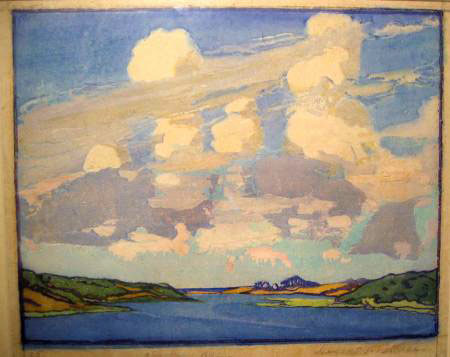
of course it was the posts on the 18th and 19th that got me started looking (and here i'm using different william rice (above right) and walter j phillips (above left) images which illustrate the same fondness we westerners seem to have with blue shadows).

the shadowless one on top is by takashi ito.

Labels: , ,

which came first...?

(seitei watanabe; francois & victor clerice; leonetto cappiello; maria likarz; theophile-alexandre steinlen; biho takahashi)

Labels: , , , , ,

19 December 2006

snow shadows

i am struck by the similarity between this walter j phillips image and the william rice image just below. well, same times, same motiva- tions. can't find a japanese print from which these could be a direct descen- dant, but there's time....

Labels:

18 December 2006

color

He was the author of three books - Block Prints: How to Make Them (1929), Block Printing in the School (1941), and Portfolio of Block Prints (1932). He taught in the public school systems of the Bay area, and he also taught at the many art societies, including the San Francisco Art Association, the California Society of Print Makers, and the Prairie print Makers.

Rice wrote about his philosophy of printmaking and said:

...the viewpoint of the artist differs from that of the commercial printer. In hand printing, each print has a beauty and individuality of its own. The aim is not to produce editions in large quantities, all alike and uniform, but to obtain slight variations which give a personal character to each print. The making of color prints of this type is essentially a painter's performance. There is a great fascination about color experimentation. The real pleasure comes from seeing the same subject appear in different colors, the design gaining in interest with each new color scheme. Wonderful color effects may be obtained by continual experiments. It would almost seem, sometimes, that no block has ever spoken its last word when it comes to its final color scheme.1

rice was clearly not the only one who felt that way, as these charming images by arthur wesley dow, and yoshida hiroshi illustrate.
blueinall

Labels: , ,

17 December 2006

between the earthquake and the war


arthur wesley dow created this work several decades before hasui kawase created his, but perhaps both were responding to the onrush of modernity, gatekeepers, both of them, of an imagined past.

or perhaps both just reporting on what they saw. like the impressionist painters, hasui didn't create his images in a studio, but rather on his constants travels in search of beautiful vistas. still preferring a kimono, he wandered the countryside, staying at inns and hunting for "live" views.

by the time he done this image of shichiri beach in soshu, kawase had already lost everything once: in a 1923 earthquake that killed 140,000 people, and that had destroyed everything in watanabe's publishing house (along with the work of many other shin hanga artists as well.)

everything was lost again in the bombing of tokyo in WWII. as they had once before, hasui kawase and watanabe shozaburo rebuilt again.
blue apple pie

Labels: ,

15 December 2006


kuniyoshi, cat lover, cat artist, portrays himself, with his cats, at home.

i realize that kuniyoshi has drawn himself as a cat as well.


Labels: , ,

14 December 2006

the gift of light


thomas paquette's new book: gouaches.

almost more a book of poetry
than one
of paint.

http://www.thomaspaquette.com/books.html

Labels:

13 December 2006

eating oranges


for seventeen and a half years, every time i ate an orange, i never touched it with my hands. i figured out a way to do the whole peeling and separating part through a plastic bag.

robert just hated that smell on my hands.


while i buried him, a white- crowned sparrow pecked around in the spilled niger thistle seed under the gold- finch feeder. his friend sang. i was grateful.

over time, after once leaving me the gift of a hummingbird in my bedroom slipper, robert learned not to chase and catch birds. he was very smart.


for the last seventeen and a half years it has been just me and robert living alone together. monogamous. this now feels unreal.

i am going to go and eat an orange with my bare hands.


(ohara koson; yoshitoshi; hoytema; walther klemm; carl moser; otto eckmann; carl moser again; totoya hokkei.)

Labels: , , , ,

12 December 2006

till there was you

from The Music Man, by Meredith Wilson

There were bells....on the hill,
but I never heard them ringing
No, I never heard them at all,
Till there was you.

There were birds....in the sky,
but I never saw them winging,
no, I never saw them at all
Till there was you.

And there was music,
and there were wonderful roses,
they tell me, in sweet fragrant
meadows of dawn and dew.


There was love, all around

but I never heard it singing,
no, I never heard it at all
Till there was you.

Then there was music and wonderful roses
they tell me, in sweet fragrant meadows
of dawn and dew

There was love all around
But I never heard it singing
No, I never heard it at all
Till there was you
Till there was you

isn't it strange, isn't it interesting, that "we," well, the west anyway, didn't seem to see plum blossoms, or cherry, until they saw japan see plum blossoms and cherry. also interesting, though, is that i rarely see ornamental design being used the same way in both cultures; if it's on pottery in the west, it generally isn't in the east.


(top is by toshi yoshida, for dom; ohara koson; eiho hirezaki; royal doulton.)

Labels: , , , ,

11 December 2006

thanks, folks.

can't respond personally right now.

will resume when i can.

09 December 2006

flight


robert died this morning about an hour before it started getting light. as soon as i could see i went out and began to dig a space for him under a tree where he used to like to hang out. he's had other spots since then, but none for as long.

i wrapped him in his red towel and carried him outside and found i hadn't made it deep enough. it was kind of difficult because of all the roots, but i finally made it okay.

nine and a half years ago he developed kidney disease and i was told he wouldn't live much longer. i have been giving him kitty dialysis since then, so feel like i got ten extra years. about a year ago his heart began to fail, and for a year he's been on all these meds.

in the last month or so his eyesight really went, he lost a lot of weight, his legs really began bothering him. each change, he would adjust to, and he's spend as much time in the sun, or drinking from the pond as he could.

this morning he was hurting, i could tell, and when he didn't seem to want anything i offered him, and he was crying this pitiful little yow that he had always only done specifically get my attention.

i took him back on the bed with me and scratched his head and his chest to try to help him relax. i paused at one point and he put his head back to my hand. we stayed like that for ten or twenty minutes. i didn't stop scratching. and then found myself wondering if he were still breathing. i kept scratching for a long while after, not knowing, not caring, knowing it didn't matter--it would be good for him in any case.

putting the dirt back felt rude, but it was very important that noone, not squirrel, racoon, nor possum dig him up.

i wanted peace for him, and for the garden around him.

i herringboned mossy bricks over him, and felt guilty for doing this before his body was completely cold. but he had been gone for over an hour, and it also didn't feel right not to. it's easier, i learned a long time ago, to feel guilt than to feel grief.

08 December 2006

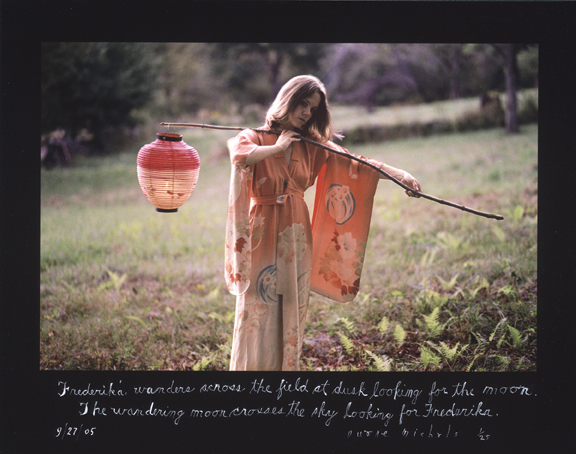
Frederika wanders across the field at dusk looking for the moon

DUANE MICHALS
Japonisme: Photographs From the Floating World

November 9 through December 30, 2006
Opening reception with the artist:
Thursday, November 9, 6-8pm

This exhibition is accompanied by a lecture at the Photographic Resource Center at Boston University on Wednesday,
November 8. Please call the PRC for more information (617) 975-0600

38 Newbury StreetFourth Floor Boston, MA 02116

Inquiry@RobertKleinGallery.comThis email address is being protected from spam bots, you need Javascript enabled to view it
Phone: 617.267.7997
Fax: 617.267.5567

Labels: ,

07 December 2006

100 views of carl otto czeschka


die nibelungen, again, by czeschka

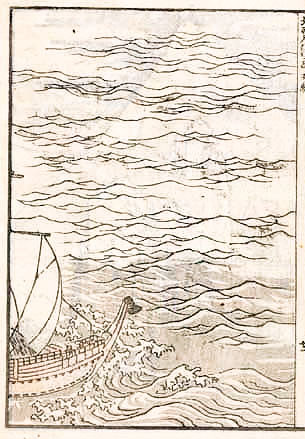
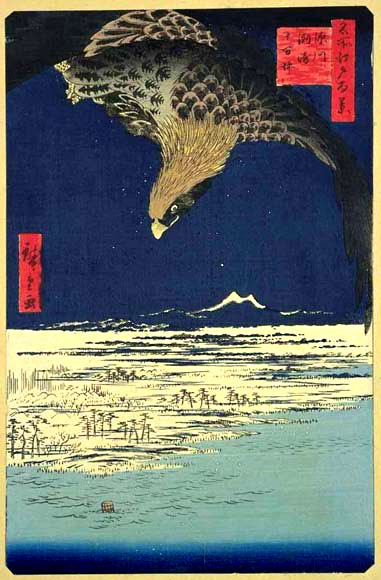
and then one of hiroshige's 100 views of edo.

Labels: , ,

down to the sea in ships

on her stunning anthology of a website, featuring dozens of beautifully illustated books, the webmaster says, [Die Nibelungen by Carl Otto Czeschka is] "The best Art Nouveau illustrated book. Period ! The scans doesn't do justice to the images, heightened in gold. A pure delight. Enjoy."

czeschka was a member of the wiener werkstaette and the vienna secession.

the whole of hokusai's manga volume one is here. if anyone knows of anywhere the others are in their entirety, i'd love to know.

thanks!

Labels: , ,

06 December 2006

change & exchange

No great artist ever sees things as they really are. If he did, he would cease to be an artist. Take an example from our own day. I know that you are fond of Japanese things. Now, do you really imagine that the Japanese people, as they are presented to us in art, have any existence? If you do, you have never understood Japanese art at all. The Japanese people are the deliberate self-conscious creation of certain individual artists. If you set a picture by Hokusai, or Hokkei, or any of the great native painters, beside a real Japanese gentleman or lady, you will see that there is not the slightest resemblance between them. The actual people who live in Japan are not unlike the general run of English people; that is to say, they are extremely commonplace, and have nothing curious or extraordinary about them.
In fact the whole of Japan is a pure invention. There is no such country, there are no such people. One of our most charming painters [whistler] went recently to the Land of the Chrysanthemum in the foolish hope of seeing the Japanese. All he saw, all he had the chance of painting, were a few lanterns and some fans. He was quite unable to discover the inhabitants, as his delightful exhibition at Messrs. Dowdeswell's Gallery showed only too well. He did not know that the Japanese people are, as I have said, simply a mode of style, an exquisite fancy of art. And so, if you desire to see a Japanese effect, you will not behave like a tourist and go to Tokio. On the contrary, you will stay at home and steep yourself in the work of certain Japanese artists, and then, when you have absorbed the spirit of their style, and caught their imaginative manner of vision, you will go some afternoon and sit in the Park or stroll down Piccadilly, and if you cannot see an absolutely Japanese effect there, you will not see it anywhere.
Oscar Wilde (1882)

Japan is more than just fancy but Wilde's senti- ments capture the mystique that surrounds the subject. When Americans first learned about Japan in the mid-19th century, it must have seemed a very peculiar place indeed. Nearly everything about the Japanese culture and lifestyle was a novelty and a complete enigma. Travelers to Japan, both then and now, attempted to discover the things which made Japan tick. Edward Said wrote in his book Orientalism that westerners have perceived the Orient through generations of enduring stereotype and even today there is an abundant literature by supposed experts on how to understand Japan and its people.*

"I feel an irresistible desire to wander, and go to Japan, where I will pass my youth, sitting under an almond tree, drinking almond tea out of a blue cup, and looking at a landscape without perspective" - Oscar Wilde (1882)
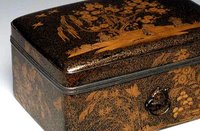
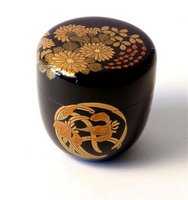
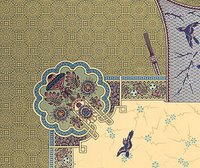
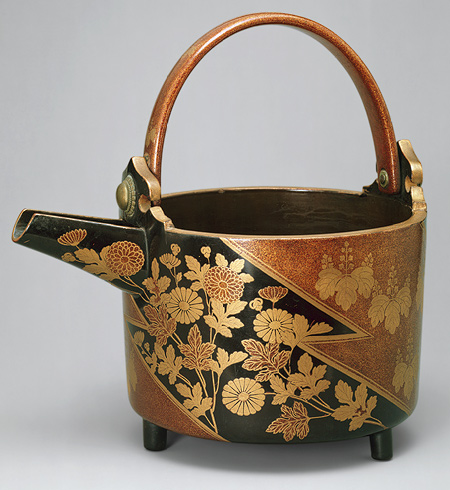
another tricky thing is.... even the "experts" nowadays can't tell, apparently, what the japanese made for themselves, and what they made strictly for expert. not just in prints, but in crafts as well, much of what we see in the aesthetic movement are reflections of japanese crafts that were designed specifically, and exclusively, for western markets.


we are fortunate, if we like this stuff. companies such as bradbury & bradbury have made many original wallpapers available again, beautifully. other companies as well are

reproducing papers, fabrics, furniture, and then, of course, there are the antiques. much is accessible through arts & crafts home.

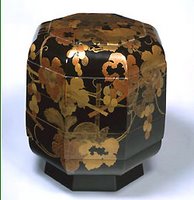
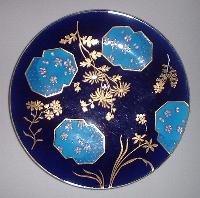
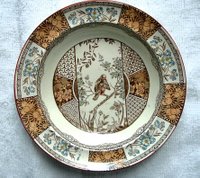
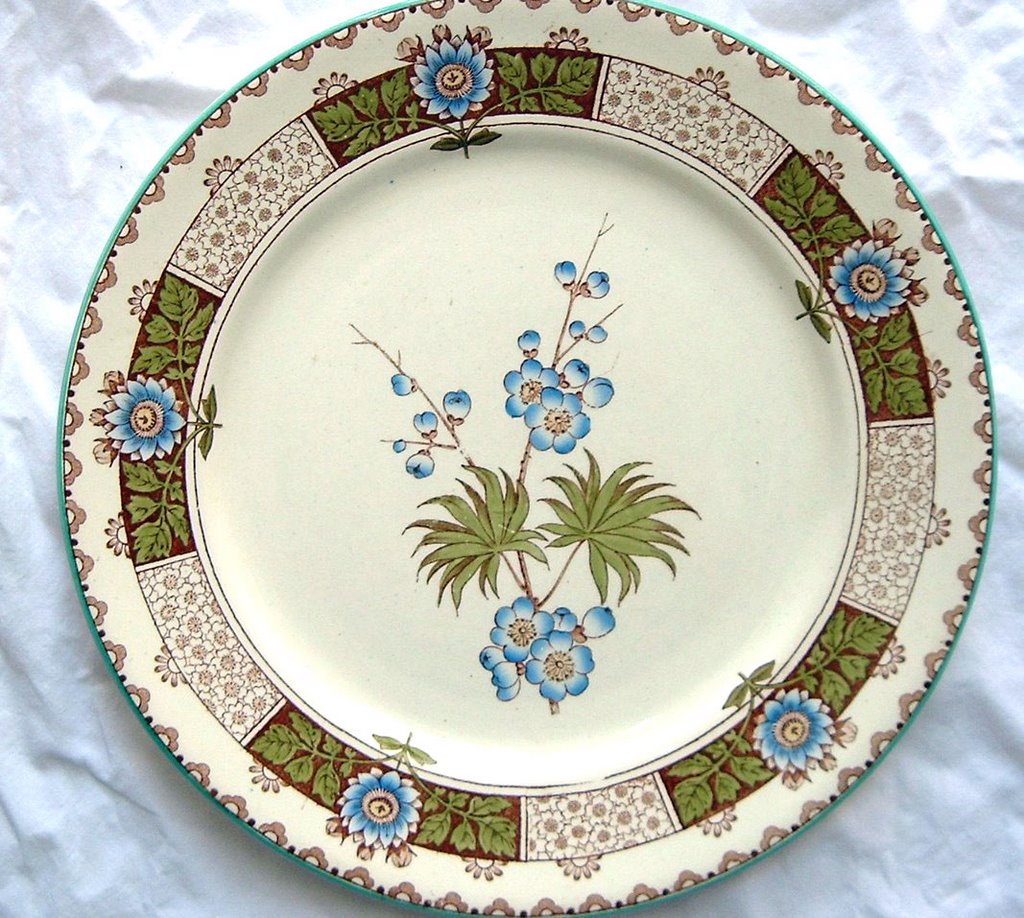
the upper right image is a godwin upholstery design for liberty & co., below it is a b & b wallpaper sample; the plates examples are wedgewood. even the most sophisticated of travellers still found it difficult to remember that china and japan were quite distinct nations. therefore, you saw "chinoiserie" china patterns named mikado.
Labels: , , , , ,

04 December 2006

letting in the light

i love these prints so much; i can't say why. the first on the right, here, is by margaret jordan patterson. she was a student of arthur wesley dow. i was fortunate enough to find a calendar a while back with this in it, so i've had it on my wall for many years. i could stare at it forever.

this one is actually a contemporary painting by a man named thomas paquette. it fascinates me that he never saw mjp's image, never even heard of her. his work is one of the only painter's work that i can see the influence of japanese prints in the technique, not necessarily the subject matter nor even the style, exactly. it's the distinctness of each color, as though, or actually, outlined. something about the ways he uses color, i've seen only in shin hanga before; the translucency of the colors, the transparency of solid objects -- that he achieves this with oil or gouache is amazing.
walter j phillips was an etcher who grew dissatisfied with working in black and white. in the studio, he read of the woodblock prints being distributed and done in europe, and decided to give it a try. a trip to europe several years later where he met with other printmakers, japanese and european, filled in some fine points for him, and taught him about japanese papers.

isn't it ironic that the shin hanga artists made prints the way they did at least in part due to the fact that it was what they knew they could sell, and in so doing went on to inspire generations of artists as to how a landscape could be.

Labels: , , ,

newer posts older posts