japonisme

25 May 2011

l'œil nouveau

perhaps a little more grounded this evening.... i was confused; somehow i'd thought the aesthetic movement was much earlier than it was, but then it fell into place. i led with some exceptions, and i'll return to them, but for the moment let's look at what i completely forgot to say.

which was to marvel at all the different japonismes and, to some extent, the order in which they took place.

george ward nichols' 1878 book (here) features the shapes, and the contents, that we also see on the japanese print, only on the print the meanings were as either thoughts, titles, sometimes poetry. in the style book they're just shapes and pretty drawings.

yes, the dresser/braquemond/rousseau/etc. pieces we began to look at yesterday preceded them, by 10 - 20 years; many of those, gorgeous though they were, were largely copies of works, often by hokusai or hiroshige, who were nearly contemporaries of the western artisans.

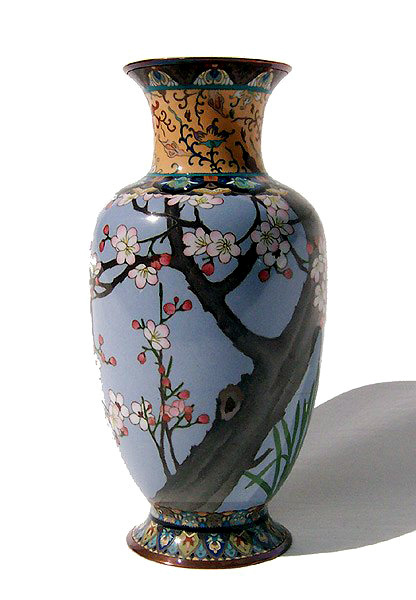
some of these fan-shaped and other patterns did appear on japanese lacquer work, but much of that turns out to appear near to the same dates as did the aesthetic work, leaving us again to blink in wonder at the escher-ish twists of the import and export.

so let us see if we can trace the arrivals of japonisme. at the very beginning, japan's contemporary masters began appearing on the dishware of the french. that, i would say was an honoring, filled with delight.

but then as both sides began to realize that, as wilde pointed out, the japan of our current fashions was was one with no reality, and thus both sides were able to take the emblems of the japanese, strip them of meaning, and sell them hand over fist to the west.

but, interestingly, at the same time, those looking at the incoming woodblock prints with a different eye saw things they translated into their paintings: series of paintings of the same spot in different lights, different perspectives. they saw an unusual balance, and a simplicity of subject choice. these still looked like western paintings (think monet, for example), but they had the changes that the artists had seen.

it wasn't until the next generation came along when the influences we talk about here most often began to appear, and would have the most profound and longest lasting effects. say it with me: outlines, asymmetry, large flat blocks of color, areas of pattern, and as, again, wilde said, 'I feel an irresistible desire to wander, and go to Japan, where I will pass my youth, sitting under an almond tree, drinking amber tea out of a blue cup, and looking at a landscape without perspective.'

but too, as we have also often seen, and despite the teasing, something profound had happened; people in the west were seeing with new eyes. nature was now something to which we paid our greatest attention, and we saw the shapes there and around us as far more permeable than we had ever let ourselves recognize. despite our best efforts, impermanence was all there really was.

was the aesthetic movement ever more than a style, a fad, an intoxication? if not, then people then were just like people now -- no surprise. and we could guess forever the cultural effects this all had, if any. or we can merely look back and thrill again what treasures the combining of cultures will produce.

these are only two of many many cartoons, often from punch, that satirize the thrall in which this china held its owners.

check out the victorian web for a wealth of information on the era.

Labels: , , , , , , , , , ,

21 May 2011

the style that dare not speak its name

one studies in order to learn new things but, as any researcher will tell you, you are more likely to come away far more aware of how much you don't know. what i thought i knew: 1. what items from the aesthetic movement looked like; 2. when the aesthetic movement was; and 3. who were its biggest names. i was right about the names.

as for the rest, i currently have over a foot of books, piled on top of each other, on my desk, about twenty-five windows open in my browser (don't you love it?), and if i'm getting a clue, it's only the sweet whisper of one.


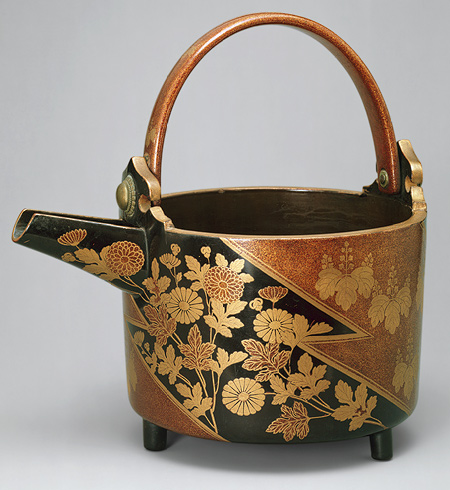
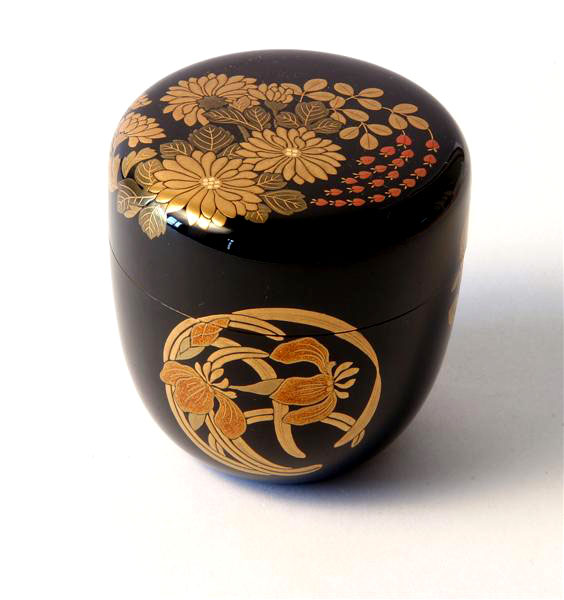
what i thought aesthetic movement china looked like (in their japonisme) was almost like collages, little overlapping stamps on an international letter, with extraneous flowery or fan-shaped decorations, and probably a couple of birds. you could find it all, in fewer colors, in the lacquers from japan which were their inspiration.

okay, but there's the rub, and it gets complicated. yes, i could, i have, show you perfect examples. so let's see if i can say this in a comprehensible manner. well, first let's say that the images on the right are by christopher dresser, and on the left are examples from one of the series in the lambert-rousseau dinner- wear (see more here).

the images of japanese goods with which i could illustrate the correspondences may very well have been made after the works they were supposed to have inspired. seems i have not paid close enough attention to dates. even more convoluted are the facts that many of these very designers began visiting japan, not only to study, but to set up with artisans in japan to produce for export good which looked like they might have inspired the japonisme wares being sold in the west! bing insisted on it.

now, christopher dresser is definitely one of those names. and yes, his designs, particularly as seen in the plate to the right, match the image i had in my head for 'aesthetic.' so, though, do the images on the left, but those designers do not appear on my lists. but here's another problem. the chronology i've always understood of all this was that the aesthetic movement followed very quickly on the tails of the arrival of japanese goods in the west, the 1850s to the 1860s, yet all of these are from the late 1880s! why do you people keep coming here when i clearly know nothing!

granted, dresser was quick out the gate, getting very involved with learning about, and writing about, during the 1860s, but that ends up seeming less germinal to this discussion than to understand what the aesthetic movement really is; hint: those little fans are only an emblem, an honorarium, a fad.

whomever you credit with beginning the era, ruskin, morris, or a number of others competing for primogenitor status, what it boils down to, in my opinion, is yet a number of new faces with the real name of japonisme. (but don't tell the pre-raphaelites.)


i will grant you, it had a different name in every country where it occurred, accompanied by what were very distinguishable national differences. but whether it's the desire for handmade, simple goods, or a cult of nature, or a new understanding of space, line and color, it all began with one catalyst: japan.

Labels: , , , , ,

27 December 2008

true beauty

when chester a arthur moved into the white house, he called in some of the most important designers of the moment to decorate. it was 1882; he called tiffany.

louis comfort tiffany and artist associates of his, including candace wheeler, designed windows, screens, fabrics and more, none of which lasted long enough for a color photo (teddy roosevelt wanted something more colonial revival).

fortunately (for several reasons), some of his interior design collaborations have lasted, and in fact some are now finally being restored.

when new york city's 7th armory was constructed on park between 66th and 67th. "It was constructed from 1877 to 1881 for the prestigious Seventh Regiment. The Seventh Regiment had a glorious history. It was the first militia to respond to President Lincoln’s call for volunteers in 1861, and the name National Guard originated with this regiment.

"After completing the Drill Hall and the three-floor Administration Building along Park Avenue, the Regiment hired the most prominent design firms in New York to create the luxurious interiors. One of the most well-known firms, Associated Artists, included Louis Comfort Tiffany, Stanford White and Candace Wheeler.

"The Aesthetic Movement, popularized in the US by the Centennial Exposition in Philadelphia in 1876, emphasized the ‘aesthetic” or artistic in the applied arts and reached its culmination in the design of interior decoration. The design is characterized by visual complexity and profusion of surface ornament, embracing many different historical styles, including Japanese, Moorish and other exotic motifs. The regimental rooms, most notably the Veterans Room and the Library, are among the most stunning spaces anywhere in New York City." 1

and it was fortunate for us, in a manner no one could have predicted:
"Ten years ago I stumbled on my first reference to the work of Louis Comfort Tiffany. I was studying American architecture at Yale University and preparing a paper on armory buildings in New York City. Tiffany, I found, had decorated the Veterans' Room and Library for one of these.

"The following semester, I presented a seminar report on Tiffany as the leading American exponent of Art Nouveau and, just for fun, I purchased a Favrile glass bowl make by Tiffany as a demon- stration of his work. It cost four dollars and I thought it was expensive. Today it is worth a great deal more. [1,000 times more] When I brought it home my wife asked, 'How long do we have to keep it?'"

Robert Koch, 1964 •
Louis C. Tiffany: Rebel in Glass.

in 1957, mr koch went on to complete his dissertation on tiffany, and then in 1958, to curate, with thomas s tibbs, the tiffany exhibition at the museum of contemporary crafts.

tiffany said, “Styles are merely the copying of what others have done, perhaps done better than we. God has given us our talents, not to copy the talents of others, but rather to use our brains and our imaginations in order to obtain the revelation of True Beauty.”

t's true: his work was stylistic enough that we can easily see when he left his "aesthetic phase" and entered his "art nouveau phase." but every artist believes this of their work, and must. it's how our collective unconscious moves through time.

Labels: , , , ,

18 August 2007

loud

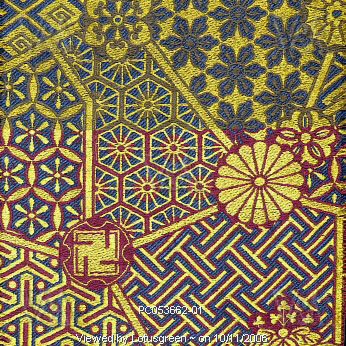
not all japanese patterns were as bold as we've seen. many were smaller, repeated, pastels.... but still they had symbolic meanings--not only the patterns themselves, but also everything from sleeve lengths to amount and colors of layers, etc. once again the west was delighted to adopt colors that were new to the victorians, and once again they adopted them sans symbology, but that didn't diminish the love for them a bit.

Once upon a time, an old man was walking around the temple courtyard. He was stopped by something in the air; he looked up and realized a large cherry blossom tree. He looked closer, and discovered several areas on the leaves were eaten by insects. He was impressed by the random patterns nature made... The name of the temple was Shiroko Kannon-ji, located in Ise region (current Suzuka City area in Mie prefecture), and this small incident in the courtyard took place more than 1300 years ago. There are various theories to the origin of Japanese stenciling, and the exact details are unknown, yet I tend to like this story. Great discovery can occur from something as simple as taking a walk in the garden! Incidentally, about four stencil shops already existed in the Enreki time (782-806) according to the documents kept in the same temple. 1
Japa- nese Kimo- no pat- terns can sig- nify the kimono’s rank in formality by how wide spread or pervasive the pattern is as well as the kimono color. Three distinct categories of Japanese kimono which define degrees of formality are, Komon, Tsukesage, and Homongi. The Komon by virtue of the wide spread stenciled or painted repeat patterns which cover the entire kimono is at the lowest most informal level of formality. Komon dyeing, which has the meaning of "small-figured designs," has a tradition of about 400 years. It started as a method of transferring the family crest to the "Kamishimo," the ceremonial attire of the warrior class. During the Edo Period, Komon dyeing gradually spread among the people in general. This Komon dyeing is a traditional technique of high quality that makes use of stencils cut in intricate patterns.

The Tsu- kes- age is next in rank to the Hom- ongi kimo- no. The tsukesage kimono can be worn by both married and single women to both formal and informal gatherings. For formal occasions, a crest should be applied to the back seam at the top. Tsukesage kimono have designs dyed from the hemline in the front and back which travel to the top of the shoulders. Designs on the sleeves also travel upward. The Homongi pattern because of its asymmetrical patterning which continues without a break across the side seams to the back hem is the highest level of formality Homongi kimono are made from bolts of silk, which are sewn up into the finished length, then hand painted, taken apart, dyed, and then resewed. 2

just as shadows and reflec- tions hadn't occurred to japanese artists, colorful prints hadn't, apparently, occurred to western designers. each had a long history in their own cultures; even perspective went back to the renaissance. japanese prints were collected in books and offered for use as kimono fabric, and also colored paper (sometimes for origami), screens, and more. in each culture, what they hadn't done before was so embraced as to be ubiquitous, emphatic, and each gained meaning by what they came to signify in their new societies.

Labels: , , , , , , , , , , ,

06 December 2006

change & exchange

No great artist ever sees things as they really are. If he did, he would cease to be an artist. Take an example from our own day. I know that you are fond of Japanese things. Now, do you really imagine that the Japanese people, as they are presented to us in art, have any existence? If you do, you have never understood Japanese art at all. The Japanese people are the deliberate self-conscious creation of certain individual artists. If you set a picture by Hokusai, or Hokkei, or any of the great native painters, beside a real Japanese gentleman or lady, you will see that there is not the slightest resemblance between them. The actual people who live in Japan are not unlike the general run of English people; that is to say, they are extremely commonplace, and have nothing curious or extraordinary about them.

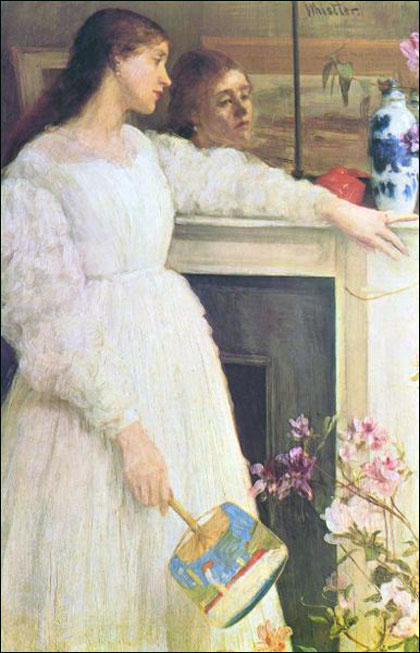
In fact the whole of Japan is a pure invention. There is no such country, there are no such people. One of our most charming painters [whistler] went recently to the Land of the Chrysanthemum in the foolish hope of seeing the Japanese. All he saw, all he had the chance of painting, were a few lanterns and some fans. He was quite unable to discover the inhabitants, as his delightful exhibition at Messrs. Dowdeswell's Gallery showed only too well. He did not know that the Japanese people are, as I have said, simply a mode of style, an exquisite fancy of art. And so, if you desire to see a Japanese effect, you will not behave like a tourist and go to Tokio. On the contrary, you will stay at home and steep yourself in the work of certain Japanese artists, and then, when you have absorbed the spirit of their style, and caught their imaginative manner of vision, you will go some afternoon and sit in the Park or stroll down Piccadilly, and if you cannot see an absolutely Japanese effect there, you will not see it anywhere.
Oscar Wilde (1882)

Japan is more than just fancy but Wilde's senti- ments capture the mystique that surrounds the subject. When Americans first learned about Japan in the mid-19th century, it must have seemed a very peculiar place indeed. Nearly everything about the Japanese culture and lifestyle was a novelty and a complete enigma. Travelers to Japan, both then and now, attempted to discover the things which made Japan tick. Edward Said wrote in his book Orientalism that westerners have perceived the Orient through generations of enduring stereotype and even today there is an abundant literature by supposed experts on how to understand Japan and its people.*
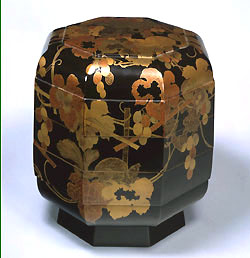
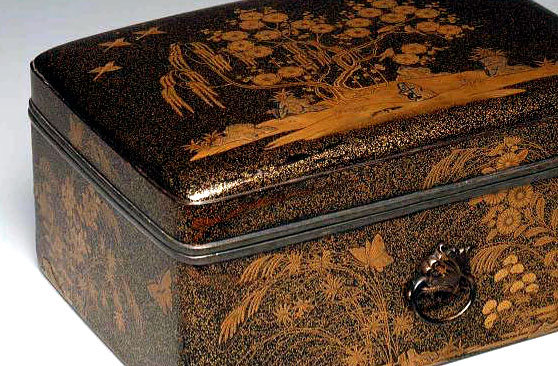
"I feel an irresistible desire to wander, and go to Japan, where I will pass my youth, sitting under an almond tree, drinking almond tea out of a blue cup, and looking at a landscape without perspective" - Oscar Wilde (1882)

another tricky thing is.... even the "experts" nowadays can't tell, apparently, what the japanese made for themselves, and what they made strictly for expert. not just in prints, but in crafts as well, much of what we see in the aesthetic movement are reflections of japanese crafts that were designed specifically, and exclusively, for western markets.


we are fortunate, if we like this stuff. companies such as bradbury & bradbury have made many original wallpapers available again, beautifully. other companies as well are

reproducing papers, fabrics, furniture, and then, of course, there are the antiques. much is accessible through arts & crafts home.

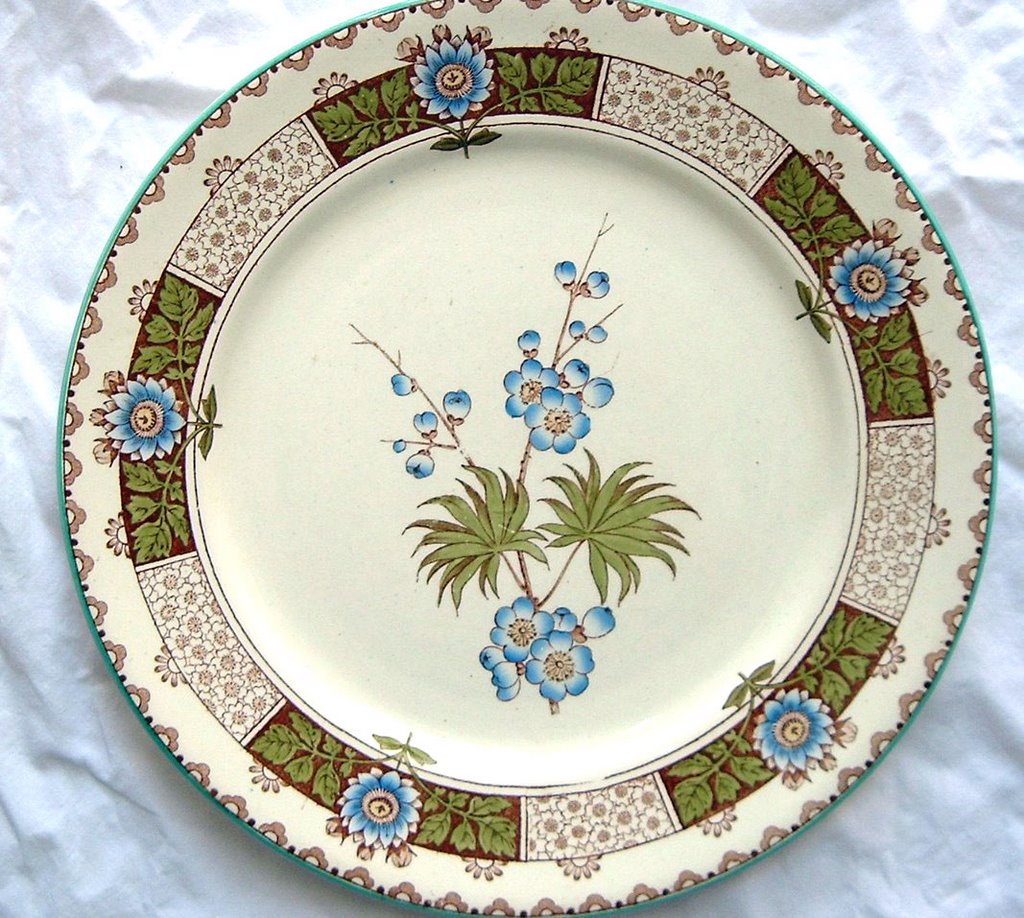
the upper right image is a godwin upholstery design for liberty & co., below it is a b & b wallpaper sample; the plates examples are wedgewood. even the most sophisticated of travellers still found it difficult to remember that china and japan were quite distinct nations. therefore, you saw "chinoiserie" china patterns named mikado.

Labels: , , , , ,

07 November 2006

aesthetically speaking

what is called 'the aesthetic movement' intrigues me. it's primarily an 'anglo' phenomenon, ie great britian and the united states. and in part, it flourished in the us because of a brit (who was wilde).

it does get complicated when one begins to discuss personalities, with wilde, ruskin, whistler, and more, and i do want to get into that--it's fascinating. but for the moment let's look at these artifacts.


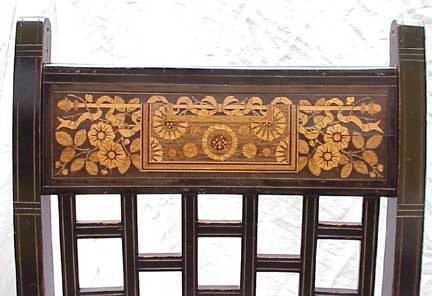
what we see is, as the chicago museum of art says, 'the floral designs emulate Japanese paintings and lacquer, but

the overall
form is West- ern.'

both countries did go into art nouveau, but in both it was embraced a little later; here we


have, essentially, victorian design with japanese symbols (fans, cranes, the japanese symbol for the chrysanthemum's) on it. none of the fluidity of line and form that would enrich the world of arts in the next few years is yet seen, and yet... it's really interesting.

(whistler 'symphony in white #2'; herter brothers chair; royal crown derby; 'aladdin' by walter crane)

Labels: , , , ,

older posts