japonisme

31 May 2011

the moon in the stone

who, after all, is the artist? or has the concept of the individual artist always been a myth? even the most solitary of the arts, writing, is probably only solitary in a small percentage of the time; as an editor, i have seen unedited manuscripts. editors, like trans- lators, are the silent hand in the process of creating art in literature.

what about painting? there, i will admit, it's hard to imagine paintings to be group endeavors. but let's look at it from another perspective: beyond even the time when students collaborated on the master's pieces, the history of art is crammed with stories of agents and galleries telling the painters what the public wants, what they can sell.

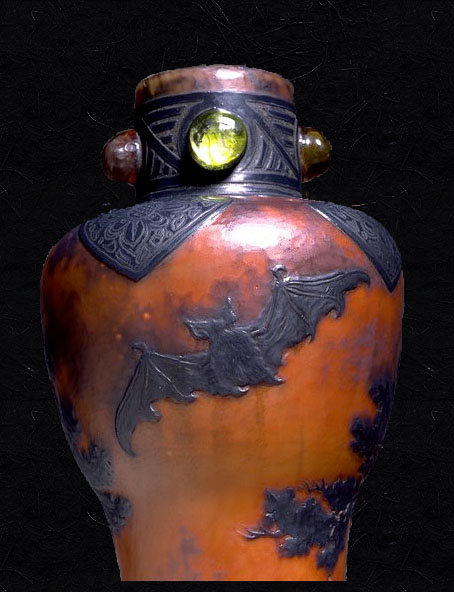
who is the artist in these little birds, the carver of the form, or the maker of the color? for me, the color in the work of almeric walter is the revelation. turns out, though, that the two ele- ments were contributed by two different people. henri berge carved the creature, walter himself developed, or rather refined, a method of calling the most from his production of pate-de-verre.

which is just like what it sounds like, mashed then made malleable glass, poured into moulds (of the little statues) which have been painted on the inside, and then with various powders and chemicals to insist on the color to go where the artist wants. who is the artist?

pate-de-verre, marqueterie-de-verre, pate-de-cristal.... numerous glass artists were avid to employ these revived methods which had been originally popular in ancient greece and rome. to my mind, of the first, walter and berge were the undisputed mas- ters, but there were other artists who offered some wonderful pieces.

one of these was gabriel argy-rousseau, who, as far as i can determine, designed his own pieces (and is a very early user of a hyphenated last name, borrowing the 'argy' from his wife's name). i really like this piece, and some of his other work is mesmerizing, but in the end the limited pallet of both color and style, loses my interest.

francois-emile decorchment produced some spectacular pieces, his experimentation drew some fabulous results, but his output of this style was limited to far fewer than the 100 or so pieces walter and berge produced.

when i was in paris, the one item in the museum of decorative arts that most aston- ished me was a simple string of glass flowers, a necklace by lalique in which every little flower seemed to contain the light of the moon. i can't tell you how that moonlight is inserted into these pieces, nor why i am so profoundly touched by it, but it is, and i am, and for this i am grateful.

the maestro, without a doubt, despite the grand trickery of decorchement, the cool brilliant elegance of lalique, the constant charm of argy-rousseau, or the radiance of walter and berge, was, of course, emile galle.


there was no technique with which he did not experiment and excel. there was nothing in the range of art nouveau styles and techniques which he did not only make his own, but take the form to an incandescent new level.

the saddest case is that of daum, the entire clan, who were the ones to bring glassmaking to nancy. galle came to nancy a bit later, establishing his own firm, a companion and competitor to the daums. sad because while they were the first, while walter and berge started off working for him. though walter sold him the rights (non-exclusively) to his methods, to my eye, the daums were never able to quite pull it off.

daum was salieri to galle's mozart; while some of his (their) work is beautiful, as a whole it is just not a revelation of genius. but i can't presume sadness from this distance. nor envy. nor pride. what is important is that the daums created an atmosphere in which great miracles could happen, and they continue still.

i must add my gratitude for a wonderful blog
for seeing this amazing, mostly regional, work:
HERE

Labels: , , , , , , , , , ,

25 May 2011

l'œil nouveau

perhaps a little more grounded this evening.... i was confused; somehow i'd thought the aesthetic movement was much earlier than it was, but then it fell into place. i led with some exceptions, and i'll return to them, but for the moment let's look at what i completely forgot to say.

which was to marvel at all the different japonismes and, to some extent, the order in which they took place.

george ward nichols' 1878 book (here) features the shapes, and the contents, that we also see on the japanese print, only on the print the meanings were as either thoughts, titles, sometimes poetry. in the style book they're just shapes and pretty drawings.

yes, the dresser/braquemond/rousseau/etc. pieces we began to look at yesterday preceded them, by 10 - 20 years; many of those, gorgeous though they were, were largely copies of works, often by hokusai or hiroshige, who were nearly contemporaries of the western artisans.

some of these fan-shaped and other patterns did appear on japanese lacquer work, but much of that turns out to appear near to the same dates as did the aesthetic work, leaving us again to blink in wonder at the escher-ish twists of the import and export.

so let us see if we can trace the arrivals of japonisme. at the very beginning, japan's contemporary masters began appearing on the dishware of the french. that, i would say was an honoring, filled with delight.

but then as both sides began to realize that, as wilde pointed out, the japan of our current fashions was was one with no reality, and thus both sides were able to take the emblems of the japanese, strip them of meaning, and sell them hand over fist to the west.

but, interestingly, at the same time, those looking at the incoming woodblock prints with a different eye saw things they translated into their paintings: series of paintings of the same spot in different lights, different perspectives. they saw an unusual balance, and a simplicity of subject choice. these still looked like western paintings (think monet, for example), but they had the changes that the artists had seen.

it wasn't until the next generation came along when the influences we talk about here most often began to appear, and would have the most profound and longest lasting effects. say it with me: outlines, asymmetry, large flat blocks of color, areas of pattern, and as, again, wilde said, 'I feel an irresistible desire to wander, and go to Japan, where I will pass my youth, sitting under an almond tree, drinking amber tea out of a blue cup, and looking at a landscape without perspective.'

but too, as we have also often seen, and despite the teasing, something profound had happened; people in the west were seeing with new eyes. nature was now something to which we paid our greatest attention, and we saw the shapes there and around us as far more permeable than we had ever let ourselves recognize. despite our best efforts, impermanence was all there really was.

was the aesthetic movement ever more than a style, a fad, an intoxication? if not, then people then were just like people now -- no surprise. and we could guess forever the cultural effects this all had, if any. or we can merely look back and thrill again what treasures the combining of cultures will produce.

these are only two of many many cartoons, often from punch, that satirize the thrall in which this china held its owners.

check out the victorian web for a wealth of information on the era.

Labels: , , , , , , , , , ,

21 May 2011

the style that dare not speak its name

one studies in order to learn new things but, as any researcher will tell you, you are more likely to come away far more aware of how much you don't know. what i thought i knew: 1. what items from the aesthetic movement looked like; 2. when the aesthetic movement was; and 3. who were its biggest names. i was right about the names.

as for the rest, i currently have over a foot of books, piled on top of each other, on my desk, about twenty-five windows open in my browser (don't you love it?), and if i'm getting a clue, it's only the sweet whisper of one.


what i thought aesthetic movement china looked like (in their japonisme) was almost like collages, little overlapping stamps on an international letter, with extraneous flowery or fan-shaped decorations, and probably a couple of birds. you could find it all, in fewer colors, in the lacquers from japan which were their inspiration.

okay, but there's the rub, and it gets complicated. yes, i could, i have, show you perfect examples. so let's see if i can say this in a comprehensible manner. well, first let's say that the images on the right are by christopher dresser, and on the left are examples from one of the series in the lambert-rousseau dinner- wear (see more here).

the images of japanese goods with which i could illustrate the correspondences may very well have been made after the works they were supposed to have inspired. seems i have not paid close enough attention to dates. even more convoluted are the facts that many of these very designers began visiting japan, not only to study, but to set up with artisans in japan to produce for export good which looked like they might have inspired the japonisme wares being sold in the west! bing insisted on it.

now, christopher dresser is definitely one of those names. and yes, his designs, particularly as seen in the plate to the right, match the image i had in my head for 'aesthetic.' so, though, do the images on the left, but those designers do not appear on my lists. but here's another problem. the chronology i've always understood of all this was that the aesthetic movement followed very quickly on the tails of the arrival of japanese goods in the west, the 1850s to the 1860s, yet all of these are from the late 1880s! why do you people keep coming here when i clearly know nothing!

granted, dresser was quick out the gate, getting very involved with learning about, and writing about, during the 1860s, but that ends up seeming less germinal to this discussion than to understand what the aesthetic movement really is; hint: those little fans are only an emblem, an honorarium, a fad.

whomever you credit with beginning the era, ruskin, morris, or a number of others competing for primogenitor status, what it boils down to, in my opinion, is yet a number of new faces with the real name of japonisme. (but don't tell the pre-raphaelites.)


i will grant you, it had a different name in every country where it occurred, accompanied by what were very distinguishable national differences. but whether it's the desire for handmade, simple goods, or a cult of nature, or a new understanding of space, line and color, it all began with one catalyst: japan.

Labels: , , , , ,

15 May 2011

can you feel his disease?


YOU LOVE, YOU WONDER

You love a woman and you wonder where she goes all night in some tricked-
out taxicab, with her high heels and her corset and her big, fat mouth.

You love how she only wears her glasses with you,
how thick
and cow-eyed she swears it’s only ever you
she wants to see.

You love her, you want her very ugly. If she is lovely big, you want her
scrawny. If she is perfect lithe, you want her ballooned, a cosmonaut.


How not to love her, her bouillabaisse, her orangina. When you took her
to the doctor the doctor said, “Wow, look at that!” and you were proud,

you asshole, you love and that’s how you are in love.
Any expert, observing
human bodies, can see how she’s exceptional, how she ruins us all.

But you really love this woman, how come no one can see this? Everyone must
become suddenly very clumsy
at recognizing beauty
if you are to keep her.


You don’t want to lose anything, at all, ever. You want her sex depilated, you
want everyone else not blind, but perhaps paralyzed,
from the eyes down.

You wonder where she goes all night. If she leaves you,
you will know
everything about love. If she’s leaving you now,
you already know it.


Brenda Shaughnessy


Brenda Shaughnessy,
“You Love, You Wonder”
from
Interior with Sudden Joy.
Copyright © 1999
by Brenda Shaughnessy.


Labels: , , , , , , , , ,

06 May 2011

t...i...m...e • (the calendars)


IN A DARK TIME

In a dark time, the eye begins to see,
I meet my shadow in the deepening shade;
I hear my echo in the echoing wood —
A lord of nature weeping to a tree.
I live between the heron and the wren,
Beasts of the hill and serpents of the den.

What’s madness but nobility of soul
At odds with circumstance? The day’s on fire!
I know the purity of pure despair,
My shadow pinned against a sweating wall.
That place among the rocks — is it a cave,
Or winding path? The edge is what I have.

A steady storm of correspondences!
A night flowing with birds,
a ragged moon,
And in broad day
the midnight come again!
A man goes far
to find out what he is —
Death of the self in a long, tearless night,
All natural shapes blazing unnatural light.

Dark, dark my light,
and darker my desire.
My soul, like some heat-maddened summer fly,
Keeps buzzing at the sill.
Which I is I?
A fallen man,
I climb out of my fear.
The mind enters itself, and God the mind,
And one is One, free in the tearing wind.
Theodore Roethke

Theodore Roethke, “In a Dark Time” from Collected Poems of Theodore Roethke. Copyright © 1963


1813
.久しぶりの顔もって来る燕哉
hisashiburi no kao motte kuru tsubame kana

arriving with faces that say
it's been a long time...
swallows


1821
.世が直る直るとむしもをどり哉
yo ga naoru naoru to mushi mo odori kana

"The world is better!
better!"
the insect dances too


1825
.鳴な虫直る時には世が直る
naku na mushi naoru toki ni wa yo ga naoru

don't sing, insects!
the world will get better
in its own time

1802
.よひ闇の一本榎なくかはづ
yoiyami no ippon enoki naku kawazu

darkening dusk--
in one nettle tree
singing frogs

Issa

Labels: , , , , , ,

02 May 2011

perchance to dream

SENSATION

Through blue summer nights
I will pass along paths,
Pricked by wheat,
trampling short grass:

Dreaming,
I will feel coolness underfoot,

Will let breezes bathe my bare head.


Not a word, not a thought:

Boundless love will surge
through my soul,
And I will wander far away, a vagabond
In Nature -- as happily as with a woman.

Arthur Rimbaud

Emile Galle was born into his craft, and at first he carried on the traditions of the Victorian Era, flounces on pottery, but he came of age in a time of massive transitions; those of them most influential to this student of horticulture (as well as art) were the psychology of dreams and the unconscious, and the tremendous influx of Japanese culture.

Allied with him in these interests and perspectives were the Symbolists, particularly the poets, several of whom were his friends.


A SLEEPER IN THE VALLEY

A green hole where a river sings;
Silver tatters tangling in the grass;
Sun shining down from a proud mountain:
A little valley bubbling with light.

A young soldier sleeps, lips apart, head bare,
Neck bathing in cool blue watercress,
Reclined in the grass beneath the clouds,
Pale in his green bed showered with light.

He sleeps with his feet in the gladiolas.
Smiling like a sick child, he naps:
Nature, cradle him in warmth: he's cold.

Sweet scents don't tickle his nose;
He sleeps in the sun, a hand on his motionless chest,
Two red holes on his right side.

Arthur Rimbaud


Thus far, when we've looked at Galle, we've looked at beauty, as well as Japanese influence, but now we must look deeper. the work of the Japanese was not merely a new graphic direction as much as, like Van Gogh, a religion. to begin to deeply absorb himself in the holiness of nature. Gabriel Weisberg points to subjects like frogs eyeing dragonflies (and dragonflies themselves), as evidence of this. 1 Galle, like the Japanese, also inscribed lines from symbolist poetry into much of his work; this one: Hugo's Escape from motionless shadows.

for dream is occasionally nightmare; where does that difference exist? Debora L. Silverman tracks the new science of psychology on developing artists. 2 Galle's deepest motivations became those to record his dreams, to recreate them in glass, and then to provoke them in anyone who held his work. He proposed to evoke the "latent spirit beneath phenomena." what better medium to reveal layers than glass.

Among the foliage, green casket flecked with gold,
In the uncertain foliage that blossoms
With gorgeous flowers where sleeps the kiss,
Vivid and bursting through the sumptuous tapestry,

A startled faun shows his two eyes
And bites the crimson flowers
with his white teeth.

Stained and ensanguined like mellow wine
His mouth bursts out in laughter
beneath the branches.


And when he has fled -- like a squirrel --
His laughter still vibrates on every leaf
And you can see, startled by a bullfinch
The Golden Kiss of the Wood, gathering itself together again.

Arthur Rimbaud
translated by Oliver Bernard 3

the establishment of reverence should be the goal of any art; the artist must therefore be on the road to open himself, to remove the layers of interpretation which blind one from genuine experience. Galle's pursuit of the dreamworld and its language was clearly this. He writes,

How can one explain the power exerted on the least noble and most delicate of our senses by the dizziness of the scent of carmine, by the flattery of subtle colour, burrowing more deeply into our souls than the thrust of crude colour, finally, by the dream-inducing, dusty velvet feel when you touch -- more subtle than any shining glaze.

Verlaine adds, We want nothing but suggestion/ No more colour, just suggestion!/ For suggestion alone can marry/ The dream to another dream, the flute to the horn.

Whether Verlaine or Hugo, Rimbaud, Baudelaire, Leconte le Lisle, Villon or many others, the addition of haiku-like bits of poetry into Galle's creations brought both halves of the brain into the experience, at the same time as the fingers touch solid where the eyes see liquid. We still today ask the question, where do dreams come from? Galle's answer intrigues and informs us still.

Emile Galle was inventing Modern Art just at the moment when the depths of dreams were beginning to enter the common language, suggesting the reality and the symbol, were both real, and both not real. That plus his invitation of glass into the universe of poetry, makes him worthy of examination to this day.

The clouds gathered over the open sea
which was formed of an eternity of warm
tears. in In the woods there is a bird,
his song makes you stop and blush. -- Rimbaud.

Labels: , , , , , , , ,

newer posts older posts