japonisme

01 November 2011

returning to the source

there's a lot of talk on the print blogs about treasure found or envied on ebay and elsewhere. most of these fall into the general category i call japonisme, ie. drawn from the styles and methods of the newly found japanese prints that had made their way to the west.

what may sometimes be forgotten is that one may find treasures on ebay or elsewhere that is less the derivative and more the original. (by the way, the beak on the egret is color-added by me.)


now of course, these distinctions become hopelessly tangled when we talk about the era around 1900, give or take 20 years, when these were made. unquestionably, the influence had been felt in both directions. though to my eyes, it's easy to tell which is western and which is japanesse.

in any case, these can be a delight on their own standing. now, i've "prettified" them, and hope i haven't made them much worse, but i was only trying to compensate for the difficulties involved in photographing an item to list and not for any deficiencies in the art itself.

it's just amazing to me what's available for so little; treasures indeed. looking at the monkeys, the bunnies, the birds, from both cultures it can be very interesting to notice the differences and the similarities.


while there are numerous japanese print shops that offer these illustrated books, on ebay i've found only one. this seller, who goes by 'utagawa123,' offers a tremendous amount of these beautiful books, which seem to be in wonderful condition, and whose prices all start at $9.99

the prices do get bid up sometimes, but i found only 3 that had gone over the neighborhood of $300, and some end up selling for much less. all but one of the images here are from her ebay stock. the one is the top right, that gorgeous swan. it comes from Morra Japanese Art, who also offers many wonderful ehon, books.

of course, if you're like me, more inclined to look and learn than to collect, there are always the MFA in Boston, and the NYC Public Library Digital Collection. there are millions of other places -- enjoy finding them on your own!

Labels: , ,

24 October 2011

catch a scent of salt

1812

.亡母や海見る度に見る度に
naki haha ya umi miru tabi ni miru tabi ni

my dead mother--
every time I see the ocean
every time...

Issa's mother died when he was a small child. In his diary, this haiku is followed immediately by another ocean poem:

murasaki no kumo ni itsu noru nishi no umi

on purple clouds
when will I set sail?
western sea

In mythic terms, the western sea separates this world from the Pure Land. The ocean, then, is a barrier between this world and the next, keeping Issa separate from his beloved mother.

Issa, translated by David G. Lanoue
OUR VALLEY

We don't see the ocean, not ever, but in July and August
when the worst heat seems to rise from the hard clay
of this valley, you could be walking through a fig orchard
when suddenly the wind cools and for a moment
you get a whiff of salt, and in that moment you can almost
believe something is waiting beyond the Pacheco Pass,
something massive, irrational, and so powerful even
the mountains that rise east of here have no word for it.

You probably think I'm nuts
saying the mountains
have no word for ocean,
but if you live here
you begin to believe
they know everything.
They maintain that huge silence we think of as divine,
a silence that grows in autumn when snow falls
slowly between the pines and the wind dies
to less than a whisper and you can barely catch
your breath because you're thrilled and terrified.

You have to remember this isn't your land.
It belongs to no one,
like the sea you once lived beside
and thought was yours.
Remember the small boats
that bobbed out as the waves rode in,
and the men
who carved a living from it
only to find themselves
carved down to nothing.
Now you say this is home,
so go ahead, worship the mountains as they dissolve in dust,
wait on the wind, catch a scent of salt, call it our life.

Philip Levine

(c) copyright 2011 Philip Levine

MOTORCYCLE CRASH

DYING MAN (inner voice): Don't look at me so stupidly! Haven't you seen anyone croak before? Shit, is it this easy? I'm lying in a puddle, stinking like an oil tanker. I can't really end up here like a cow shit! Everything so clear! How they stand there gawking at me. The oil puddle...

DYING MAN (Inner voice): Karin, I should have told you yes-terday... This thing got out of control. ...I'm so sorry. Karin! Now I'm lying here. I can't simply... I have to... Karin, there are so many things I still have to do! Karin, Baby, things look bad for me.

DAMIEL
(speaking for the DYING MAN):

As I emerged from the valley out of the fog into the sunshine...
The fire
at the edge of the prairie...
The potatoes in the ashes...
The boat-house
far off at the lake...

DAMIEL and the DYING MAN:
The Southern Cross,
The Far East,
The Great North,
The Wild West,
The Great Bear Lake!

DYING MAN:
The Isles of Tristan de Cunha.
The Mississippi Delta.
Stromboli.
The old houses of Charlottenburg.
Albert Camus.

DYING MAN :
The morning light.
The child's eyes.
Swimming in the waterfall...


(click to see the scene)

VOICE OF THE DYING MAN (off screen):

The flecks of the first raindrops.
The sun.
Bread and wine.
Skipping.
Easter.
The veins of leaves.
The fluttering grass.
The colors of the stones.
The pebbles on the river bed.
The table cloth in the open air.
The dream of the house...

...in the house.
The neighbor asleep in the next room.
Sunday's peacefulness.

The horizon.
The light from the room...

In the garden.
The night flight.

Biking with no hands.

The beautiful stranger.

My father

My mother.
My wife.
My child.


from Wings of Desire

Wim Wenders and Peter Handke 1

Labels: , , , , , , , , , , , , ,

22 October 2011

something fishy across the pond


i acknowledge readily that i leave out the commentary on most posts nowadays; despite the fact that i know there are new readers all the time, and that even those who have been reading this blog for a long time, and pretty regularly, are likely to have never read the whole thing, i get tired of repeating myself. i feel didactic. nevertheless, i think some exposition is now called for.

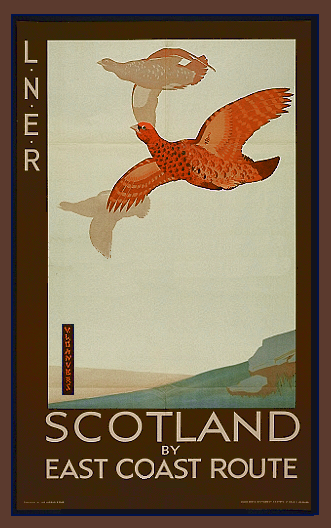
but first.... not since edward penfield playfully stole from many of the famous artists of his day have we seen the kind of trickery of v l danvers of the work of ohara koson. for example see above; where ohara koson called his image 'carp and fly,' (note the location of the flies) danvers reiterates the theme while punning on the word 'fly'! now before ed chides me again, i must admit to the ohara images, both of them, have been flipped for illustration purposes. the arc of each fish is even quite similar.

we see this same game recreated in danvers's second 'sporting' poster; the mallards. in an experiment i tried, i was able to prove to myself that the necks and heads of the male duck in both images is the identical angle.

i was interested to learn that both artists were active during the 1920s; danvers was following, in these posters and those in the previous post, as well as those of many japanese-influenced artists and illustrators of the age, many of the elements of the japanese prints, while dropping some others. you will still see the japanese-y signatures, asymmetry and background items, but more importantly, you will get the areas of flat color while losing the outlines.

in 'small town,' you can see this even more clearly than in the examples here, but studying that one will inform your viewing of this one. my argument falls apart entirely. the closest i could come, which isn't that close, is allen seaby's, though he was earlier. (toshi yoshida also did grouse, but his are not flying, and to me they look like babies, but what do i know?

danvers' cormorant is his most realized example of japonisme. there too i could find no 'original.' his mastery of the form is now obvious. perhaps he no longer had a need to borrow.

Labels: , , , ,

14 October 2011

OCCUPY EARTH

13 October 2011

small town

why do train whistles, red rooftops,
and abandoned row-boats somehow
make us feel safe, and with our true
souls revealed?


SMALL TOWN

You know.
The light on upstairs
before four every morning. The man
asleep every night before eight.
What programs they watch. Who
traded cars, what keeps the town
moving.
The town knows. You
know. You've known for years over
drugstore coffee. Who hurts, who
loves.
Why, today, in the house
two down from the church, people
you know cannot stop weeping.

Philip Booth

"Small Town" by Philip Booth, from Lifelines: Selected Poems 1950-1999. © Penguin Group, 1999.

1804

.山里や秋の雨夜の遠歩き
yamazato ya aki no ame yo no tô aruki

mountain village--
a rainy autumn evening's
long walk

Issa, translation by David Lanoue

images that should make us feel
lonely instead make us feel whole
and bathed in golden light.


PASSION FOR SOLITUDE

I'm eating a little supper
by the bright window.
The room's already dark,
the sky's starting to turn.
Outside my door,
the quiet roads lead,
after a short walk, to open fields.
I'm eating, watching the sky—
who knows
how many women are eating now. My body is calm:
labor dulls all the senses, and dulls women too.

Outside, after supper,
the stars will come out to touch
the wide plain of the earth.
The stars are alive,
but not worth these cherries,
which I'm eating alone.
I look at the sky, know that lights
already are shining
among rust-red roofs,
noises of people beneath them.
A gulp of my drink,
and my body can taste the life
of plants and of rivers. It feels detached from things.
A small dose of silence suffices, and everything's still,
in its true place, just like my body is still.

All things become islands before my senses,
which accept them as a matter of course:
a murmur of silence.
All things in this darkness—
I can know all of them,
just as I know that blood flows in my veins.
The plain is a great flowing of
water through plants,
a supper of all things. Each plant,
and each stone,
lives motionlessly.
I hear my food feeding my veins
with each living thing that this plain provides.

The night doesn't matter. The square patch of sky
whispers all the loud noises to me, and a small star
struggles in emptiness, far from all foods,
from all houses, alien. It isn't enough for itself,
it needs too many companions.
Here in the dark, alone,
my body is calm, it feels it's in charge.

Cesare Pavese

translation by Geoffrey Brock

"Passion for Solitude" from Disaffections:
Complete Poems 1930-1950.

Copyright © 2002 by Cesare Pavese.


it's neighborhood,
being tucked into bed,

the smell of fresh bread,
the human voice,

the slam of the
refrigerator door....


1805

.里の火の古めかしたる月夜哉
sato no hi no furumekashitaru tsuki yo kana

the village fires
old and familiar...
a moonlit night

Issa, translation by David Lanoue

Labels: , , , , , , , , , , , ,

04 October 2011

High Wire Venus


OFF A SIDE ROAD NEAR STAUNTON

Some nothing afternoon,
no one anywhere,

an early autumn stillness in the air,

the kind of empty day you fill
by taking in

the full size of the valley
and its layers leading

slowly to the Blue Ridge, the quality of the country,

if you stand here long enough, you could stay

for, step into, the way a landscape, even on a wall,

pulls you in, one field at a time,
pasture and fall

meadow, high above the harvest, perfect

to the tree line, then spirit clouds and intermittent

sunlight smoky rain riding the tops of the mountains,

though you could walk until it's dark
and not reach those rains --

you could walk the rest of the day into the picture

and not know why,
at any given moment,
you're there.

Stanley Plumley

Stanley Plumly is the author, most recently,
of "Posthumous Keats:
A Personal Biography"
(Norton, 2008).

All rights reserved.

Labels: , , , , ,

newer posts older posts