japonisme

15 October 2009

waltz, tango, quickstep, rumba, cha-cha, mambo, samba, swing


...The only change in the creative process I've seen with the dance poems comes with the luxury of writing within a framework -- each dance has a distinct feel, an embedded cadence that will suggest a certain shape or silhouette on the page.... "Fox Trot Fridays" was the first in the group; it wrote itself rather quickly.

After that felicitous birth, I imagined writing a poem about each type of ballroom dance -- waltz, tango, quickstep, rumba, cha-cha, mambo, samba, swing, even paso doble. And then, of course, I couldn't write a word, because I was trying to write about dance, not get inside the dance.

When I began to appreciate the technical intricacies of each style -- not just the pattern "quick- quick with a / heel-ball-toe" but the rise upon tiptoe that occurs between the slow count and the first quick in fox-trot, for example, or the gradual lowering from tiptoe that one executes in the second half of the third beat in the waltz -- only then did "American Smooth" [her most recent book] start to shimmer into being.

My scaffolding was to provide a humble description of the dance technique -- what each part of the body should be doing, measured out precisely, without emotion -- in the hopes of finding the poem's true desire, to achieve flight of consciousness, a lifting of the spirit as well as of the human form. 1


THE MUSICIAN TALKS
ABOUT "PROCESS"


(after Anthony 'Spoons' Plough)

I learned the spoons from
my grandfather, who was blind.

Every day he'd go into the woods
'cause that was his thing.
He met all kinds of creatures,
birds and squirrels,
and while he was feeding them
he'd play the spoons,
and after they finished
they'd stay and listen.

When I go into Philly
on a Saturday night,
I don't need nothing but
my spoons and the music.
Laid out on my knees
they look so quiet,
but when I pick them up
I can play to anything:
a dripping faucet,
a tambourine,
fish shining in a creek.

A funny thing:
When my grandfather died,
every creature sang.
And when the men went out
to get him, they kept singing.
They sung for two days,
all the birds, all the animals.
That's when I left the South.

Rita Dove

© 1999 Rita Dove from On the Bus With Rosa Parks pub Norton

also see more combs!

Labels: , , , , , , , , ,

11 February 2009

the new math

we've already looked at dow's moment of epiphany, the realization that what he had been looking for was the book of hokusai prints right there in his hands. let's look a little closer:

dow has now met ernest fenollosa, and is studying with him at any possibility.

"In May, Fenollosa, with a certain flair he had for the dramatic, opened a door and showed Dow two magnificent screens by Okio. Dow looked at them in silence for a space and then exclaimed, 'Why can't I do that?' (The subject was a pine covered with snow.)

To this question Fenollosa replied, 'You can do it if you dare, but you don't dare.'

Dow instantly replied, 'I will dare!'

This pleased the Orientalist and he exclaimed, 'You will, you will, and I dare you to do it.'"

clearly, this was a moment of discovery for dow, of synthesis and excitement. he began seeing in a new way, one that, from his own perspective, returned to the basics in art, what all cultures had at some time done, the essential line, with everything extraneous removed.

the clarity of his vision was such that he went on to formulate, and to develop ways of teaching these insights to others, work that some say became more important than making art itself. he is credited for having changed the way art is regarded and taught in this country radically, and his methods were the staple of american art education for many years.


okay -- so we have a moment of person discovery, life-altering, piercing and pervasive. so.... um.... -- what about all these other guys??! was it worldwide epiphany-itis?

i went to the jung pages and apparently the descriptive phrase i wanted to use, 'collective unconscious,' doesn't actually mean what i have always taken it to mean, so that won't work, unless i am allowed to redefine (or expand its definitions) the concept to what i always thought it meant and what fits in rather well here, namely that there is some mysterious (until science figures it out) connection of every human's mind that rises and falls with the tide and explains how one idea can occur in many places at the same time.

spontaneous combustion?

wasn't this the stuff of impressionism, anyway? the release of detail in pursuit of truth?

artists throughout the west were paring down, simplifying, following ideas they had imbibed from the japanese prints; did each and every one of them feel themselves to be a solitary traveler?

it's such an interesting phenomenon-- i wish i knew the name for it.

when things change, we each want to name it, to own it, and to think we know the reason why.

Labels: , , , , , , , , , , , , , ,

27 March 2008

bliss

I WANDERED LONELY AS A CLOUD

I WANDERED lonely as a cloud
That floats on high o'er vales and hills,
When all at once I saw a crowd,
A host, of golden daffodils;
Beside the lake, beneath the trees,
Fluttering and dancing in the breeze.

Continuous as the stars that shine
And twinkle on the milky way,
They stretched in never-ending line
Along the margin of a bay:
Ten thousand saw I at a glance,
Tossing their heads in sprightly dance.

The waves beside them danced; but they
Out-did the sparkling waves in glee:
A poet could not but be gay,
In such a jocund company:
I gazed -- and gazed -- but little thought
What wealth the show to me had brought:

For oft, when on my couch I lie
In vacant or in pensive mood,
They flash upon that inward eye
Which is the bliss of solitude;
And then my heart with pleasure fills,
And dances with the daffodils.

Wordsworth 1804

Labels: , , , , , , , , ,

16 January 2008

clay

sometimes i'm just overwhelmed by the beauty of this stuff. does it appear that way to you too?

after a day of research, i'd say the most i've learned is that the clay in your location is very very important, and that many nooks, crannies & villages have distinctive styles of the porcelain/pottery that come from their town.


but i am so grateful that more every day is available online, that others seem to find this important as well, and that one can come across articles like this one. it's not precisely on topic with these particular illustrations, but it's not exactly not, either. it reveals more of the complexity of the incoming japonisme, and some of the importance of ceramics as cultural artifact.

and besides, it's by gabriel weisberg.

JAPANESE ART ON A PLATE


At the Paris World’s Fair of 1867 there was immense interest in a ceramic service decorated by Félix Bracquemond for Eugène Rousseau. It was considered to be revolutionary in the evolution of dinner-service decoration, as it was not only the first in France in which Japanese motifs were used, it was also the first to break from traditional schemes of plate decoration.

It at once became the touchstone by which other decorators using Japanese motifs were judged, and remained successful for decades. Other versions were produced after Rousseau (1827-1891), its primary promoter, sold his business in 1885 to Ernest Leveillé. He in turn sold it to Harant et Guignard, known as ‘Maison Toy’, in 1902. Louis Harant of Maison Toy continued to edit the service until 1938.

The Bracquemond- Rousseau service demonstrates that there was a commercial market for ceramic decoration in this style. However, while it may have been the first of its kind, and eminently successful, it was not the only early table service influenced by Japanese art.

In 1873-74 another service was shown at the exhibition of the Union Centrale des Arts Décoratifs in Paris.

Commis- sioned by the jeweller Frédéric Boucheron, designed and painted by Henri Lambert, and produced for Eugène Rousseau at Creil- Montereau, it is possibly as large as the Bracquemond-Rousseau service. Although comparable in quality to the earlier service, it appears to exist only as one set in a private collection in Paris, together with a few pieces in the Musée National Adrien Dubouché, Limoges, and there is no evidence that it was commercially manufactured.

As a result, it has remained almost entirely unknown, and is published here for the first time. Its story makes clear how ceramic decoration became the way in which Japonisme was introduced to a public that had the financial means to purchase such table services for their homes. (read the rest of the article here)

Labels: , , , , , , , , ,

15 September 2006

by any other name


i guess we haven't yet mentioned many of the other names or styles that are japonisme, in one way or another, in disguise. Of course art nouveau, but also jugendstil, liberty style, arts and crafts, and many more.

the parts of japanese style elaborated on might be different in each, but a little research and the secrets are handed up easily.

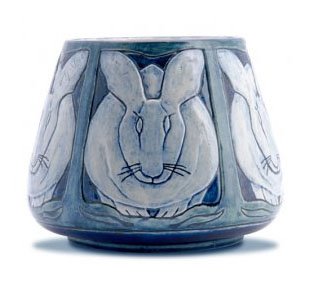
how else does a japanese family crest, usagi, become a vase made by Marie de Hoa LeBlanc in 1902, a member Newcomb Pottery in louisiana, and expect to draw $75,000 at auction?

Labels:

older posts