japonisme

23 February 2012

高澤圭一, 中西利雄 & Matisse

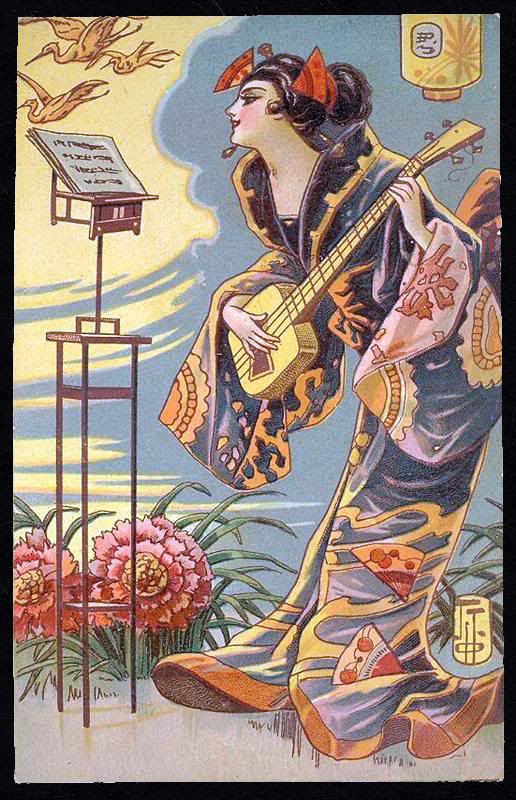
in 1947, just after the war and the year i was born, two artists in japan were finding work, beyond their own "western-style" painting, as the painters of covers of women's magazines. since i first saw them in 2007 here, they have struck as very matisse-like. so i went out exploring.

closer examination proved me more accurate than i'd imagined. the two japanese artists whose work i most admired were toshio nakanishi and keiichi takasawa, i could find next to nothing about them in english, and the japanese translator (google) is pretty poor. but one thing i think i was able to ascertain was that the two that were my favorite were by keiichi takasawa, though they look nothing like his painting style (mostly of his wife, it is believed) which are not illustrated here. but there is similarity in style to his pamphlet on the kimono.

others were by toshio nakanishi whose painting style does look a lot his magazine colors. could i have misunderstood the japanese and these are really by nakanishi too?

but the similarities to matisse, not only in facial style and use of pattern, but in body language too. the outline is evident as are similar uses of flat color. though matisse, like frank lloyd wright, denied he was influenced by japanese art, the truth, also as with wright, was inescapable. as nakanishi began to fill in the flesh, matisse began to simplify it.

and the connections prove it not far-fetched. keiichi takasawa studied with foujita tsugeharu and both soon became integral parts of the paris art scene.

toshio naka- nishi was part of a group of rebellious artists, reaching to the west to grow parts of themselves. one like-minded artist, bijutsu shinron, said, "Of course one has to imitate. Even if we want to create works that are uniquely Japanese, we still need to look at Western paintings in order to supplement our own deficiencies. And I don't believe we have to set out to be 'Oriental.' If we simply express ourselves, the results will be sufficiently 'Oriental,' I'm sure."

i find it quite interesting, the similarities each culture went through adjusting to the new influences, the new style. another young japanese artist, koide narashige, was moved to comment, "I often hear that Japanese women are rather shapeless and that nudes other than those of Western women are worthless. Those who say so want to make fun of shapes of women depicted in Japanese oil paintings.

I do not know whether theirs is indeed the right form of the human body, but if a French beauty with thin hair about her lips comes at a distance of one foot from me, then, before being struck with her grace, I will be overwhelmed by her strange exaggerated nose, her deep-set piercing eyes and each pore of her rough skin, and I will possibly begin weeping. Some people despise short legs in view of a certain sort of individualism. In a streetcar I see fat young women sitting, their stocky legs not reaching the floor, but I can regard them as quite charming."

MATISSE, TOO

Matisse, too, when the fingers
ceased to work,
Worked larger and bolder,
his primary colors celebrating
The weddings of innocence and glory, innocence and glory

Monet
when the cataracts blanketed his eyes
Painted swirls of rage,
and when his sight recovered
Painted water lilies, Picasso claimed


I do not seek, I find,
and stuck to that story
About himself,
and made that story stick.
Damn the fathers.
We are talking about defiance.

Alicia Ostriker

Ostriker"Matisse, Too" from Poetry Magazine 12/06.

Labels: , , , , ,

14 February 2012

the Great Road to cheap instant Enlightenment

COMIC VERSE

As long as you've got inherited provisions stored in your cellar,
go ahead and look hungry,
play at being poor to be chic.
When you tire of the Parthenon and Notre-Dame,

fine, go on to lanterns, Mount Fuji,
Hiroshige, Harunobu, Basho, Buson,
throw in Taiga, back to Sesshu,
praise the blank paper.

Pick, as you please,
tanka or haikai.
But I,
who know the thing about your cellar,
won't join your playing at being chic.
You may tap me on the shoulder,
but I won't feel good.

With your wooly hands
you may tug at me
and try to seat me on the Great Road to cheap instant Enlightenment,
but I'll have to excuse myself.

You see, like those fellows in the Kojiki,
I just like to shuffle about in the sun;
to tell you the truth,
— Japon, Japon, Japon, Japon, Japon —
ah, you're too noisy.

Takamura Kotaro (1883–1956)

tr. Hiroaki Sato

takamura kotaro lived through the precise time that this blog covers -- the arrival of westerners, the modernization of japan and the japanization of the west. though from japan, he studied in paris and other places, and was inspired by the art he saw there; in the west's reinterpretation of japanese style he was able to see new ways to write, and to sculpt. he is considered the earliest japanese poet to abandon himself to free verse, carrying home with him as a souvenir an ancient japanese poetry form that had evolved into something new.

he was uncomfortable with the swift westernization of his own country, and yet it's clear he also was as enriched by the swirling cross-cultural currents as was the west.

Labels: , , ,

12 February 2012

dammed self!

what of identity, then?
is it a fixed thing, or fluid?
self, no self, shifting self?


i dilute, like water-color
drop of paint assuaged by water.
but how do i know, then, it's me?

one simple thing: my mouse
goes out, and i am suddenly
without connection, without hands.


my every thought is dammed,
my constant curiosity is still
plugged in yet impotent.

will i disappear? or
spend some time remembering
i will come back, i'm already there.


when connections are severed,
if you feel selfless you are
looking in the wrong direction.


1810

.生て居るばかりぞ我とけしの花
ikite iru bakari zo ware to heshi [no] hana

just being alive
I
and the poppy

Issa

tr. David G. Lanoue

Labels: , , , , , , , , , ,

08 February 2012

her back

HOW SIMILE WORKS

The drizzle-slicked cobblestone alleys
of some city;
and the brickwork back
of the lumbering Galapagos tortoise
they'd set me astride, at the "petting zoo"....

The taste of our squabble still in my mouth
the next day;
and the brackish puddles sectioning
the street one morning after a storm....


So poetry configures its comparisons.


My wife and I have been arguing; now
I'm telling her a childhood remini- scence,
stroking her back, her naked back that was
the particles in the heart of a star and will be
again, and is hers, and is like nothing
else, and is like the components of everything.

Albert Goldbarth

from To Be Read in 500 Years by Albert Goldbarth.
Copyright © 2009 by Albert Goldbarth.
All rights reserved.

Labels: , , , , , , , , ,

04 February 2012

is it wise, or is it nothing at all?


.よ所からはさぞ此島を月見哉
yoso kara wa sazo kono shima wo tsukimi kana

elsewhere, no doubt
someone's viewing this island
this moon

issa

how many moon stories would you tell
if you told all of your moon stories?
have you watched its flirtations?
has it laid balm to your loneliness?


has it been prominent in your arts?
un chien andelou? moonstruck?
is it a symbol, or are you?
was it your only light?

HUNGER MOON

The last full moon of February
stalks the fields;
barbed wire casts a shadow.
Rising slowly,
a beam moved toward the west
stealthily changing position


until now, in the small hours,
across the snow
it advances on my pillow
to wake me,
not rudely like the sun
but with the cocked gun
of silence.

I am alone in a vast room
where a vain woman once slept.
The moon,
in pale buckskins, crouches
on guard beside her bed.


Slowly the light wanes,
the snow will melt
and all the fences thrum
in the spring breeze
but not until that sleeper, trapped
in my body, turns and turns.

Jane Cooper

from The Flashboat: Poems Collected and Reclaimed.
Copyright © 2000 by Jane Cooper.

think of everyone watching
as you do tonight.

Labels: , , , , , , , , , , , ,

25 January 2012

mew

there's so much to say about today's selection of images, but i won't say it all because to tell you the truth i am simply not interested in who patented what technique and who showed what when. i shall remind you, though, that what all of these artists were doing at that moment of time was nothing short of revolutionary in that they were breaking free of the academy's formal classicism. though each has his own distinctive style, they are clearly friends and brothers, and students of the new japonisme that facilitated that break.


crossword

a woman moves through dog rose and juniper bushes,
a pussy clean and folded

between her legs,
breasts like the tips of her festive shoes
shine silently in her heavy armoire.

one blackbird, one cow,
one horse.
the sea beats against the wall of the waterless.
she walks to a phone booth
that waits
a fair distance from all three villages.


it’s a game she could have heard on the radio:
a question, a number,
an answer, a prize.
her pussy reaches up and turns on the light in her womb.

from the rain,
she says into the receiver,
we compiled white tables and chairs under a shed
into a crossword puzzle
and sat ourselves in the grid.


the receiver is silent.
the bird flounces
like a burglar caught red-handed.
her voice stumbles
over her glands.
the body to be written
in the last block—
i can suck his name
out of any letter.

all three villages cover their faces with wind.

Valzhyna Mort

Source: Poetry (December 2009)

Labels: , , , , ,

newer posts older posts