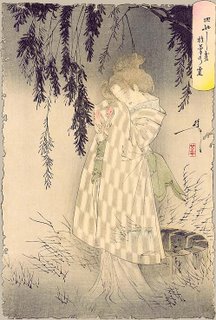
an unfamiliar, silent place

but i must interrupt myself to introduce you to quite an amazing, and growing, image source. in keeping with our exploration of turn-of-the-century vienna, wiener werkstatte, ver sacrum, et al, i tried to find some of the poetry that had been published in that magazine. but i failed. so here we have poems from poets who were in ver sacrum, if not necessarily with these poems.
LOVESONG
 How shall I withhold my soul so that
it does not touch on yours? How shall I
uplift it over yours to other things?
Ah, willingly would I by some
lost thing in the dark give it harbor
in an unfamiliar, silent place
that does not vibrate on when your depths vibrate.
Yet, everything that touches us, you and me,
Takes us together as a bow's stroke does,
That out of two strings draws a single voice.
Upon what instrument are we two spanned?
And what player has us in his hand?
O sweet song.
Rainer Maria Rilke
trans. M.D. Herter Norton, from Translations from the Poetry of Rainer Maria Rilke, 1938, 1966. 1
 How shall I withhold my soul so that
it does not touch on yours? How shall I
uplift it over yours to other things?
Ah, willingly would I by some
lost thing in the dark give it harbor
in an unfamiliar, silent place
that does not vibrate on when your depths vibrate.
Yet, everything that touches us, you and me,
Takes us together as a bow's stroke does,
That out of two strings draws a single voice.
Upon what instrument are we two spanned?
And what player has us in his hand?
O sweet song.
Rainer Maria Rilke
trans. M.D. Herter Norton, from Translations from the Poetry of Rainer Maria Rilke, 1938, 1966. 1
AN EXPERIENCE
 What wondrous flowers had bloomed there,
cups of colors darkly glowing! And a thicket
Amidst which a flame like topaz rushed, Now
surging, now gleaming in its molten course.
All of it seemed filled with the deep swell
Of a mournful music. This much I knew,
Though I cannot understand it – I knew
That this was Death, transmuted into music,
Violently yearning, sweet, dark, burning,
Akin to deepest sadness.
Hugo von Hofmannsthal
translation. D. McClatchy? 3
HUNTING LASSES
 My soul is sick to-day;
my soul is sick with absence;
my soul has the sickness of silence;
and my eyes light it with tedium.
I catch sight of hunts at a standstill,
under the blue lashes of my memories;
and the hidden hounds of my desires
follow the outworn scents.
I see the packs of my dreams
threading the warm forests,
and the yellow arrows of regret
seeking the white deer of lies.
Ah, God! my breathless longings,
the warm longings of my eyes,
have clouded with breaths too blue
the moon which fills my soul.
Maurice Maeterlinck 3
 no. i don't really love those last two poems, but i think i'm a translation snob. but it doesn't take snobbery to recognize treasure.
all of these images are but a particle of what awaits you at mattia moretti's photosets on flickr.
included are not only two complete volumes of ver sacrum, which is 40% of the total run, but stunning secessionist buildings throughout europe (mostly), decorative objects, and much more. don't miss his blog, either: http://www.szecesszio.com/.
 What wondrous flowers had bloomed there,
cups of colors darkly glowing! And a thicket
Amidst which a flame like topaz rushed, Now
surging, now gleaming in its molten course.
All of it seemed filled with the deep swell
Of a mournful music. This much I knew,
Though I cannot understand it – I knew
That this was Death, transmuted into music,
Violently yearning, sweet, dark, burning,
Akin to deepest sadness.
Hugo von Hofmannsthal
translation. D. McClatchy? 3
HUNTING LASSES
 My soul is sick to-day;
my soul is sick with absence;
my soul has the sickness of silence;
and my eyes light it with tedium.
I catch sight of hunts at a standstill,
under the blue lashes of my memories;
and the hidden hounds of my desires
follow the outworn scents.
I see the packs of my dreams
threading the warm forests,
and the yellow arrows of regret
seeking the white deer of lies.
Ah, God! my breathless longings,
the warm longings of my eyes,
have clouded with breaths too blue
the moon which fills my soul.
Maurice Maeterlinck 3
 no. i don't really love those last two poems, but i think i'm a translation snob. but it doesn't take snobbery to recognize treasure.
 all of these images are but a particle of what awaits you at mattia moretti's photosets on flickr.
included are not only two complete volumes of ver sacrum, which is 40% of the total run, but stunning secessionist buildings throughout europe (mostly), decorative objects, and much more. don't miss his blog, either: http://www.szecesszio.com/.
Labels: adolf bohm, fredrich konig, Hugo von Hofmannsthal, josef maria auchentaller, Maurice Maeterlinck, poetry, Rainer Maria Rilke, ver sacrum
posted by lotusgreen at 8:27 PM
4 comments