japonisme

25 December 2008

scarlett ribbons


I never got along with my
father - when I was 3 I wished
they would break up so I could
go off with my mom.

The same mom who was so
jealous of his adoration of
the infant me that she cut
it off at the source.

He hauled off and slugged me
often. “Don’t you talk to your
mother that way!”
She hit me too. With a shoe.

But stuck in my head
like a treasure in the attic
are memories of
my father and music.

He played the piano.
He played “Fur Elise.”
When I was very little
he played “The Airplane Song.”

I was the plane. spinning
through the living room,
arms outstretched as wings.
Sometimes I just sat

At his feet, as they worked
the pedals. It was cozy
hiding under the keyboard,
listening to him play.

There was one song he sang
every year about this time. “Scarlett Ribbons,” the Burl Ives
version. He sang it anywhere.

In his dark car driving
home from work, with
me in the back seat,
singing along.

Labels: , , , , , , , ,

22 December 2008

Am I to gang ba-are-foot?

JAPANESE CHILDREN are accustomed to lots or toys. They have their games and nursery rhymes galore. Their "Mother Goose" is centuries older than ours; in fact, it is said that Japanese mothers used to recite its jingles long before Columbus discovered America. (new york times 1908)

どんぐり ころころ どんぶりこ!
おいけに はまって さあ たいへん!
どじょうが でてきて "こんにちは!"
"ぼっちゃん, いっしょに あそびましょ!"

Acorn bowl is small and round thing rolling!
Now you go out into the most!
Loach have been in the "Hello!"
"Son, ASOBIMASHO together!"


も~もたろさん, ももたろさん
おこしに つけた きびだんご
ひとつ わたしに くださいな

あ~げましょう, あげましょう
これから ぼくと おにたいじ
ついて~ くるなら あげましょう

- MOTARO also said, she MOMOTARO
TSUKETAKI to come BIDANGO
One is to me, please

I ~ GEMASHOU,'ll
Fetus in the future and I
If you happen to come about --

あめ あめ ふれ ふれ かあさんが~
蛇の目(じぁのめ) で お迎え (おむかえ) うれしいな ~
ピッチ ピッチ! チャップ チャップ! ラン ラン ラン!

Bandy bandy candy from a candy KAASAN
Bull's-eye (ANOME time) to pick up (meeting) is pleased to
Pitch Pitch! Chap chap! Run Run Run!

むすんで ひらいて
手をうって むすんで

また ひらいて 手をうって
その手を上に

むすんで ひらいて
手をうって むすんで

また ひらいて 手をうって
あの手を下に

むすんで ひらいて
手をうって むすんで
MUSUN to come flying in
MUSUN hand in the fire

The thick hands that come flying
On their hands

MUSUN to come flying in
MUSUN hand in the fire

The thick hands that come flying
I get to the bottom

MUSUN to come flying in
MUSUN hand in the fire

forgive me forgive me
the translations are google's
they're senseless indeed --
please help if you can!
but no more senseless
than the english ones
with meanings lost in their births.

but for you, dear reader, they're gifts
i hope you enjoy them.
the whole book, a volland, of course,
is here. much more on the japanese rhymes are here.

drawings were in children's books: the rhymes belong to each culture alone, but the earliest japonisme -- greenaway, caldecott, and crane were far earlier than richardson, but the tradition is clear.

Labels: , , ,

20 December 2008

bells are ringing

Ring Your Bell for Peace

Sunday Dec 21 • 12 noon (wherever you are)

think • wish • pray • meditate for peace
then ring your bell for one minute


more info at ringthebellsofpeace.com

Labels: , , ,

13 January 2008

sinbad the buddha

i am not a hokusai expert, so i am still vulnerable to the wonder encountering a new area of his talents fosters. so when moon river mentioned a site with books illustrated by him, i went to check it out.

my first reaction was that these were different from any hokusai i remembered seeing; they were more narrative, with more depth to the characters. two books are offered. one is a collection of limerick-type poems (humorous, perhaps a bit ribald), none of which could i find a translation for. though the women featured look neither ribald not humorous, they do look more like real women than one usually finds in ukiyo-e.

my second impression, though, was that the illustrations in the other book(s), the life story of the buddha, reminded me of the illustrations from the era called the golden age of illustration.

when i first saw this one i immediately thought of s. clay wilson's 'the checkered demon.' but as i paged through the illustrations from edmond (or edmund--he changed it) dulac, i began to feel that the similarities were even more striking.

hmmmm, i thought... could dulac have seen them? "Dulac was born in Toulouse, France, 22 October 1882, the son of a commercial traveller. He began drawing and painting at a very early age, and his holidays were spent copying Japanese prints." 1

discussing another artist, bpib says, "Goble [was] well-versed in watercolor techniques and very influenced by the same Japanese techniques that fascinated Dulac." (though they don't mention this in dulac's bio).

according to wikipedia, "The Jātaka Tales [the books hokusai was illustrating] refer to a voluminous [547] body of folklore-like literature concerning the previous births (jāti) of the Buddha."

hmmmm, i wondered... could there be any actual relationship between these stories and the sinbad ones? or was the similarity of the illustrations merely coincidence, or perhaps inspiration?


"I have now followed the Western history of the Buddhist Book of Birth Stories along two channels only. Space would fail me, and the reader's patience perhaps too, if I attempted to do more. But I may mention that the inquiry is not by any means exhausted. A learned Italian has proved that a good many of the stories of the hero known throughout Europe as Sinbad the Sailor are derived from the same inexhaustible treasury of stories witty and wise." wrote thomas william rhys davids in 1880. 2

"These 'Jakata stories' about the Buddha were translated into Persian, Greek, Latin and Hebrew and formed the basis of some of the most famous story sequences of the Common Era - Sinbad, the Arabian Nights and Aesop's Fables - the latter being compiled by a monk in 14th century Byzantium."3

as has been mentioned here before, dulac was certainly not the only illustrator of his time to be influenced by the japanese prints. to mention only two others here by no means excludes anyone. in fact one would be hard pressed to find one who wasn't.

as dulac, along with arthur rackham and harry clarke and countless others demonstrate with their numbers, the phenomenon of japonisme was deeper and more labyrinthine than we have even begun to discuss.
Labels: , , , , , ,

16 September 2007

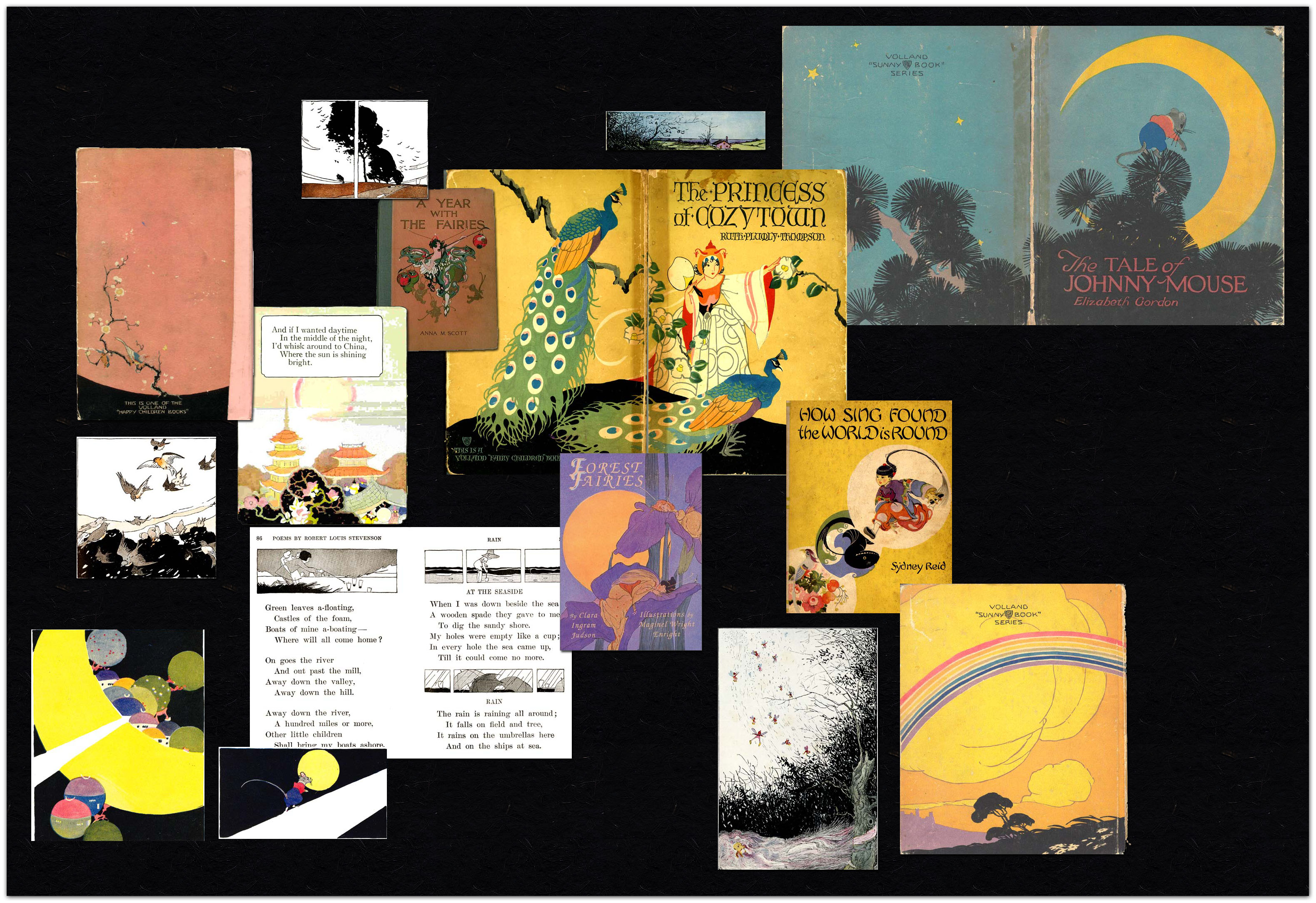
volland

all of this from one publisher, from the early part of the last century. there are varying stories about volland's history, but someone there was extraordinarily wise and very tuned in to the design pulse of the moment.

i don't think there were any other publishers who featured such undiluted japonisme on such a regular basis, and thank goodness for them.

illustrators featured:

maginel wright enright
janet laura scott
m t "penny" ross
johnny gruelle (of raggedy ann fame)
katharine sturges dodge

find the whole books for many of these (and many more) here. just do a search for 'volland' in the publisher space.

Labels: , , , , , ,

27 April 2007

the crane you never knew

it's odd, i know, but whenever i heard the names of certain of male artists, who lived long ago, i always, until beginning this blog, pictured them as old, white-haired, hoary and wizened. not so. many of them, i am finding, are young--and they're cute! take walter crane, for instance.

Walter Crane is one of the most popular English illustrators of the second half of the 19th century. With Kate Greenaway and Randolph Caldecott, he established the genre of picture books for children. The characteristics of his illustrations are decorative frames, use of black outlines and exquisite depiction of, for example, dresses and furniture. His work was influenced by the Pre-Raphaelites and by Japanese woodblock prints. 1

crane's illustrations and paintings demonstrate his clear placement in the aesthetic movement (primarily the 1860s and 70s, pre-dating the japonisme/art nouveau era by a decade), but even here in this work we see the fans, the pottery, and even the occasional japanese print beginning to sneak in.

his aladdin has strong japanese elements, but is clearly of indeterminate national origin! but even here we have the blue and white tiles of the aesthetic movement (and crane's own home).

what most surprised me about crane were his strong socialist beliefs. in these lithographs, the copy is enlightening (though i really don't understand all the politics).

they are each pages from "Mrs. Mundi at Home RSVP: The Terrestrial Ball", published by Marcus Ward & Co., 1875

/
MRS MUNDI GAVE A GREAT BALL...
DAME EUROPE WAS THERE IN THE LAST PARIS PASSION.
MISS AMERICA TOO, IN IDENTICAL FASHION.
WITH ASIA AND AFRICA PICKING THEIR CRUMBS
AND AUSTRALIA MELTING HER GOLD SUGAR PLUMS.
FRAULEIN GERMANY, FULL OF IMPORTANCE AND LAND,
WITH FAIR SIGNORA ITALY, HAND WITHIN HAND;
COUSIN RUSSIA, MORE FRIENDLY THAN EVER WAS KNOWN,
AND THE POOR DOGGY DENMARK WITH NEVER A BONE.

it was crane's observation that since the time when east-west trade began in the mid-19th century, it had exerted an enormous influence on the arts of europe. this was because, in his view, life in japan had still been akin to life in europe during medieval times and was thus a country where artists and craftsmen marvelously trained for many kinds of decorative work, and who took part of a bold and unconstrained naturalism. europeans found a living art, an art of the people, in which tradition and artistic talent had remained untainted, and whose work was beautiful, diverse, and with tremendous connection to and communicative of nature. it was not surprising that this art effected western artists as strongly as it did, and that its effects were so profound.

Labels: , ,

25 April 2007

rock-a-bye baby, the cat's in the cupboard!

an interesting contrast, from the same era, illustrations for two of the same nursery rhymes as in the previous post. they both are clearly influenced by the japanese, but so differently.


the artist is ww denslow, best known for all of his work with l frank baum, of the oz books.


we'll see more from him in future days.


i thought this was cool.

Labels: , , ,

at long last blanche

Little is known regarding the writer/artist Blanche McManus, except that she was born on Talladega Plantation, in East Feliciania Parish, Louisiana, in 1870, studied in London and Paris, and returned to the U.S. in 1893 when she established a studio in Chicago. By 1895, she was authoring and illustrating a series of children's books, including The True Mother Goose (1895), The Voyage of the Mayflower (1897) and How the Dutch came to Manhattan (1897). In those same years, she was producing illustrations for other authors books, often working on three or four books at one time.

Around 1900, she travelled with writer/husband, Francis Miltoun (Milburg Francisco Mansfield), throughout Europe and North Africa.

Their collaboration led to a series of travel books, fully illustrated by McManus....The couple is probably best known for a series of illustrated travel books which incorporated the newly invented automobile within a typical travelog of the period.

Blanche McManus' sketches and water colors of the people they met and views of archi- tectural/natural scenes adds an interesting element to the books.

McManus published her first work at the age of 25. and by 30 had illustrated 15 books, 6 of which she authored also.1

(here are her alice in wonderland illustrations.)

and one more wonderful image.

Labels: ,

older posts