a man for all seasons: 1905
what an adventure this is turning out to be!
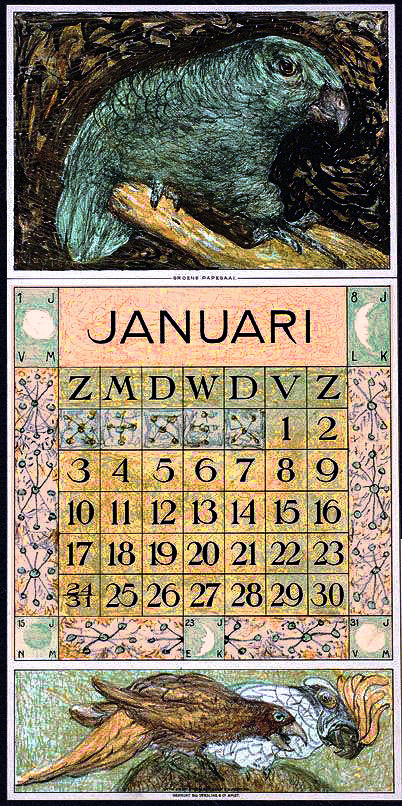
 first, from jalf flach, i received a bunch of months i (coincidentally) didn't have before and couldn't find! because they're numbered differently from the ones i had, i couldn't match up months by end/start dates, so i asked him if he knew the years for the ones he sent. he responded that for many years after hoytema's death, the calendars were continually re-printed, not always keeping the same months' images together as they had first appeared!
 so please let me explicitly ask: if anyone out there has images from these calendars, i would love to hear from you. thanks.
 coincidence as well, synchronicity. laura at her cool animalarium blog, being perhaps the only other person on the planet who owns the book that inspired me to start on this, did a post on it.
 and, being italian, as is the book, was in the process of translating bits of it, which she will allow me to post here!
 "The book from which these images are taken is Theodoor van Hoytema – Calendari by Ezio Godoli. it was published in 1989 by Cantini Editore, a Florentine publisher who in the 1980s–90s produced some really nice and well documented illustrated books about art, illustration, fashion and ephemera. Unfortunately, as far as I know Cantini is no longer active but some of these out of print books can be found at bargain prices in used bookstores around the city and on the web." 1
 more from the book: "As an adolescent Theo van Hoytema loved animals, and was fascinated by illustrated books on entomology and natural history. Having noticed this, in 1888 his uncle A.P.M. van Oordt, a publisher and typographer, commissioned him to draw some illustrations for scientific publications on zoology. To accomplish the job, Theo went to study and sketch the animals at Leiden's Museum of Zoology and perfected his lithographic technique. This experience marked the beginning of his career as a serious artist, and in a few years' time, he became internationally known as one of the most original interpreters of the Nieuwe Kunst, the Dutch version of Art Nouveau." 1
 laura has also offered to do more translation, and, as she did for her post on her blog (and you'll see some here), to provide us with scans!
 a bit on my process. these images are collected from 1001 places; some i've had for years. others i've adapted from illustrations in the book. while laura can scan them beautifully, my photos of the pages really do not turn out very well. some that i find are abbreviated, showing only the main image, thus leaving out the madly delightful critters in the frames.
 and now further truth -- sometimes i even have the images with the clever frames, but use a main image only because one i've downloaded and the other i'd have to photograph and then spend an amazing amount of time trying to make it look halfway decent.
 i will continue to search for better images, to work with my photos, and to welcome any scans, and will replace old images for new in an ongoing way, if i can improve on them. the calendars are still being reprinted and sold, so more images might be out there somewhere.
 the flip side is that if the close-up images are good enough, then they're lovely to have all in themselves, and i likely will run both, when i can.
 so thanks for visiting here; only 15 years remaining!
Labels: birds, calendar, theo van hoytema
posted by lotusgreen at 2:27 PM
2 comments