japonisme

14 January 2007

the light

alexandre lunois made his first original color lithographs in 1886, and his continued work in this field helped to elevate the field to a fine art by the end of the century.


his study of japanese art is particularly evident in his use of color, outline, structure, and the flat planes of hue. the shape of clothing and lighting fixtures are an indication as well.

edmond de goncourt, an artist, writer, philo- sopher, critic, and contemporary of lunois said of his work, "a very remarkable print is the lithograph entitled spanish dancers be-
fore the dance
. a sheet of the grandest character might pass for a japanese imitation in its intensity of tones, the raw blue at the bottom, the yellow, the pure red, the nocturnal black shadows at the fullness of the figure."


the image with the single woman is the one from the 'seeking the floating world' catalogue, as is the quote. interestingly, it is entitled, l'illumination, the light.


Labels:

13 January 2007

flowers from our shores

it occurred to me this evening that though many of my favorites from this era are women, i show you the work of more men than women.

well... there are a lot more to choose from, in the west, and in the east there are only men to choose from. but i want to remedy that a bit tonight. i've mentions some of these women before, but here's a little context.


Edna Boies Hopkins studied under Dow at the Pratt Institute in 1899 and 1900, learning block printing and Dow's principles of composition. She then taught design at the Veltin School for Girls in New York City.

Hopkins taught the wood-block technique to Ethel Mars (1876-1956), a friend from the Art Academy of Cincinnati in Ohio, who moved to New York in 1900.


Mars in turn taught Maud Squire (1873-1955), also an art student from Cincinnati living in New York. By 1906 each of the three women had settled in Paris, and together they formed the nucleus of a group of American print makers.

In 1910 they were joined by Margaret Jordan Patterson, who had studied at Pratt in 1895, and although she had not enrolled in Dow's classes, she credited him as her teacher.


Patterson, who was also a textile designer, learned the wood-block technique from Mars.1


Magazine Antiques, Sept, 1996 by Lindsay Leard


(margaret jordan patterson, mjp, edna boies hopkins, ebh, ethel mars, maud squire, mjp, mjp.)

Labels: , , ,

12 January 2007

lest we forget


In 1885, King Leopold II declared the Congo Free State (as large as the whole of Europe) to be his personal fiefdom and set about enriching himself and Belgium in earnest. In 1887, Scottish surgeon J B Dunlop used rubber for constructing inflatable tubes for bicycles and the demand for rubber grew sharply. The motor car was also becoming popular and Leopold sought to provide the rubber for the tyres. Leopold issued a decree in 1891 giving himself the monopoly on the trade in rubber and ivory. The same decree obliged natives to supply these products without payment. Those who refused or failed to supply enough had their villages burned down, their children murdered and their hands cut off, even if dead, as proof to the Belgian masters.1

Labels:

calligraphy


(from the catalogue for the exhibition 'seeking the floating world.')

Labels:

11 January 2007

auriol

many people know the name auriol from the font, a font that perhaps typifies art nouveau in the minds of many, that even more typifies japonisme, in it's clear debt to brush calligraphy. but behind the font is the man, the designer of the font, and of much of the japonisme legacy with us today.

when auriol arrived in paris, he was quickly enthralled by the japanese influences everywhere, and set off to study with riviere, who had begun to teach printmaking in the japanese style.

some of auriol's designs were nearly strict reproductions of japanese designs, but others flowered forth from his own creative spirit into his typography, book design, and illustration.

(bottom left from utamaro's series of birds in a song competition with each other.)

Labels: ,

10 January 2007

seeking the floating world

in 1989 an exhibition was in japan when i was. it was between shows at two different museums, and i didn't know about it while i was there, but other than that i would have loved to have gone. "seeking the floating world: the japanese spirit in turn-of-the-century french art." while it was shown in only japanese museums, it was assembled with help from the japonisme center at rutgers, which is where i bought the catalogue. (it is out there, i just checked.)

the selection of items is stunning, though what we are shown is primarily the french images only; the japanese 'equivalent,' when one was mentioned, is shown as a thumbnail. still, as always, fascinating.

i thought i'd go through the book over time and show you some of the similars they suggest, and others i've found.

the first japanese image i'll use is from yoshitoshi tsukioka. it's called, 'looking cool: the fashion of a geisha in the early 1870s,' from his series 'thirty two aspects of woman.'

paired with that in the exhibition is this poster from mucha. the copy in the catalogue reads, 'mucha's distinctive style of flowing arabesques and a unique use of variegated linear patterns suggests inspiration from such late nineteenth-century japanese printmakers as yoshitoshi.'


to my eye, this image by georges de feure captures a similar moment in a similar style as well. de feure, in addition to his attraction to the nature-based patterns and decorations of the japanese styles, as well as many of the kimono fashions, is known for portraying women in a way found in the work of few artists of the time.

in these, he found depth, variation, pride, thoughtfulness, and a wide range of emotions still notable for their wisdom. in this he shared something with yoshitoshi, whose series does the same from a japanese perspective.

the similarity may end there, though. while de feure linked up with samuel bing, indeed so much so that much of the interior of bing's l'art nouveau shop was designed and decorated by de feure, and the store sold much of de feure's furniture. de feure then went on to design furniture for high-end clients throughout paris.

yoshitoshi sold his furniture as well, but in this case it was literal: he had to sell his furniture to pay his bills.

Labels: ,

09 January 2007

santo kyoden

i realized that i couldn't just be done with this guy: he was too fascinating. let me show you some of the things people write about him:

*SANTŌ Kyōden (1761-1816) was a popular writer of gesaku fiction in late eighteenth century Edo. He wrote in many genres of popular fiction, including kibyōshi (satiric picture books), sharebon (witty books about fashion), kokkeibon (comic fiction), hanashibon (humorous books), gōkan (bound picture books), and yomihon (reading books). He also was known as an illustrator, artist, poet, and collector of antiques.1


Santo Kyoden, was a multitalented artist of the Edo period (1603–1867). Kyoden, whose activities crossed media boundaries, was successful as an ukiyoe painter, writer of popular novels and designer.

Kyoden was born in 1761 in Fukagawa Kibacho, Edo (Tokyo). His real name was Iwase Samuru. At the age of 15, he became an apprentice of leading ukiyoe artist Kitao Shigemasa, and renamed himself Kitao Masanobu. A precocious genius, Masanobu became one of the best three ukiyoe artists of that time in just five years.

At the time, various forms of popular literature, generically termed gesaku, or popular books, were in fashion. The gesaku genres included: sharebon, literally translated as “witty books,” which told stories about life in the red-light district; kibyoshi, or yellow backs, which were illustrated, satirical books for adults; and gokan, or books of illustrated long stories, often of a moralistic nature.

Kyoden started out illustrating for kibyoshi, however, by the time he was 20, he had begun to write stories of his own and these would become very popular. At first, writing remained a sideline, but the weight of work gradually shifted from that of illustrator to writer.

In 1785, when he was 24, Kyoden was already a successful kibyoshi writer, but upon venturing into writing sharebon, he became the leading author in that genre. When he was at the peak of his writing career, the Kansei Reforms were initiated by the Tokugawa shogunate, and kibyoshi and sharebon became subject to regulation as publications liable to corrupt public morals. Under the new laws, Kyoden was arrested and detained for 50 days by the authorities. Deciding it was not worth the bother, Kyoden quit writing sharebon and opened a store selling tobacco pouches in Ginza. His artistic genius was expressed again in the new business. To promote his products, Kyoden made advertising flyers, in which he used to wrap his tobacco pouches. The promotion was highly successful. Customers bought the products to see the flyer filled with the art and the taste of the designer. Kyoden's other area of expertise thus became well known.

There is no other artist/writer in the Edo period that was as versatile and multitalented as Kyoden. He died in 1816 at the age of 55. He is said to have been enthusiastic about creative art until his death.2

harvard professor adam l. kern's pdf introductions to his new book on the origins of manga can be found here and here; they contain fascinating and amusing insights, perspectives, into santo kyoden's career and life.

and utamaro features him (lower left), in his own element, even in his own style.

Labels: ,

08 January 2007

designs

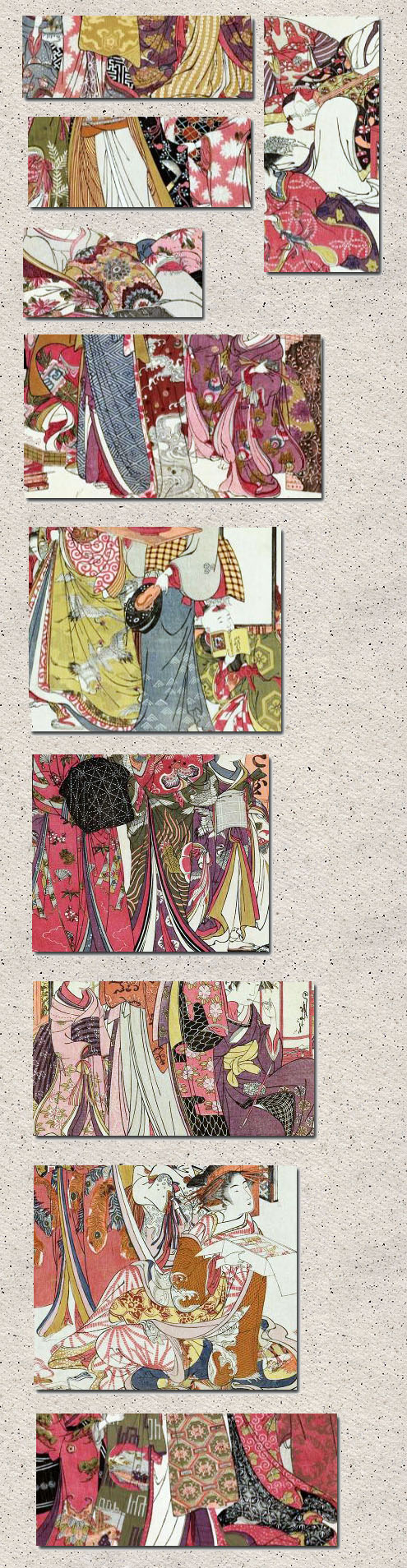
when i first made this little collage, a selection of fabric designs from one single series by one single artist, i wanted to learn what i could about the artist, with regard to, as we were discussing. fashion and designers and such.

did the same artist who made this set of prints design both the fabrics and the clothing made up of them? (click the image several times to see full-size -- there is one print from the series below)

i learned nothing about this at all! what i learned about was this amazing character of an artist, author, poet, and general scalawag named iwase sei.

this was not a name he used, however, in any of his artistic endeavors. the name he used when he was creating this series, a manga purportedly analysing the personalities of all of the courtesans of the yoshiwara (pleasure district) through their calligraphy, was kitao masanobu.

kitao masanobu did very little art, as it turned out (a fact which surprised me since i thought the prints were pretty amazing), though he did become the illustrator for a writer of manga and other fiction named santo kyoden. santo kyoden, however, was also him!

as the japanese middle class had grown starting in the late 1600s, a market had arisen for materials about the yoshiwara, the "floating world" (which was off-limits to most men). iwase sei, who was active in the 1700s joined the likes of ihara saikaku and all of the ukiyo-e artists to fill this market. his titles offered ways for a gentleman to win admiration from a courtesan, and similar techniques.

i mentioned the crackdown on these artists discussing utamaro's shackling, and the same thing happened to this guy. when released, however, apparently he went on to become one of the instigators of modern fiction in japan. he also married two different wives, each a licensed worker of the yoshiwara.

Labels: , ,

07 January 2007

Early in the Morning

Early in the Morning ....

While the long grain is soft- ening
in the water, gurgling
over a low stove flame, before
the salted Winter Vegetable is sliced
for breakfast, before the birds,
my mother glides an ivory comb
through her hair, heavy
and black as calligrapher's ink.

She sits at the foot of the bed.
My father watches, listens for
the music of comb
against hair.

My mother combs,
pulls her hair back
tight, rolls it
around two fingers, pins it
in a bun to the back of her head.
For half a hundred years she has done this.
My father likes to see it like this.
He says it is kempt.

But I know
it is because of the way
my mother's hair falls
when he pulls the pins out.

Easily, like the curtains

when they untie them in the evening.

-- Li-Young Lee, ©1986.


(Li-Young Lee was born in 1957 in Jakarta, Indonesia, of Chinese parents. In 1959, his father, after spending a year as a political prisoner in President Sukarno's jails, fled Indonesia with his family. Between 1959 and 1964 they traveled in Hong Kong, Macau, and Japan, until arriving in America. Rose, the book from which this poem is taken, was published by BOA Editions, Ltd. upper left: utamaro kitagawa; edgar degas; gotosei kunisada; henri-edmond cross; utamaro kitagawa; edgar degas; gotosei kunisada.)

Labels: , , , , ,

06 January 2007

mr mucha, please meet japan

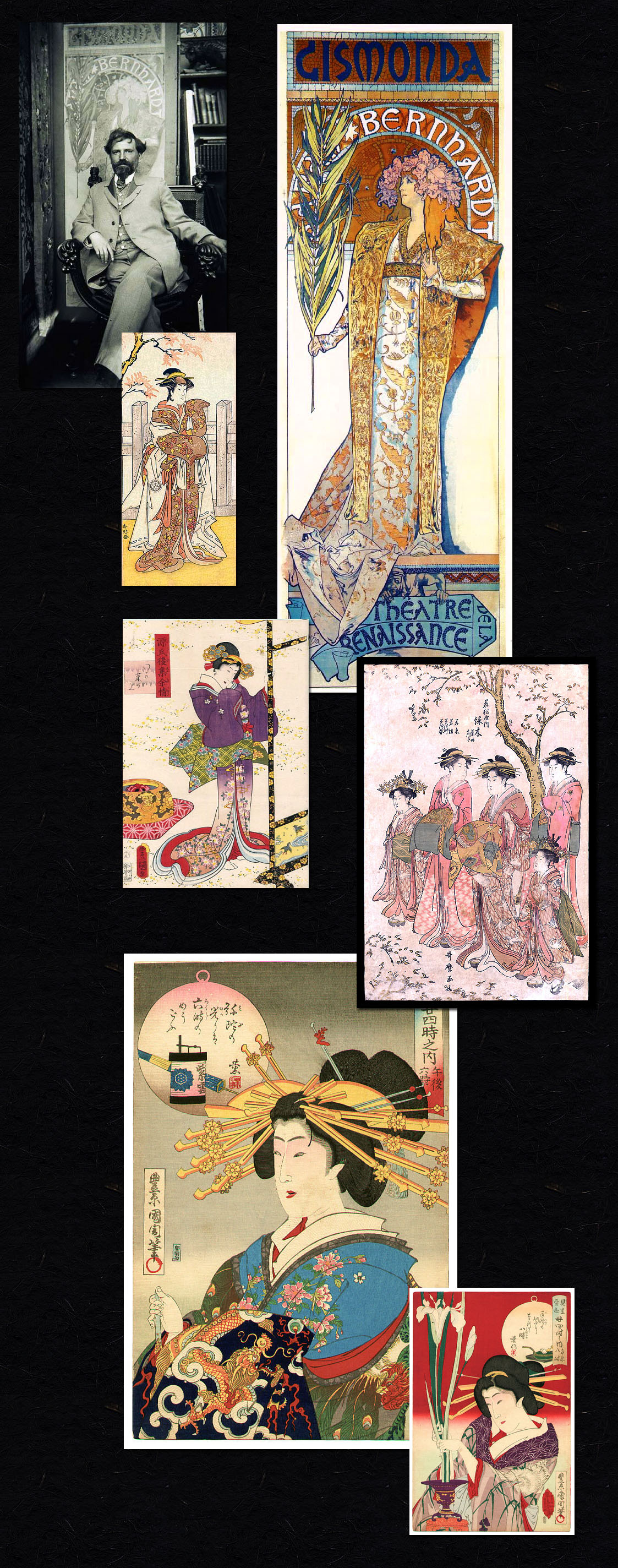
mucha was an unknown. yes, he was making his living by his art, an obscure illustrator, and this was his dream -- well, not the obscure part. one night when he was working late into the night, sarah bernhardt phoned the printer in a fit of pique! this new poster!!, she cried. it will not do! (of course she probably cried this in french)

although it may sound like a scene out of a busby berkeley movie, the only artist they could find that snowey night was this little man, awork at his station. and he vowed he would give it a try.

the rest, as they enjoy repeating, is l'histoire. she loved the poster so much that she signed mucha to be her exclusive poster-maker, and more, her costume and jewelry designer, stage sets, headdress and more. his work was so original! like nothing seen before--not even in mucha's own work!

and it suddenly became the design rage throughout paris: the scroll-like shape, the simplified grace of one woman, adorned, and set off by her glorious fabric. mucha was an overnight success, posters were seen for the first time as fine art, and the definition of art nouveau had now been solidified.

but... uh... wait.... you know what i'm going to say, don't you? gee, wonder where mucha found the inner vision to create something so "revolutionary"? come on now--give it a guess.

the solitary peaceful woman, the flowery hairpiece, the fabric and background as focus, the lack of perspective, even the shape of the dress, the clothing--what mucha did for a decade is to put a slavic/parisian spin on an ancient design scheme and claim it as his own.

and rarely if ever do i see anyone suggest otherwise, though to me it couldn't be more obvious.

(mucha's gismonda poster, his first of this style, is from 1894. the image just below the artist's photo is from about 50 years before that, i believe. forgot to get a credit for that one. below that, kunisada, 1858, in purple. notice her hair ornaments. in pink to the right are courtesans--with the elaborate wooden stick hair ornaments--and maiko, apprentice geisha, with the garland of flowers. sarah's headdress is much more a maiko hairdo than a geisha; yes it is inventive, but not invented. this one is by utamaro kitagawa and dates to the 1700s. and then two from kunichika toyohara from 1890. women of presence clearly did exist in print before mucha reawoke them in a new vernacular.)

please don't get me wrong--i adore mucha's work. i seem to never tire of it. i remember the thrill of seeing the original of one of his posters, a sketch, i guess, at the zimmerli at rutgers, that thin, human pencil line. so simple. it's just that, well, credit where credit's due, don't you think? what do you think?

Labels: , , , , ,

05 January 2007

Les Estampes Japonaises, la collection de Claude Monet

"One day in 1871, legend has it, a French artist named Claude Monet walked into a food shop in Amsterdam, where he had gone to escape the Prussian siege of Paris. There he spotted some Japanese prints being used as wrapping paper. He was so taken by the engravings that he bought one on the spot. The purchase changed his life — and the history of Western art."1

03 January 2007

the bleed of culture, the stain. the blossom

Hannah Borger Overbeck was one of the four Overbeck sisters who founded the Overbeck Pottery studio in Cambridge City, Indiana in 1911. She is credited as being the chief designer for several decades until her death in 1931, an influence that led to large decorated pieces with highly colored patterns, uncluttered, and incised lines based on nature.1


Otto Heintz was born into a family of manufacturing jewelers in Buffalo , NY . By about 1902 he had purchased a small company, renamed it the Art Crafts Shop, and began design and manufacture of copper items with colored enamel decoration. He was granted three patents. By 1906 he changed the name to Heintz Art Metal Shop, and shifted to bronze as the base material and sterling silver as ornamentation. The Art Crafts Shop hammered “look” was replaced by a series of machine-shaped bodies with sophisticated patinas. The definitive patent for applying sterling silver to bronze without solder was granted August 27, 1912 .

Heintz’ line consisted of vases and bowls, candlesticks, smoking accessories, trophies, lamps, desk accessories, picture frames, bookends and jewelry. From a circa 1916 trade catalog: “Heintz wares have won an enviable reputation among buyers of art goods, because of originality and beauty of design, and unusual quality of attractiveness. The articles are of bronze, and are decorated with sterling silver designs, permanently applied by our patented process. Beautiful colored finishes have been produced after much thought and experiment...”2

(ohara koson; hannah borger overbeck; heinz art metal; hiroshige)

Labels: , , ,

31 December 2006

fear not the night, dears


with no pattern but beauty!

for no reason
but
joy!


welcome the light!


(kogyo tsukioka; ethel kirkpatrick; ito sozan; biho hirose; seitei (shotei) watanabe; unknown; bairei kono; chikuseki; edna boies hopkins)

Labels: , , , , , , , ,

newer posts older posts