japonisme

10 November 2008

18th century, part II; the bits


 now as we've seen in culture after culture before, a thriving middle-class nurses the arts and 18th century japan was no different. with the edo period, the long isolationist era, peace and prosperity reigned across the land.

kabuki theater, poetry -- humorous and serious, the novel, the visual arts -- prints, paintings, and illustrated books -- and the sexual ones -- the courtesan districts, for example, prospered. and as a sort of visual chronicle of these growing realms, ukiyo-e -- images of this floating, ephemeral, world, was born as well.

what began as painting quickly turned to (at first) black-ink, occasionally hand- colored, prints, due to their ease of reproduction and the money there-by to be made. not surprisingly, spring painting was among the first genre to achieve major popularity. (it would be the waves of censorship that would bring back the landscape.)

the full-color print, however, was soon to follow, and it was primarily used in the spring painting; it was a natural hit, given all the newly- found free time. here's where we get to that debate again, though.

many, including the artist himself, attribute its invention to haranobu suzuki, late in the 18th century. but there is debate. some credit hu cheng yen, in china in the 17th century. "This was the medium the amateurs of spring painting had been looking for." 1 some, though, credit the jesuits for introducing this to the chinese (if they had only known!).

some point to the witch paintings of hans baldung grien, a german artist in the early 16th century, but since there is very little information about his full-color process, i believe it was the tool known as the pen which provided the reds, yellows and blues.

in any case, does it matter? it would not be the first time technology travelled east while philosophy/ design travelled east, nor, as you know, would it be the last. but as i said, haranobu said he was the man. "The inventor of the color printing was Suzuki Harunobu (1725-1770). Harunobu had begun with the printing from the three or four woodblocks, gradually enlarging the number of the blocks to seven or nine." 2 (note how the prints are still somewhat 'primitive' to what our eyes are used to, as does the color.)

during the 17th and 18th centuries, as prosperity flourished, more and more dutch books (except those on religion) were allowed into japan. books of botany and anatomy, history and works by german copper-plate artists. we can see their tell-tale footprints everywhere. just as we can see the simplification of line, a shift in perspective, and a new awareness of the moment in the west in all the arts.

Labels: , , , ,

09 November 2008

the 18th century

the longer i look into the 18th century the more confused i get. it was a time of great social and technological change.

as much as i may be learning, there are too many gaps in my know- ledge for me to put together anything that feels cohesive, or even comprehensible. so why don't i just toss some stuff out here and when i'm done (this will take several posts) we'll see if anything has come clear.

now if you look at the two images above you might assume that they are somehow related. are they? i think even knowing the answer doesn't answer the ques- tion. (even diagramming its frac- tals explains nothing of this.) 1

the line on top is from an 18th century british painter and theoretician named andrew cozens (reputedly the bastard son of peter the great). his son robert followed him in form as well.


"In 1759 Andrew published An Essay to Facilitate the Invention of Landskips, Intended for Students in the Art, setting out in brief his method for composing with the aid of ink blots and citing the precedent of Leonardo da Vinci, who had recommended looking for images in crumbling walls as a means of assisting the invention. " 2

this was new? the japanese were following their chinese teachers at the same time without having read this essay.

the work of the dutch, however did become popular in great britian after 1700, so i can't see it as inconceivable that dutch traders brought in artwork along with kimono, and that the british saw that too.

what a stunning and dramatic departure we begin to see, as from constable, for example. well, departure from european art, anyway.

I think that's enough for the moment. i don't know that i'll ever get any definitive answers, here, but my eyes can be informed.


yes, mountains just look this way. we can all see it. at least it's true to our eyes, now. but if that's true, why didn't western painters paint it that way until after they met the japanese? and why isn't anyone mentioning it?

Labels: , , , ,

05 November 2008

the 17th century

we have seen what landscape painting looked like in japan and the netherlands before 1600, when the two met, so now we shall look at the 17th century's products, and question who influenced whom.


a booklet i have from the national gallery of art reads, "The Dutch school of painting, arising in the early seventeenth century and already in decline by its end, is one of the most remarkable phenomena in the history of art.

"Unusual, first of all, is the abrupt- ness with which it appears; suddenly, about 1620, there is a Dutch school, fully-developed, a school which has its origins in sixteenth-century Netherlandsish painting to be sure, but which is quite unexpectedly original.

"Unusual, too, is the extraordinary number of great artists who worked in such a small country during so short a period of time. Finally, the solid excellence of their painting is remarkable and what might be called the homogeneity of their view of life and their interpretation of it, the consistent way in which they express their land and its people.

"They are, in fact, so Dutch! They stand apart from the artists of the other schools of seventeenth-century painting in Europe, even that of the Spanish Netherlands, just to the south. Dutch painting of the great age reveals the period and place of its origin in every passage of paint as legibly as they may be read in the label on the picture frame." 1

now we also read, "Folding screens called the Namban-byobu were produced in great number by artists of the Kano School from the end of the sixteenth through the seventeenth century. These screens were Japanese in style and technique.

"On the other hand, Church taught Western art techniques for the production of icons and other works of religious art which were necessary for the propagation of Christianity.

"But the Western-style of expression seen in the Edo period, the adoption of a realistic style of expression employing methods of perspective and shading, is in a different category from Namban-byobu and those religious works." 2

we read, "some suggest that "In the late 1620s van Goyen shifted to simpler motifs -- a few cottages along a village road or in the dunes, like in this painting -- and he achieved unification and depth by a leading diagonal and by a tonal treatment that subdues the local color and is expressive of atmospheric life." 3

this sounds to my ears like the very description of japanese art.

i'm very curious about your impression to these; did the japanese influence the dutch as much as the dutch influenced the japanese?

we may get more clues as we progress further into the edo period, and the beginnings of ukiyo-e. the dutch created everything we've defined as japanese? let's see what you think.

i want you to understand that i really do not like any of this at all. it throws so much of what i think i know into question. hokusai, hiroshige, so not japanese-y? stay tuned.

Labels: , , , , , , , , , , , ,

04 November 2008

halleluljah


The artists featured in this video are Empress of Soul, Gladys Knight, Vanessa Bell Armstrong, Patti Austin, Bernie K., Daryl Coley, Commissioned, Andraé Crouch, Sandra Crouch, Clifton Davis, Charles Dutton, Kim Fields, Larnelle Harris, Edwin Hawkins, Tramaine Hawkins, Linda Hopkins, Al Jarreau, Chaka Khan, Gladys Knight, Lizz Lee, Dawnn Lewis, Babbie Mason, Johnny Mathis, Marilyn McCoo, Stephanie Mills, Jeffrey Osborne, David Pack, Phylicia Rashad, Joe Sample, Richard Smallwood, Sounds Of Blackness, Take 6, Darryl Tookes, Mervyn Warren, Thomas Whitfield, Vanessa Williams, Chris Willis, Mike E., Kim Fleming, Angela Wright, and Gayle Mayes

Labels: , , , , , , , , , , , ,

03 November 2008

before 1600

last time we discussed anything, we discussed the kimono in vermeer's paintings, and how the dutch bumped into japan in 1600 and were allowed to stay. (click image above to see the whole thing)

this has actually sent me into days of research into eras about which i know nothing. i must admit it's interesting watching time telescope when seen through an art history lens.


the reason i've felt the need to go in this direction is the assertion, which i've read in numerous places now, that the art of the landscape in japan bloomed due to exposure to dutch landscapes after that fateful moment in 1600.

huh?

i don't see it; in fact i'd say the reverse is true, if anything. still, it's been surprising looking at what was being done when. i hope you think so too. to start i'll illustrate what was being done in japan and europe before 1600.

"The Dutch were savvy: They didn't try to bring culture or religion to Japan, only business. But it got in anyway. That island filled with strange-looking, wide-eyed, long-nosed, curly-haired, tobacco-smoking, telescope-toting Dutch beckoned. The Japanese developed a craze for all things Dutch, called hollandisme, the counterpart of European japonisme.

"At the same time, Western art's foundations—shading, the frame, three-dimensional perspective—crept into Japan to create a magnificently mongrel strain of Japanese art, from paintings, ceramics, and prints (including the great printmaker Hokusai, represented in this show) to lacquerware, tourist tchotchkes, and "peep-show boxes" set out on the streets." 1

"In Holland in the late 1500s, artists such as Claes Jansz Visscher and Willem Buytewech developed landscape art, which focused on topographically-correct landscape representation." 2

"The Dutch engraver Lucas van Leyden (1494–1533), greatly influenced by Dürer and by the classical style of his Italian contemporaries, gently depicted Dutch landscape and interior scenes." 3

"Sixteenth century Flemish landscape began with Joachim Patinir and lasts over a hundred years and ends with the refined Jan Breughel the Elder. His father, Pieter Breughel the Elder, or Peasant Breughel (for his portrayals of that life) was considered the greatest of Flemish painters of the period with his combination of Italian maniera or style and Netherlands realism. Hunters in the Snow, 1565 (Oil on wood) is believed to be December or January from a series of the Months." 4

"In his work Oranda kiko (Travels in Holland), Ryotaro Shiba, a popular Japanese historical novelist who passed away in 1996, wrote, 'If Japanese society, which had been isolated from the rest of the world, was a solitary black box, Nagasaki was like a pinhole, and Holland was the faint ray of light shining in.' He also wrote, 'It is one of the miracles in the history of civilization, even when taking into account the curiosity of the Japanese, that the dozen or so Dutch people confined to the island of Dejima in Nagasaki exerted an influence on a society with a population of over 20 million'. " 5

"While tea drinking had been brought to Japan from China in earlier centuries, in the fifteenth century, a small coterie of highly cultivated men, influenced by Zen ideals, developed the basic principles of the tea (chanoyu) aesthetic.

"At its highest level, chanoyu involves an appreciation of garden design, architecture, interior design, calligraphy, painting, flower arranging, the decorative arts, and the preparation and service of food. These same enthusiastic patrons of the tea ceremony also lavished support on renga (linked-verse poetry) and No dance-drama, a subtle, slow-moving stage performance featuring masked and elaborately costumed actors." 6

"The foremost artists of the Muromachi period are the priest-painters Shūbun and Sesshū. Shūbun, a monk at the Kyōto temple of Shokoku-ji, has created in the his mid-15th century paintings a realistic landscape with deep recession into space. Sesshū, unlike most artists of the period, was able to journey to China and study Chinese painting at its source. The Long Handscroll (Mori Collection, Yamaguchi) [above] is one of Sesshū’s most accomplished works, depicting a continuing landscape through the four seasons.

"Because of secular ventures and trading missions to China organized by Zen temples, many Chinese paintings and objects of art were imported into Japan and profoundly influenced Japanese artists working for Zen temples and the shogunate. Not only did these imports change the subject matter of painting, but they also modified the use of color; the bright colors of Yamato-e yielded to the monochromes of painting in the Chinese manner.

"Typical of early Muromachi painting is a depiction by the priest-painter Kao (active early 15th century) of the legendary monk Kensu (Hsien-tzu in Chinese) at the moment he achieved enlightenment. This type of painting was executed with quick brush strokes and a minimum of detail. Catching a Catfish with a Gourd (early 15th century, Taizō-in, Myōshin-ji, Kyōto), by the priest-painter Josetsu (active about 1400), marks a turning point in Muromachi painting. Executed originally for a low-standing screen, it has been remounted as a hanging scroll with inscriptions by contemporary figures above, one of which refers to the painting as being in the 'new style.' In the foreground a man is depicted on the bank of a stream holding a small gourd and looking at a large slithery catfish. Mist fills the middle ground, and the background mountains appear to be far in the distance. It is generally assumed that the 'new style' of the painting, executed about 1413, refers to a more Chinese sense of deep space within the picture plane." 7

next we'll look at the years just after 1600.

Labels: , , , , , , , , , ,

01 November 2008

rain


1820

.はいかいの報恩講やはつしぐれ
haikai no hôonkô ya hatsu shigure

a haiku reading
in memoriam...
first winter rain

The reading is taking place to commemorate the Death-Day
of the great haiku poet, Bashô: Tenth Month, 12th day. 1

Labels: ,

31 October 2008

trick or treat!!

30 October 2008

in case you missed it

Labels:

27 October 2008

the rush to finery

i have long wondered about the dutch. now, we've talked here about twelve dozen times, at least, about the roots of japonisme as having begun after japan was opened to trade in the middle of the 19th century after around 200 years spent in chosen, peaceful, isolation. this gauguin image with a japanese print, for example, is from 1889.

as we've also seen, japanese objects began appearing in artworks before truly inspirational and profound changes were to take place. we know that it wasn't until the end of the nineteenth century that europe began to be flooded with japanese goods, and we even know something of who facilitated the flooding.

so then tell me. what is this kimono doing in the painting by vermeer??? 'that's not a kimono. it couldn't be,' you will respond. but you would be wrong. "The history of exchange between Japan and the Netherlands started when the Rotterdam ship de Liefde drifted ashore in Japan in 1600. From the end of the 16th to the beginning of the 17th century, during the warring states period, Japanese culture was strongly influenced by Portugal and Spain.

In 1639, the Tokugawa Shogunate prohibited the Portuguese from visiting Japan and decided to continue official trade only with the Netherlands. In 1641, the Dutch Factory of the VOC was relocated from Hirado to Deshina [an island] in Nagasaki and trade between Japan and the Netherlands entered a new stage. At this time, the Netherlands was the only country that provided Japan with western culture." 1 [and vice versa]

"The Dutch VOC envoy left the trading post on the island of Deshima once a year as he was allowed only one visit Edo [Tokyo]. The VOC United East India Company gave exquisite gifts to the Emperor in order to show its gratitude for the trade monopoly privilege. [In return] the very first silk kimono's were a gift from the Japanese emperor to the Dutch envoy.

A 'Japonsche rok' chamber coat is padded and is designed to be worn inside the house during cold weather. That was quite necessary in winter as heating was sparse (foreign visitors remarked on it in their travel journals). Padded kimonos sent back to the Republic were exotic and very warm and thus became a hit when introduced in The Dutch Republic. The wide arms were often narrowed to fit Dutch requirements for use. The Japanese style chamber gown was often worn by wealthy traders and later on by scientists, authors and painters, sedentary people working at home." 2

in fact, these wealthy traders were also responsible for 'subsidising' another major development in the world of art: the still life. "In general, the rise of still-life painting in the Netherlands reflects the increasing urbanization of Dutch and Flemish society, which brought with it an emphasis on the home and personal possessions, commerce, trade, learning—all the aspects and diversions of everyday life. Floral still-lifes were especially prominent in the early 1600s, and in their highly refined execution and in their subjects and symbolism were addressed to a cultivated audience." 3
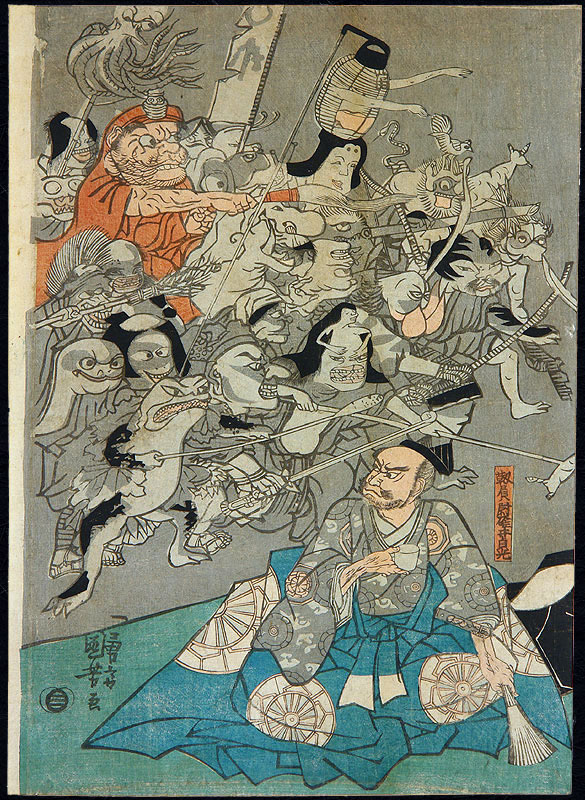
"While artists found limited opportunity to produce the religious iconography which had long been their staple — images of religious subjects were forbidden in the Dutch Reformed Protestant Church — the continuing Northern tradition of detailed realism and hidden symbols appealed to the growing Dutch middle classes, who were replacing Church and State as the principal patrons of art in the Netherlands.

It was not until the decline of the Academic hierarchy in Europe, and the rise of the Impressionist and Post-Impressionist painters, who emphasized technique and design over subject matter, that still life was once again avidly practiced by artists." 4

the new middle class having become the audience for still-lifes, the paintings themselves had a grand task: they had to announce the sophistication of their owners. "Japanese aesthetics were seen as signs of cultural distinction. Still-life paintings afforded the opportunity to evoke Asian cultures and the values associated with them, and thus Impressionists painted images of table settings that mingled Japanese, Chinese, and American objects. Japan was not simply a sign of chicness and exoticism: it was also a dream-image of utopia." 5

and thus our treats from the dutch: still-lifes, and the very earliest glimpses of japan's cultural riches. from high-culture to low-, the inclusion of a japanese figurine or print as part of still-life spread across the globe. and we are reminded once again of the eye-opening necessary links between the finest of arts and the bourgeoisie.

Labels: , , , , , , , , , , , , ,

newer posts older posts
