In a dark time, the eye begins to see, I meet my shadow in the deepening shade; I hear my echo in the echoing wood — A lord of nature weeping to a tree. I live between the heron and the wren, Beasts of the hill and serpents of the den.
What’s madness but nobility of soul At odds with circumstance? The day’s on fire! I know the purity of pure despair, My shadow pinned against a sweating wall. That place among the rocks — is it a cave, Or winding path? The edge is what I have.
A steady storm of correspondences! A night flowing with birds, a ragged moon, And in broad day the midnight come again! A man goes far to find out what he is — Death of the self in a long, tearless night, All natural shapes blazing unnatural light.
Dark, dark my light, and darker my desire. My soul, like some heat-maddened summer fly, Keeps buzzing at the sill. Which I is I? A fallen man, I climb out of my fear. The mind enters itself, and God the mind, And one is One, free in the tearing wind.
Through blue summer nights I will pass along paths, Pricked by wheat, trampling short grass: Dreaming, I will feel coolness underfoot, Will let breezes bathe my bare head.
Not a word, not a thought: Boundless love will surge through my soul, And I will wander far away, a vagabond In Nature -- as happily as with a woman.
Arthur Rimbaud
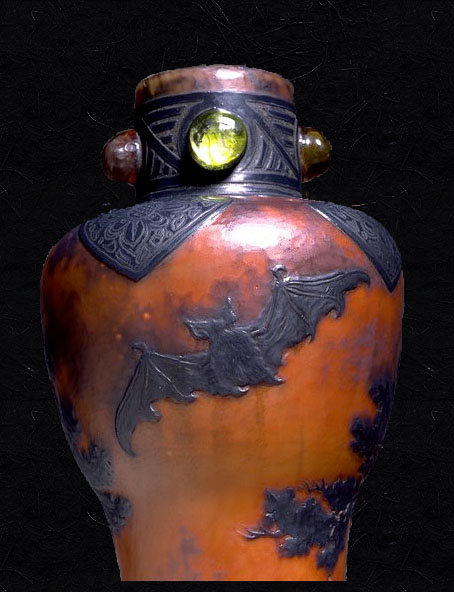
Emile Galle was born into his craft, and at first he carried on the traditions of the Victorian Era, flounces on pottery, but he came of age in a time of massive transitions; those of them most influential to this student of horticulture (as well as art) were the psychology of dreams and the unconscious, and the tremendous influx of Japanese culture.
Allied with him in these interests and perspectives were the Symbolists, particularly the poets, several of whom were his friends.
A SLEEPER IN THE VALLEY
A green hole where a river sings; Silver tatters tangling in the grass; Sun shining down from a proud mountain: A little valley bubbling with light.
A young soldier sleeps, lips apart, head bare, Neck bathing in cool blue watercress, Reclined in the grass beneath the clouds, Pale in his green bed showered with light.
He sleeps with his feet in the gladiolas. Smiling like a sick child, he naps: Nature, cradle him in warmth: he's cold.
Sweet scents don't tickle his nose; He sleeps in the sun, a hand on his motionless chest, Two red holes on his right side.
Arthur Rimbaud
Thus far, when we've looked at Galle, we've looked at beauty, as well as Japanese influence, but now we must look deeper. the work of the Japanese was not merely a new graphic direction as much as, like Van Gogh, a religion. to begin to deeply absorb himself in the holiness of nature. Gabriel Weisberg points to subjects like frogs eyeing dragonflies (and dragonflies themselves), as evidence of this. 1 Galle, like the Japanese, also inscribed lines from symbolist poetry into much of his work; this one: Hugo's Escape from motionless shadows.
for dream is occasionally nightmare; where does that difference exist? Debora L. Silverman tracks the new science of psychology on developing artists. 2 Galle's deepest motivations became those to record his dreams, to recreate them in glass, and then to provoke them in anyone who held his work. He proposed to evoke the "latent spirit beneath phenomena." what better medium to reveal layers than glass.
Among the foliage, green casket flecked with gold, In the uncertain foliage that blossoms With gorgeous flowers where sleeps the kiss, Vivid and bursting through the sumptuous tapestry,
A startled faun shows his two eyes And bites the crimson flowers with his white teeth. Stained and ensanguined like mellow wine His mouth bursts out in laughter beneath the branches.
And when he has fled -- like a squirrel -- His laughter still vibrates on every leaf And you can see, startled by a bullfinch The Golden Kiss of the Wood, gathering itself together again.
the establishment of reverence should be the goal of any art; the artist must therefore be on the road to open himself, to remove the layers of interpretation which blind one from genuine experience. Galle's pursuit of the dreamworld and its language was clearly this. He writes,
How can one explain the power exerted on the least noble and most delicate of our senses by the dizziness of the scent of carmine, by the flattery of subtle colour, burrowing more deeply into our souls than the thrust of crude colour, finally, by the dream-inducing, dusty velvet feel when you touch -- more subtle than any shining glaze.
Verlaine adds, We want nothing but suggestion/ No more colour, just suggestion!/ For suggestion alone can marry/ The dream to another dream, the flute to the horn.
Whether Verlaine or Hugo, Rimbaud, Baudelaire, Leconte le Lisle, Villon or many others, the addition of haiku-like bits of poetry into Galle's creations brought both halves of the brain into the experience, at the same time as the fingers touch solid where the eyes see liquid. We still today ask the question, where do dreams come from? Galle's answer intrigues and informs us still.
Emile Galle was inventing Modern Art just at the moment when the depths of dreams were beginning to enter the common language, suggesting the reality and the symbol, were both real, and both not real. That plus his invitation of glass into the universe of poetry, makes him worthy of examination to this day.
The clouds gathered over the open sea which was formed of an eternity of warm tears. in In the woods there is a bird, his song makes you stop and blush. -- Rimbaud.
the reason this fact is so notable besides, of course, all the regular reasons, is that i first heard about him, even saw a film about him, 40 years ago... today.
i had to double- and triple-check to believe my eyes -- that the one time i look him up is the day he dies.
•
but i get ahead of myself.
•
If you're going to San Francisco Be sure to wear some flowers in your hair If you're going to San Francisco You're gonna meet some gentle people there
For those who come to San Francisco Summertime will be a love-in there In the streets of San Francisco Gentle people with flowers in their hair
All across the nation such a strange vibration People in motion There's a whole generation with a new explanation People in motion people in motion
For those who come to San Francisco Be sure to wear some flowers in your hair If you come to San Francisco Summertime will be a love-in there
If you come to San Francisco Summertime will be a love-in there
•
and so i went. the first commune i lived in was called "free city," wherein among many other things, a young man named David Lloyd-Jones transcribed, printed up, and circulated a speech by R. Buckminster Fuller. he, like so many others of that moment, could see further into the future than many republicans can see to this day. he could see that it was a world of abundance, and that it could be made to work for every soul on the planet.
•
skip to one day early in 1971, i began to hear commercials on the then very cool KSAN, fm radio. they were for this thing called, "World Game," a series of workshops, and classes and discussions, all about ways to make the world work, a brainchild of R. Buckminster Fuller.
and it was indeed very cool. to simplify to the extreme, Bucky had worked it out so that if all nations would cooperate (yeah, right) in allowing there to be an international grid, there would be more available energy for each person on the planet to have what americans have today.
the sources of all this power: tidal, solar, and wind. it's all there; it's just not hooked up right.
to the left is his Dymaxion Map (or Globe). Bucky believed that to view the planet from this perspective, not only was it more accurate, but it also relieved the viewer from having to try to figure out what's up. for, of course, there is no up, or down for that matter. only in and out.
very quickly we students formed a gang, and did all and sundry things. we dropped acid and had profound discussions out on the grass. we had massive thanksgiving dinners in a Russian Hill mansion someone had donated for the duration.
we went to the Institute of Ability where we attended Enlightenment Intensives. we had dinner at the Swami Satchidananda ashram which was right up the hill from where i lived.
and, forty years ago today, we went to University of California at Davis's first Whole Earth Festival, held on the very first Earth Day. it was concerts, and dancers, and craftspeople and lectures and yoga and huge "Om" circles and so much more.
there was the woman who had come down from the mountains, who walked around all day with a green parrot on her shoulder, wearing nothing but a green crocheted bra-top, and a large piece of yellow satin wrapped around her hips.
she sold earrings she had made with feathers from her parrot; i still have one green feather earring today.
•
and there was the Fairfax Street Choir (hear them here). singing full-of-light songs and dancing, even tap dancing; how heavenly.
and, in a classroom, in a building a bit away from the rest, we saw a movie about Sai Baba.
Hear me a moment. Laureate poets seem to wander among plants no one knows: boxwood, acanthus, where nothing is alive to touch.
I prefer small streets that falter into grassy ditches where a boy, searching in the sinking puddles, might capture a struggling eel.
The little path that winds down along the slope plunges through cane-tufts and opens suddenly into the orchard among the moss-green trunks of the lemon trees.
Perhaps it is better if the jubilee of small birds dies down, swallowed in the sky, yet more real to one who listens, the murmur of tender leaves in a breathless, unmoving air.
The senses are graced with an odor filled with the earth. It is like rain in a troubled breast, sweet as an air that arrives too suddenly and vanishes.
A miracle is hushed; all passions are swept aside. Even the poor know that richness, the fragrance of the lemon trees.
You realize that in silences things yield and almost betray their ultimate secrets.
At times, one half expects to discover an error in Nature, the still point of reality, the missing link that will not hold, the thread we cannot untangle in order to get at the truth.
You look around. Your mind seeks, makes harmonies, falls apart in the perfume, expands when the day wearies away. There are silences in which one watches in every fading human shadow something divine let go.
The illusion wanes, and in time we return to our noisy cities where the blue appears only in fragments high up among the towering shapes. Then rain leaching the earth. Tedious, winter burdens the roofs, and light is a miser, the soul bitter.
Yet, one day through an open gate, among the green luxuriance of a yard, the yellow lemons fire and the heart melts, and golden songs pour into the breast from the raised cornets of the sun.
School Entrance Ceremony Amid Radiation Fear in an Exclusion Zone Near the Fukushima Daiichi Reactor
In Japan, April’s cherry blossoms signal a symbolic beginning, a new stage in life. On April 6th, along with school children across the nation, Iwaki City, within the 40 km radiation exclusion zone, held many school entrance ceremonies for elementary, middle and high schools.
Iwaki's Yumoto Daini Middle School’s ceremony was a bit different: not only were there 33 new students, but refugees living on the school grounds and some members of the Self Defense Force also attended. Overall 107 people participated in the ceremony. Headmaster Sawai Shiro may have exceeded his authority in taking the humanitarian step of granting permission for the refugees to remain on campus as the school year begins, at the risk of being punished later for breaking rules.
School Entrance Ceremony at Yumoto Daini Middle School, Iwaki City, Fukushima
Local sources report that in the first week or so after the nuclear crisis began, Iwaki City experienced difficulties in receiving supplies like food and fuel because many agents refused to deliver.Since early April, refugees who had evacuated outside the prefecture started returning. Restaurants in downtown Iwaki are reopening and many convenience stores boast reasonably well-stocked shelves, while gas, water and electricity have been restored. Iwaki City has repeatedly confirmed that “radiation is at a stable level which is not harmful to human health.” Iwaki officials explain that this judgment is based on figures provided by the Fukushima prefectural government regularly updated since March 11.
Principal Sawai began his welcome speech by saying, "I am glad to be able to confirm that all 33 new students are participating in this ceremony amidst a disaster that had forced many people to leave Yumoto.""In our district,” he continued,“some people survived by drinking water from their bath for weeks as there was no running water. I want you to care for each other especially for anyone who is in trouble." He concluded, "You young students, are the future of Japan. Now, we should be bound as one beyond differences in ideas, position or self interest."
Though all the new students attended, not all teachers were there. As a result of the catastrophe, personnel for the school was frozen and new teachers were not dispatched to the school, Sawai explained. As a result of the lack of teachers, there will be only one class run by a teacher for each grade.
School Doctor Informs Children “The radiation problem is already finished.”
Following the principal’s speech, the school’s doctor in his white coat stated matter-of-factly that, based on science, people should know that the worst of the earthquake damage had passed and that radiation leakages from the Fukushima Daiichi plant were decreasing and would soon fade away.
“The radiation problem is already finished,” he told the children and their parents. “You can go to school and go outside without any problem. You should not fear malicious gossip.”
While the doctor’s assurance that all major risks have ended would certainly raise eyebrows among most people outside the prefecture, many locals share this belief. We note the difference in perspective between radiation experts and people assessing the issues at a distance and those on the ground facing the destruction of their livelihood. While rumors of the dangers of radiation continue to swirl, many locals are even more afraid that rumors will destroy their businesses and any hope of securing their livelihood and rebuilding their communities.
Ikarashi Yoshitaka, 33, is one who is particularly keen on restoring his business and the local economy, a goal that leads him to downplay warnings of radiation risk.“It is just an emotional thesis that ours is ‘a city in danger!’” he insisted. Together with dozens of volunteers from across Japan, Ikarashi has visited many areas throughout the radiation exclusion zone. He confidently asserts that his $600 made in U.S "Geiger counter" has detected no abnormal amount of radiation.
Ikarashi is troubled by the fact that the milk business he manages suffered a 90% drop in sales as a result of radiation fears. Some farmers have been forced to throw away their milk, and at least one local farmer is rumored to have committed suicide over the ruin of his business.
Following the government announcement of level 7, Ikarashi observed that “residents will not listen; they don’t trust the government. The greatest concern for locals is to restore their towns and I’m doing my best to restore Iwaki City.”
Honma Hiroshi, 56, on patrol with the SDF in Iwaki comments: “I’m surprised that local people are so calm. Even within the 30 km radiation exclusion zone, they don’t even wear special anti-radiation clothes (Taibex). Even after the level 7 announcement, there has been no panic in the city."
Desperation over the destruction of the local economy appears to have provoked an unscientific optimism concerning radiation in some local communities struggling to get back on their feet.
in a fact almost unbelievable to me, redon drew only in black and white until he was sixty. his turn to color, which no one explains, brought to him finally the recognition and wealth he'd always craved.
now we've looked at some ways in which his black and white work was influenced by the japanese work he'd appreciated. (here) in fact that work has been tributed with a poem, which in turn has been tributed with numerous videos.
we've also seen his own influence on the japanese from the impressionist phase that hit japan much like theirs did western artists. but nowhere do i find the recognition of the influence of the japanese on his color work.
He was 60 years old when he abandoned the black and white of his graphic work and turned instead to oils and pastels. He began expressing himself in radiant colours, in visionary subjects, flower paintings and mythological scenes (The Chariot of Apollo was one of his favourite themes). In particular, his flower paintings were well received by Matisse. The Surrealists found Redon's work fascinating, as they, too, took their inspiration from dream imaginary and the subconscious. Furthermore, he had a number of young artists that admired his work greatly, which made a significant impact on Redon.
Redon himself interpreted his later adoption of colour as follows: 'In ceaselessly making myself more objective,' he wrote in 1913, 'I have since learned, with my eyes more fully open on all things, that the life that we can unfold can also reveal joy. If the art of an artist is the song of his life, a grave or sad melody, I must have sounded the note of gaiety in colour.' Of his 'noirs' he wrote, 'They were executed in hours of sadness, of pain and ... for this reason, are probably more expressive. Sadness, when it is without a cause, is perhaps a secret fervour, a sort of oration, something vaguely like worship, in the unknown .' 1
whatever odilon (which has got to be the most beautiful first name ever) said, or what others interpreted as, for example, 'the quest for meaning in the slow and gradual process of seeking synthesis between the certain and the uncertain, between physics and metaphysics.' (redon, seurat, and the symbolists), another influence appears right before our eyes.
if redon's creative sources had begun to revolve around the communication between human and nature, namely flowers, if woman could become indistinguishable from flower or at least exquisitely in tune, there is no contradiction in the japanese work.
while the japanese may be more ecumenical, women, men, men playing women, etc., the result is quite similar. in portraying his subjects garbed in flowers, and surrounded by gigantic flowers, larger in the scheme of things than the humans themselves, the japanese artists are also revealing that space in which people are indistinguishable from nature rather than separate from it.
this perception has never been popular in the west; it still isn't. but then only the smallest minority of people in the west take lessons from the arts; most would rather find the artists the madmen and the fools than themselves.

 In a dark time, the eye begins to see,
 What’s madness but nobility of soul
 A steady storm of correspondences!
 Dark, dark my light,
 1813
1813 1821
1821 1825
1825 1802
1802