japonisme

21 October 2006

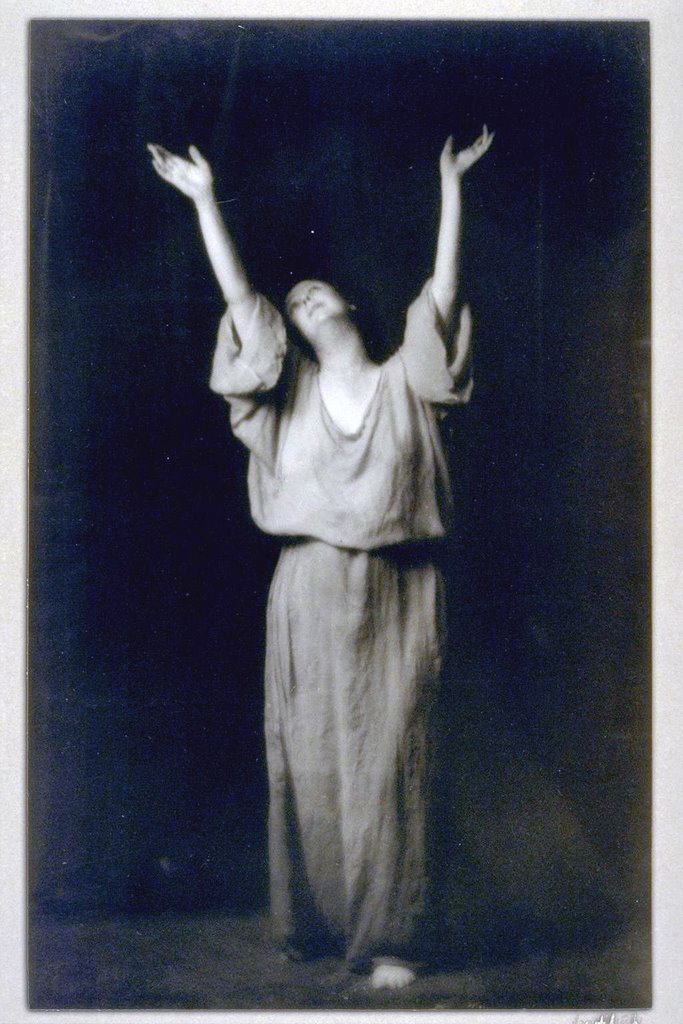
isadora's dance


isadora duncan credited seeing the japanese prints with women in kimono as her inspiration to loosen, to free, her clothing and her dance.

Labels: , ,

love & destruction

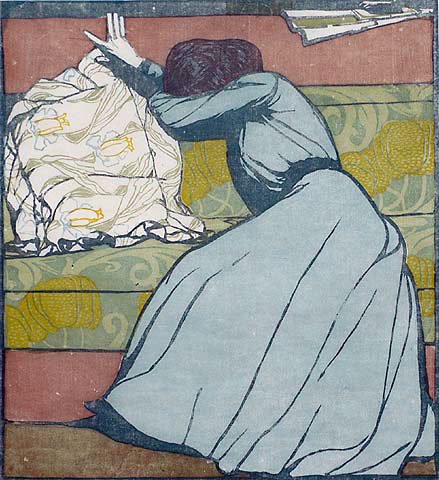
max kurzweil, a founding member of the vienna secession, lived a charmed life, filled with love, sunlight, and the sparkling waves. though he may have been outshone by his fellows (klimt, moser), he was an enthusiastic contributor to the movement's journal ver sacrum (sacred spring), loved teaching as well as being a father.

or so it appeared until he killed himself in 1916 at the age of 49. he made this print of his wife in 1903.


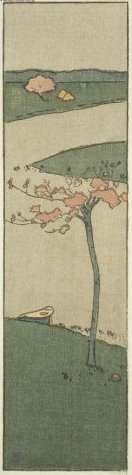
kanae yamamoto was an innovator as well, being a pioneer in the sodaku hanga movement in which unlike the generations before him, the artist himself carried out the whole process of creating the prints, from cutting the wood to doing the printing. he also joined with others in the movement to start their own magazine, hosun (little things).

having come from a modest family, kanae was supporting himself as an illustrator from an early age. while in europe to explore the art movements there, he became aware of the socialist movements gaining strength, and when he returned to japan, he worked tirelessly to bring art education to children and the poor.

having developed the obsession, though, he began to ignore his own artwork. just before he died of a cerebral hemorrhage at 64 he destroyed all of the woodblocks of his works with a hatchet.

(thanks to bibliodyssey for turning me on to kanae.)

Labels: ,

20 October 2006

continental drift

"Because people cannot see the color of words, the tints of words, the secret ghostly motion of words;
"Because they cannot hear the whispering of words, the rustling of the procession of letters, the dream-flutes and dream-drums, which are thinly and weirdly played by words;
"Because they cannot perceive the pouting of words, the frowning and fuming of words, the weeping, the raging and racketing and rioting of words;
"Because they are insensible to the phosphorescing of words, the fragrance of words, the noisomeness of words, the tenderness or hardness, the dryness or juiciness of words, the interchange of values in the gold, the silver, the brass and the copper of words;
"Is that any reason why we should not try to make them hear, to make them see, to make them feel?"

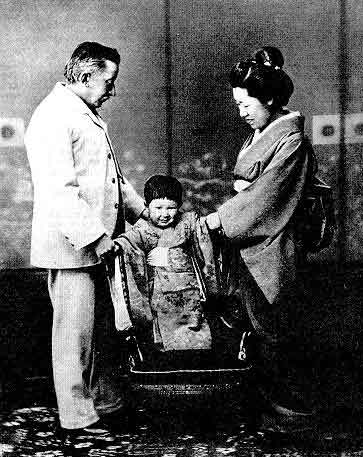
these are the words of lafcadio hearn (pictured here with his family), just one of the westerners, mainly americans, who became intrigued with japan and made it a major part of their lives, thus becoming invaluable conduits for this cultural exchange that was going on.

i want to talk in depth about each of them (and of others i'm sure to find along the way), but i wanted to do a short introduction of each first.

"In the late 19th century Japan was still largely unknown and exotic to the Western world. With the introduction of Japanese aesthetics,
however, particularly at the Paris World's Fair in 1900, the West had an insatiable appetite for exotic Japan, and Hearn became known to the world through the depth, originality, sincerity and charm of his writings. In later years, some critics would accuse Hearn of exoticizing Japan, but as the man who offered the West some of its first glimpses into pre-industrial and Meiji Era Japan, his work still offers valuable insight today." (from wikipedia)

over time, i want to go more fully into the contributions of hearn, as well as those commodore matthew perry, edward morse, ernest fenollosa, ezra pound, bertha lum, helen hyde, arthur wesley dow, and of course, s. bing. it's fascinating to me, how the two cultures became intertwined. but i also don't want to lose track of the questions that keep cropping up: did the westerners "exoticize" japan? was it helpful to the japanese to redefine for them the nature of their own arts?

aggh.... too long a post already.... one step at a time....

blueinall

Labels: ,

19 October 2006

separated at birth?

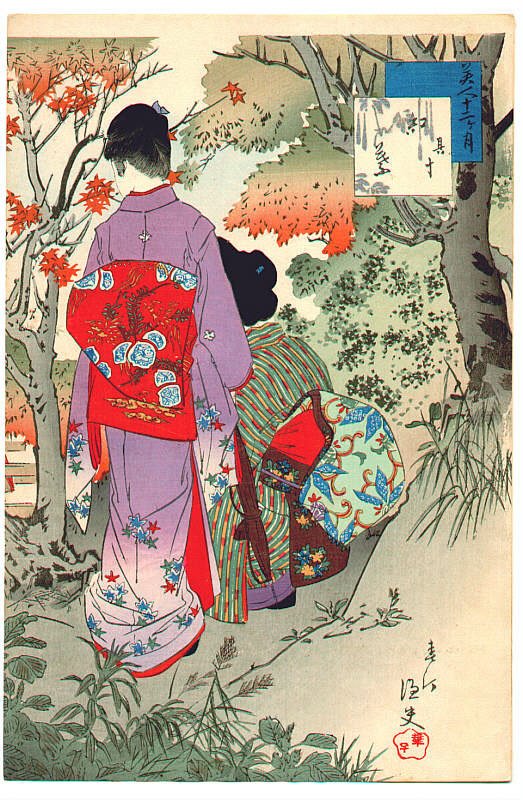
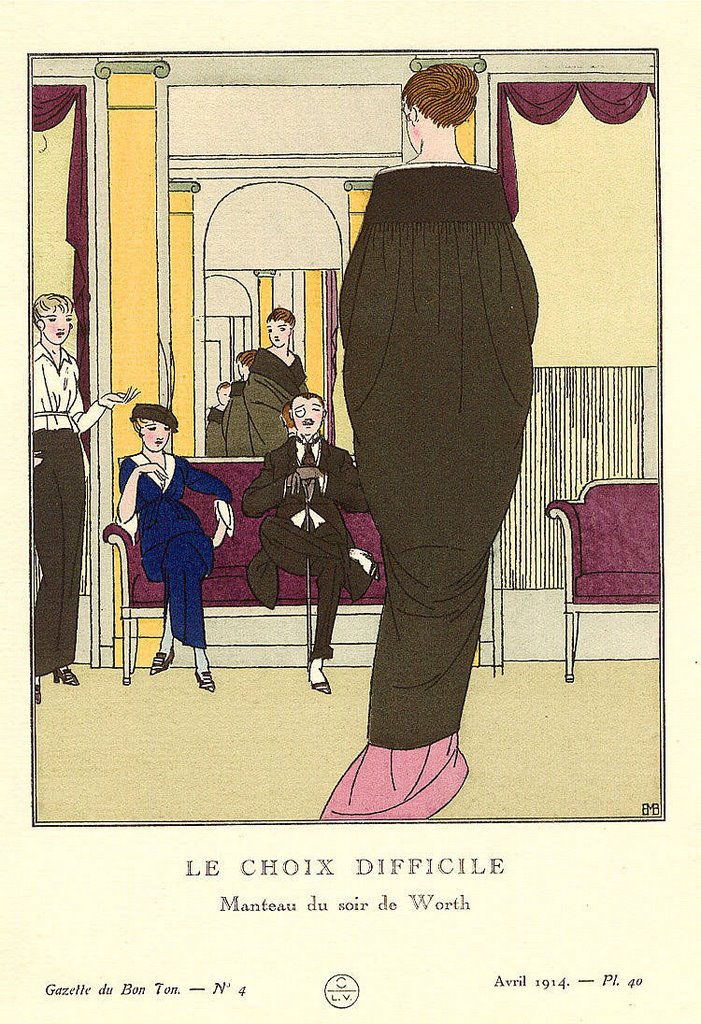
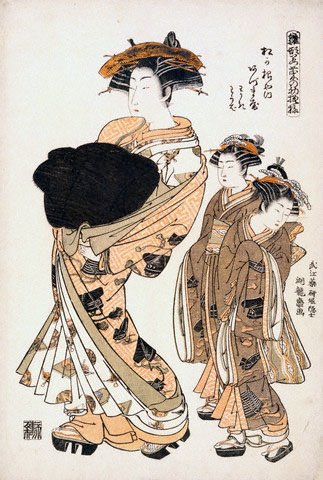
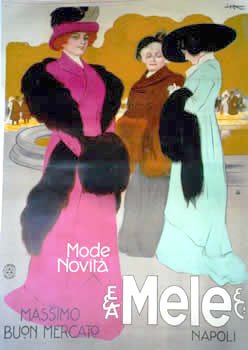
one thing that continues to strike me is how similar the silhouettes of women's clothing during the fin-de-siecle period to the japanese silhouettes of that and previous eras.

if you sort of squint or see them in just thumbnails, it's really hard to tell just which you're seeing, other than, perhaps, the use of pattern on the japanese fabrics.

Labels: , , , , ,

18 October 2006

ginkgo

a gentleman on livejournal asked if anyone knew the significence of ginkgo leaves because they were used quite a lot in art nouveau architecture. his web site features the best of 40 years of taking 2500 photos of these buildings. it's an extraordinary place(s) to visit.

the ginkgo leaf, in japan, can represent love, long life, and health.


(click either of these two smaller images and you will find yourself in the art section of another amazingly comprehensive site: the ginkgo pages! the big one on top is ' Pigeons on Ginkgo Branch' by ohara koson.)

17 October 2006

death and morning glories

unlike the nasturtium, however, morning glories are plentiful in both cultures, though in japan they are very likely to be found in poetry known as death haiku. along with the cicada, and dew in the grass, the morning glory appears as a reminder of both life's beauty and life's brevity.

the moon departs:
frost falls upon the
morning glory.

asagao ya
tsuki no wakare o
hana no hie

kato

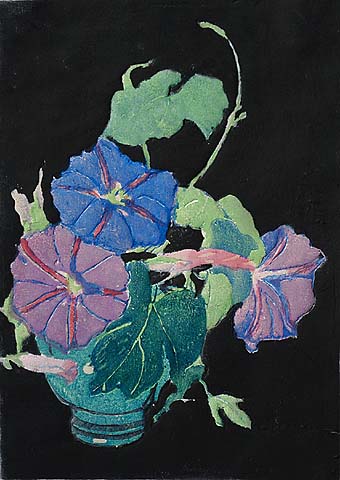
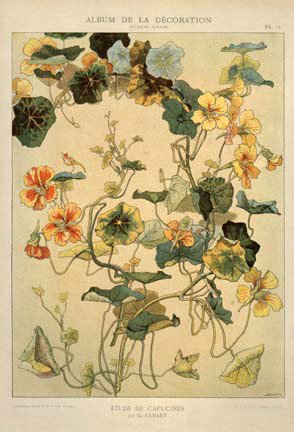
(the first image is by ide gakusui; the second is margaret jordan patterson, third is katei taki, and last is g. lebart.)


Labels: , , , , ,

a curious case

one thing that i have found
interesting and curious


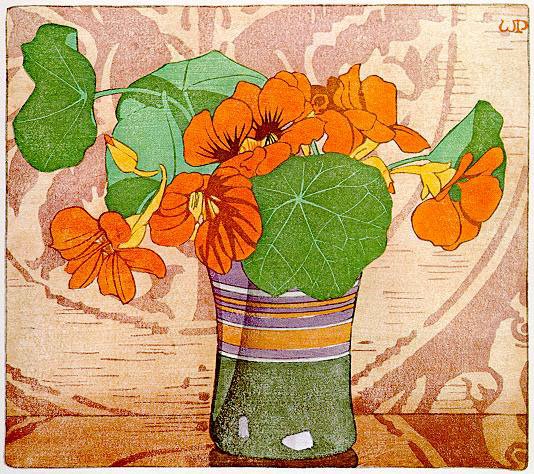
is that while nasturtiums seem to be
fairly ubiquitous in art nouveau,


they don't seem to exist at all in
japan.


this is the only case of this i've found

so far.


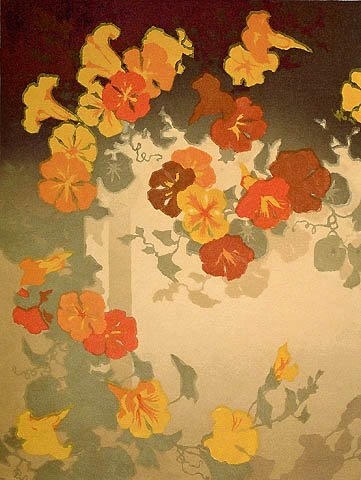
(voysey is the first one, then G. Lebart, then oscar droege, and lastly, walter j. phillips.
i don't know who did the seed packet!)


(added on 1.9.2010: i have no idea what i was talking about! it seems to be saying that here was the only japanese example i could find, but there's no japanese example, and i still can't find one!)

Labels: , , ,

16 October 2006

interrelationships

how interesting. this image, by bairei kono from an 1892 manga, is clearly part of this "set"!

Labels:

15 October 2006

it's rarely a narrative

i realize that i've been somehow trying to make this into a narrative (much as i tend to do with my own life), and, like my life, it just isn't. so this blog now becomes randomized. there's just so much, so much beauty, so much irony, so much of dreadful interest, that to try to make it orderly is to create a deceit. it's complex and complicated and redundant and contradictory, and so it is. when, if, connections appear i'll do my best to notice. feel free, if you notice, to let us know.

in 'international arts and crafts,' by livingstone and parry, a 1898 review from 'house beautiful' is quoted as saying, "the japanese have taught us much, but nothing more clearly perhaps than that beauty does not depend upon intricacy or elaborateness of design and ornamentation."


the article, however, was comparing grueby pottery, seeing it as 'japanesque,' and grueby pottery is simple, as was much pottery coming from japan. it still is.


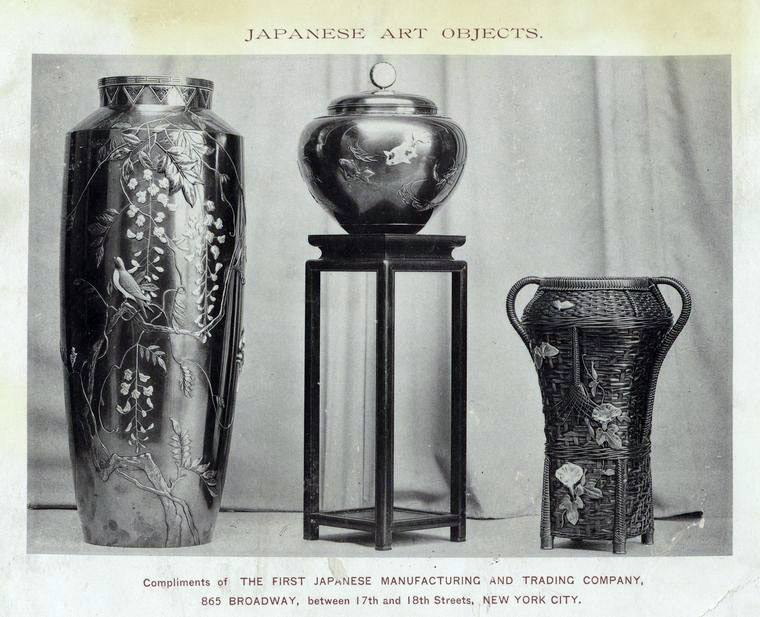
but not all of it was, as you can see.


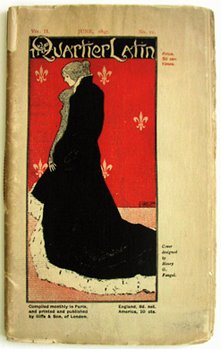
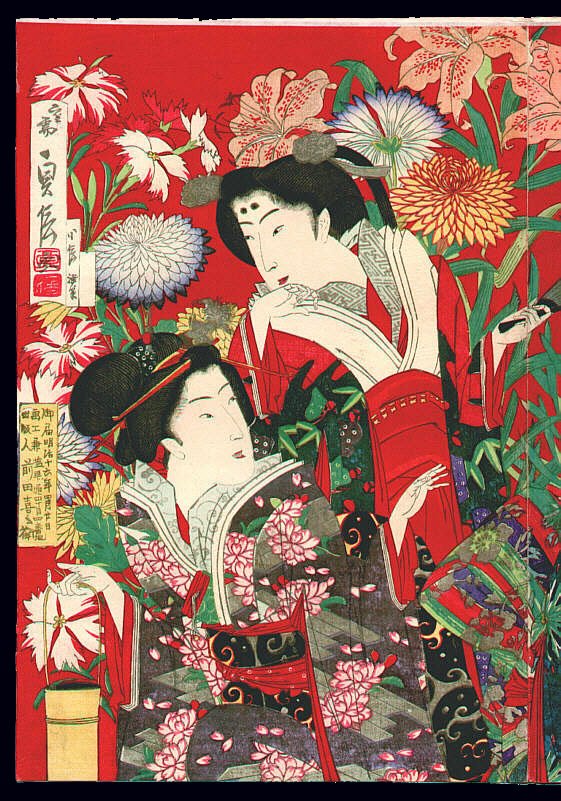
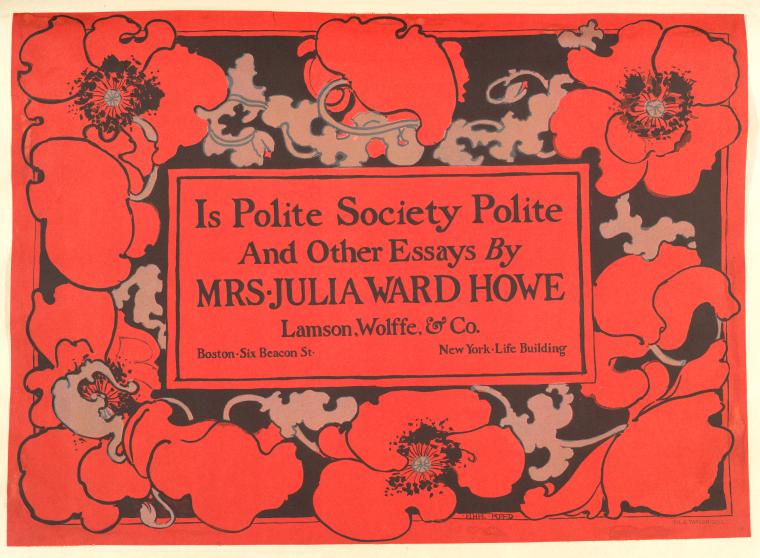
nor were many of the prints any more simple than what was happening in the west, as the japanese print and the american magazine cover from the same time period illustrate.


not to mention that that which was called 'japonesque' was often far from simple.


mystification, again. the west needed something simple--freedom from the clutter of the victorian era, distance from the clamor of the industrial age--and japan was just different enough, just unknown enough, to use to fill that bill.


Emile Galle
"Alla Japonica", 1900

Labels: , , ,

the japonistic aesthete

14 October 2006

ah sunflower, weary of time....

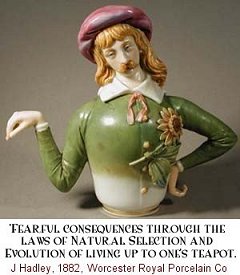
what the poppy became to the art nouveau movement, the sunflower and lily became to the aesthetic movement. and the artist most associated with the flowers was oscar wilde. below he is pictured in one of many cartoons of him from the magazine punch, and as both sides of a teapot as well. (perhaps this illuminates the previous cartoon a bit more fully.)

however, that is where any clarity ends. it gets so wonderfully complicated, lawsuits, people going mad, others being shipped off to america to promote work that is critical of themselves...!

numerous people: wilde, as well as ruskin, whistler (and more to come about them), and many more both considered themselves as 'aesthetes,' standing by the movement's creed of 'art for art's sake,' while at the same exact time savaging other artists for saying that they were doing exactly the same thing.

i'll get this sorted out at some point and do my best to lay it out here, but now i just read,
shake my head, and decide perhaps i need a nap.

a wonderful book for all of this is 'the aesthetic movement' by lionel lambourne, whose most recent book is on japonisme.

and a very interesting website on design which includes and encompasses this era is katsclass.


Labels: , ,

13 October 2006

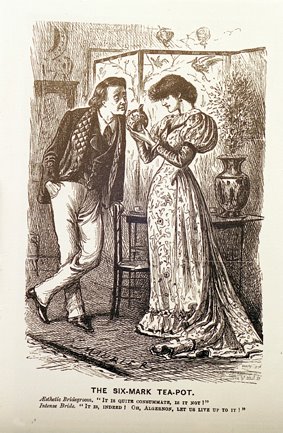
"let us live up to our teapot"

another name for the japonisme movement, along with art nouveau, liberty style, the arts and crafts movement, jugentstil, etc., is the aesthetic movement. while each of these have some elements that can never be confused with one of the others, they all overlap quite a great deal as to who claims what art occurred during their popularity.

but no appellation received more parody, derision, scorn and satire than the aesthetic one. i've already mentioned gilbert and sullivan's "punch version of japonism" -- 'the mikado,' but their 'patience' is a musical poke in the eye of aestheticism.

(aesthetic bridegroom: "it is quite consum- mate, is it not?"
intense bride: "it is, indeed! oh, algernon, let us live up to it!")


while many of it's critics: oscar wilde, george bernard shaw, wb yeats, and others, stood staunchly in favor of the aesthetics' creed, "art for arts sake," they lambasted the masses for being too superficial about it!

to be continued....

Labels: ,

12 October 2006

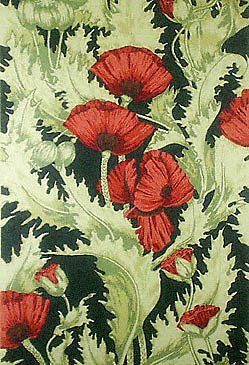
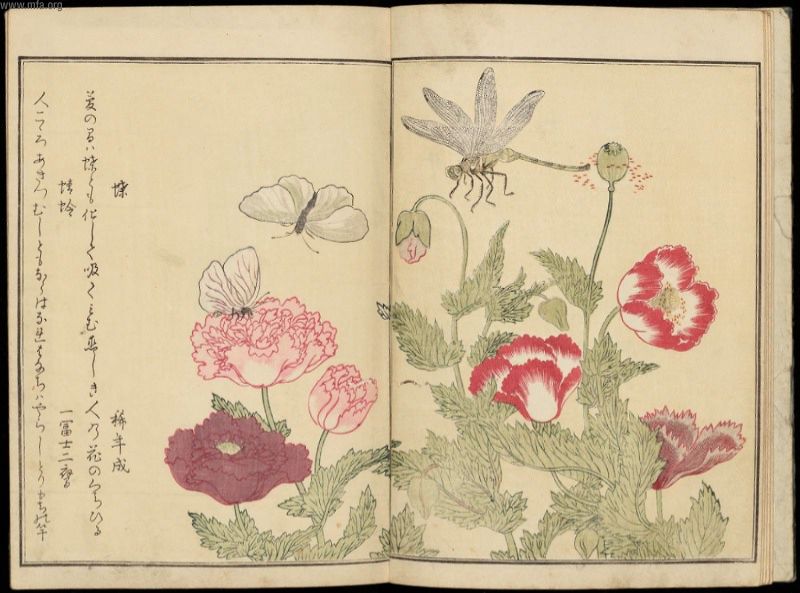
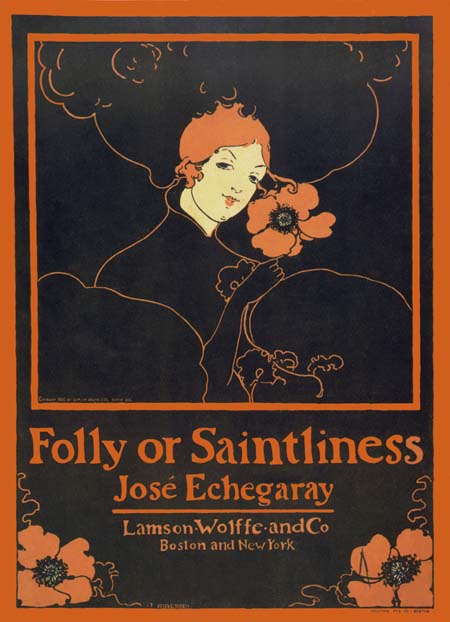
poppies


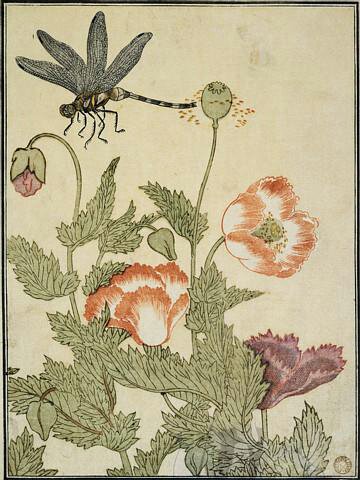
the humble poppy -- from formal, occasional

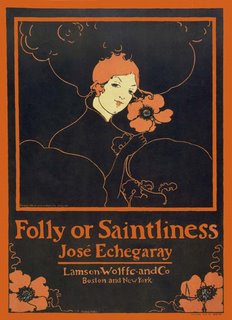
inclusions in paintings of full vases, to becoming fairly emblematic of the entire art nouveau movement.

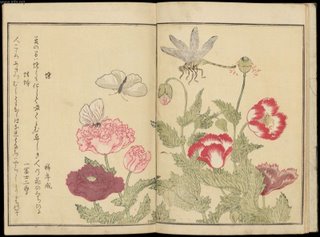
the exuberant prints by utamaro and others arriving from japan were so inspirational that this simple flower became the adornment of the age, on posters, in women's hair (see mucha), as wallpaper, bookjackets, and more.

the more i read about this era, the more i realize that because what the westerners were seeing of the japanese,


in the arts and crafts that were arriving from the east, they thought them simple -- not as in mentally incapable but as in "gentle folk," spiritually elevated, naturally "natural," graceful, and erotic.

lack of contact with the west for numerous generations gave this new influx of japanese goods and information no context, no genuine way to understand, but rather images only; a grand mystification of context was laid upon them. perhaps the joyful way this flower looked when portrayed from a stance of nature's presence rather than nature's dominance was seized upon and set up to be something that the japanese artists
had never imagined.


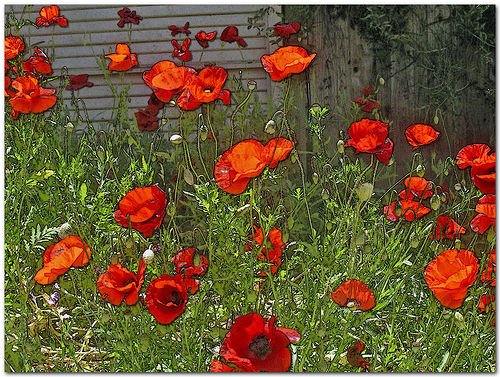
still, because i love the look of these prints i work with many of my photos to make them look something like woodblock prints. the patch of red poppies in the grasses i took in front of the house next door to the health food store in my neighborhood.
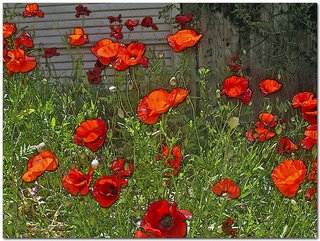

i call these photos "woodblock photos."
Labels: , ,

11 October 2006

the bluebird of happiness

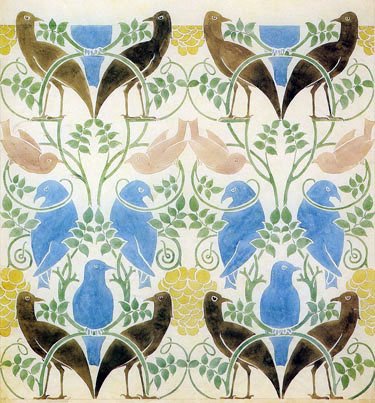
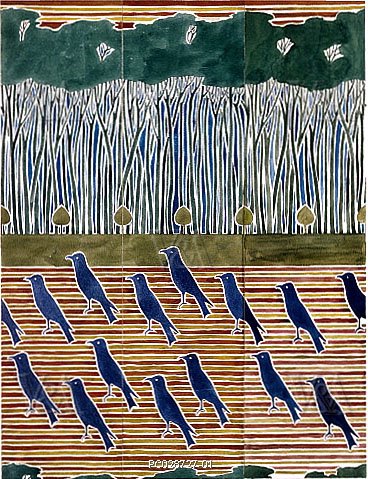
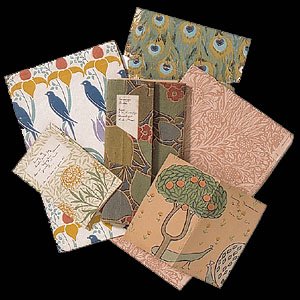
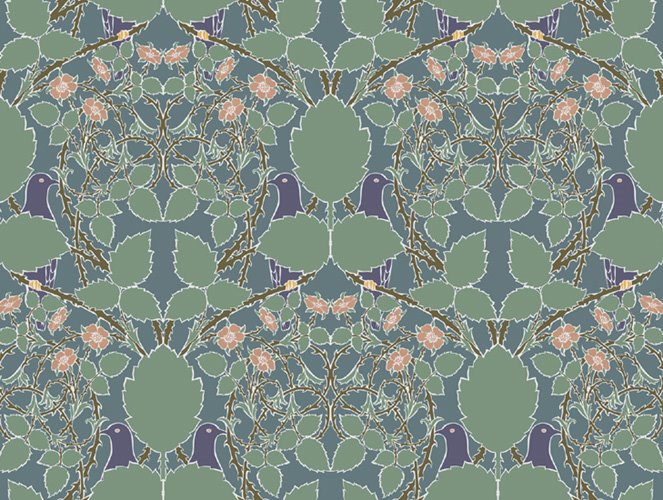
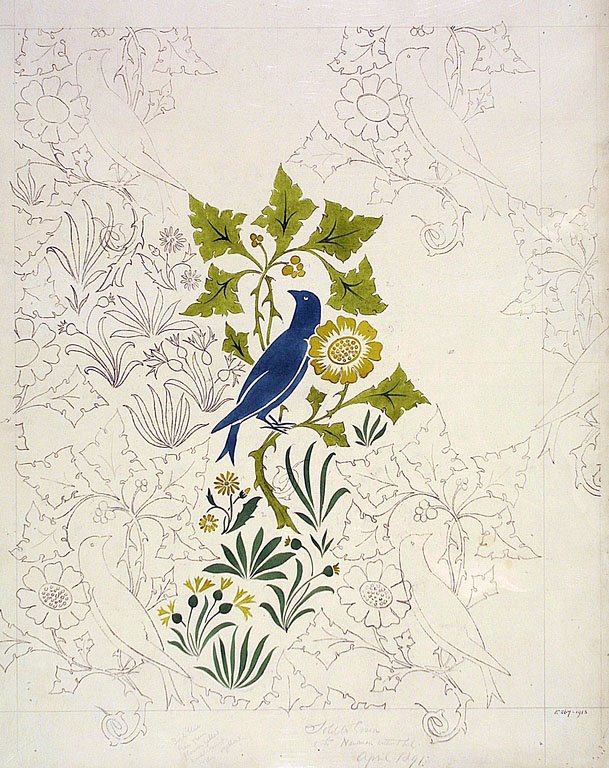
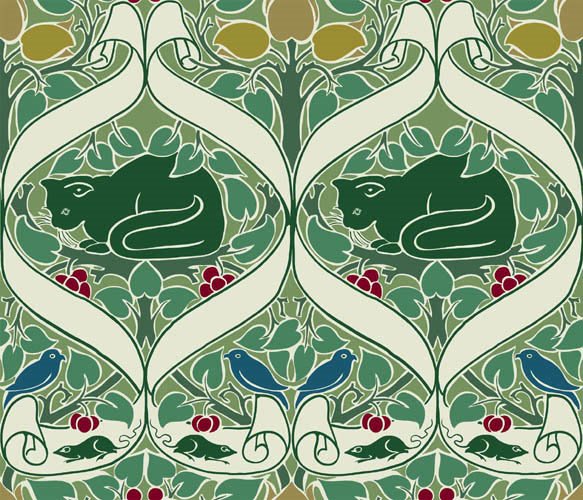
before he became one of great britian's best known architects, cfa voysey designed wallpaper and fabric patterns, many of which featured simply drawn plants and animals -- most frequently birds. most frequently blue ones.

so imagine my surprise when i learned that this one is not by voysey at all but by sugiura hisui, an artist from japan working right around the same time period.

i swear i have seen a voysey even closer to this than the ones i have pictured; i'll let you know if i find it!

but what sweet poetic justice: after being influenced and inspired by the japanese arts (one of his wallpaper designs was called 'tokio,' he was able to return the favor.

Labels: ,

newer posts older posts