japonisme

23 July 2011

the music of wallpaper

while actually reading the text in my copy of 'hidden impressions,' the catalogue for the exhibition of the same name at the MAK in vienna, of instances where the japanese influenced the austrian arts. we'll get back to that catalogue in a future post, but for now, let's follow this little adventure.

i was wildly taken with the two images of japanese endpapers, the cranes on the salmon background and the puppies. sure i had seen a western equivilent, i searched for days to no avail. all of the western endpapers, even those from childrens' books, were, to my eyes anyway, far more rigid by design.

refusing to give up, i started perusing some others of my books. i double-checked the catalogue and all of my other books about design in vienna at that time: nothing. why, i asked myself, and still do, have japanese endpapers in the catalogue with no japonisme version for comparison?

i started on my other books about paper, wallpaper, and had myself an aha moment. i recalled having noticed so many times how actually un-equivalent these matches-up usually are. rarely does a japanese design form get re-interpreted in some into something comparable back and forth. usually, it, like some inherited traits, skips a generation.

but once i found these, not only didn't they surprise me, but they gave me deeper understanding in both sides of the equation. first, we've discussed the lesson that the west learned that caused them to question the validity of any differences between art, decoration, and craft.

no one embraced this concept more strongly than the nabis, for whom there was no less a creative act in creating wallpaper than in painting a painting. much of what we know as paintings are actually bits of a wall-hanging or a screen (see here), but even when the item was a painting itself, it was covered with wallpaper, and, or, the sort of design that hangs in an invisible balance between subject and surround.

in fact, the more one looks at the work of the nabis (here represented by maurice denis, pierre bonnard, and vuillard), the more one sees rhythm, pulse. these pieces do not make a statement, they make a song.

and the songs have continued out in ever widening circles. whistler sued over it; the right to see a surface as something other than flat, the right to name a painting a symphony, a rhapsody, a song.

Labels: , , , , , , , ,

04 October 2008

the travels of inspiration

one of the things morse brought back with him when he returned from japan was a notebook of kimono pattern designs from 1734.

it had been created by Ôoka Shunboku, who "was one of the first artists to expand painting techniques to a broader audience through publishing monochromatic block-printed books, painting manuals, and other handbooks." 1

the designs in this collection were ostensibly created for wood-carving, but they were charming enough that they were chosen for fabric design, metalwork, room-divider screens, and much else.

interestingly, it would appear that this volume's reach, both geographically and chronologically, was certainly broader than he'd likely ever imagined. enter arthur silver and the silver studio.

from photographs we have of his home, we see that
silver collected and displayed treasures from japan.
his company, the silver studio, produced thousands
of designs for everything from textiles
and wallpaper to silver and jewelry.

the silver studio was on retainer to arthur lazenby liberty's department store, liberty. they provided many of the items they produced to liberty's solely. both men were instrumental in introducing japanese goods, and styles, to the growing middle class. liberty was to england as bing was to france.
we know this book was brought to the west early in the days of japan's trade with the west. is it such a reach that a collector such as silver might have gotten his hands on a copy?

of course, since it was one of the first multi-copy publications coming out of japan, it's also possible that that many others saw it as well. seemingly inspired textile designs came out of northern england, france, and the wiener werkstatte as well.


fortunately, you don't have to take my word for it:

Japan and British Art Nouveau, 1880-1900

July 2009 - Feb 2010, Middlesex

An exhibition exploring the influence of Japanese motifs and techniques on British Art Nouveau, with particular reference to the design output of the Silver Studio. The West London-based Silver Studio was founded by Arthur Silver, who during the 1880s and 90s was heavily interested in and influenced by the art of Japan. The exhibition will feature many Japanese and Japanese-inspired objects from the Silver Studios collection, and explore ideas around cross-fertilisation and the way in which design influences were shared between two very different cultures. 2

Labels: , , , , , , , , , , ,

03 May 2007

safety glass

these are kageyama, the stencils with which kimono fabric is made.


this is kimono fabric.


edouard benedictus was a designer of fabric and wallpaper patterns.

his rug designs are of my favorites. here are some. and here is where to get in touch with the arts and crafts home, which grows more comprehensive all the time, with biographies of the artists/craftspeople of the period, and and increasingly wide selection of examples.

he also coordinates a service wherein rugs of distant eras can be woven anew for you. god i wish i was rich.

so why, you might ask, is this post entitled 'safety glass'? In 1903, a French chemist called Edouard Benedictus dropped a glass flask on the floor of his laboratory. The flask shattered but, to Benedictus's surprise, the glass did not fly apart. Rather, the shards and splinters stayed together in the shape of the original flask. The flask had contained a solution of cellulose nitrate. A thin film of this chemical had been left behind in the flask and formed a lining. This lining was strong enough to hold the glass together when it broke. Benedictus kept and labelled the interesting flask. He thought little more of it until a few weeks later, when he read of two accidents in which motorists had crashed and been seriously injured by flying glass. (more)

yup. same guy.

Labels: , ,

06 December 2006

change & exchange

No great artist ever sees things as they really are. If he did, he would cease to be an artist. Take an example from our own day. I know that you are fond of Japanese things. Now, do you really imagine that the Japanese people, as they are presented to us in art, have any existence? If you do, you have never understood Japanese art at all. The Japanese people are the deliberate self-conscious creation of certain individual artists. If you set a picture by Hokusai, or Hokkei, or any of the great native painters, beside a real Japanese gentleman or lady, you will see that there is not the slightest resemblance between them. The actual people who live in Japan are not unlike the general run of English people; that is to say, they are extremely commonplace, and have nothing curious or extraordinary about them.

In fact the whole of Japan is a pure invention. There is no such country, there are no such people. One of our most charming painters [whistler] went recently to the Land of the Chrysanthemum in the foolish hope of seeing the Japanese. All he saw, all he had the chance of painting, were a few lanterns and some fans. He was quite unable to discover the inhabitants, as his delightful exhibition at Messrs. Dowdeswell's Gallery showed only too well. He did not know that the Japanese people are, as I have said, simply a mode of style, an exquisite fancy of art. And so, if you desire to see a Japanese effect, you will not behave like a tourist and go to Tokio. On the contrary, you will stay at home and steep yourself in the work of certain Japanese artists, and then, when you have absorbed the spirit of their style, and caught their imaginative manner of vision, you will go some afternoon and sit in the Park or stroll down Piccadilly, and if you cannot see an absolutely Japanese effect there, you will not see it anywhere.
Oscar Wilde (1882)

Japan is more than just fancy but Wilde's senti- ments capture the mystique that surrounds the subject. When Americans first learned about Japan in the mid-19th century, it must have seemed a very peculiar place indeed. Nearly everything about the Japanese culture and lifestyle was a novelty and a complete enigma. Travelers to Japan, both then and now, attempted to discover the things which made Japan tick. Edward Said wrote in his book Orientalism that westerners have perceived the Orient through generations of enduring stereotype and even today there is an abundant literature by supposed experts on how to understand Japan and its people.*
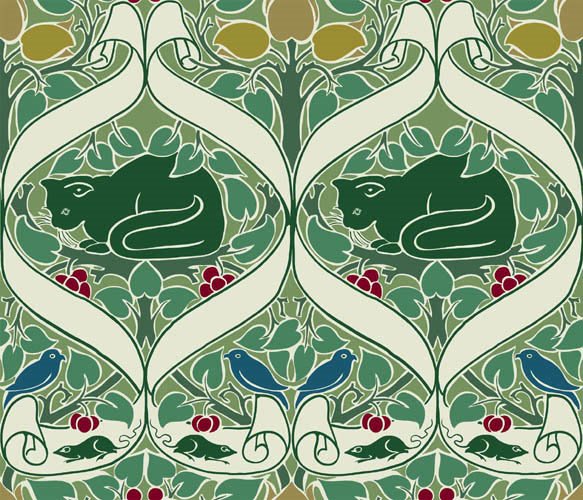
"I feel an irresistible desire to wander, and go to Japan, where I will pass my youth, sitting under an almond tree, drinking almond tea out of a blue cup, and looking at a landscape without perspective" - Oscar Wilde (1882)

another tricky thing is.... even the "experts" nowadays can't tell, apparently, what the japanese made for themselves, and what they made strictly for expert. not just in prints, but in crafts as well, much of what we see in the aesthetic movement are reflections of japanese crafts that were designed specifically, and exclusively, for western markets.


we are fortunate, if we like this stuff. companies such as bradbury & bradbury have made many original wallpapers available again, beautifully. other companies as well are

reproducing papers, fabrics, furniture, and then, of course, there are the antiques. much is accessible through arts & crafts home.

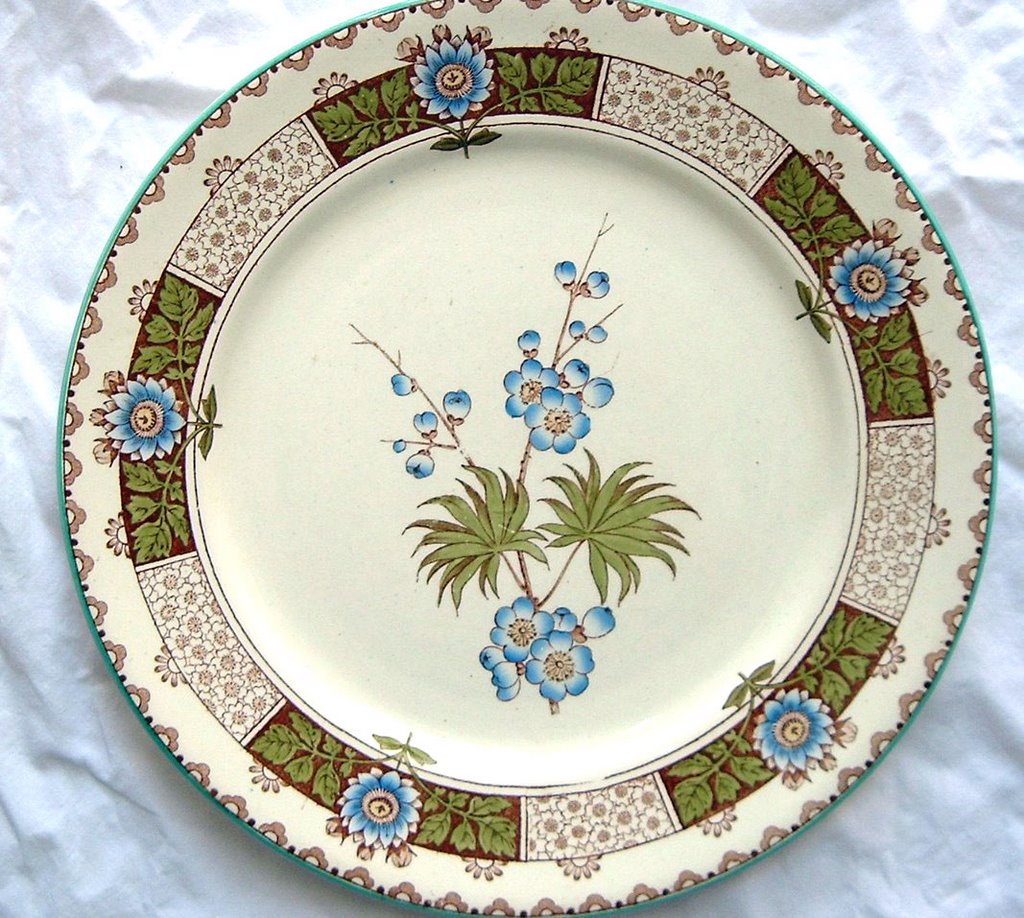
the upper right image is a godwin upholstery design for liberty & co., below it is a b & b wallpaper sample; the plates examples are wedgewood. even the most sophisticated of travellers still found it difficult to remember that china and japan were quite distinct nations. therefore, you saw "chinoiserie" china patterns named mikado.

Labels: , , , , ,

11 October 2006

the bluebird of happiness

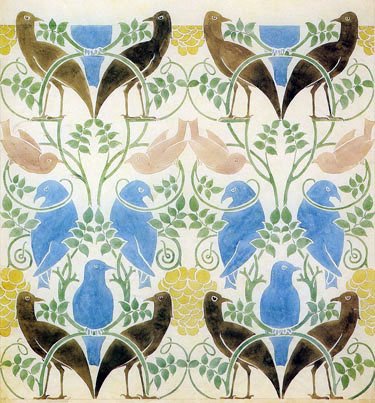
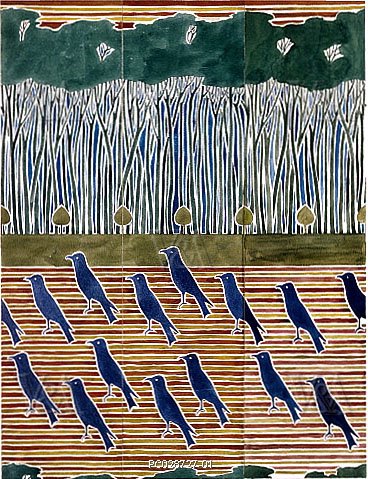
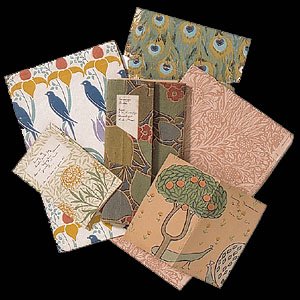
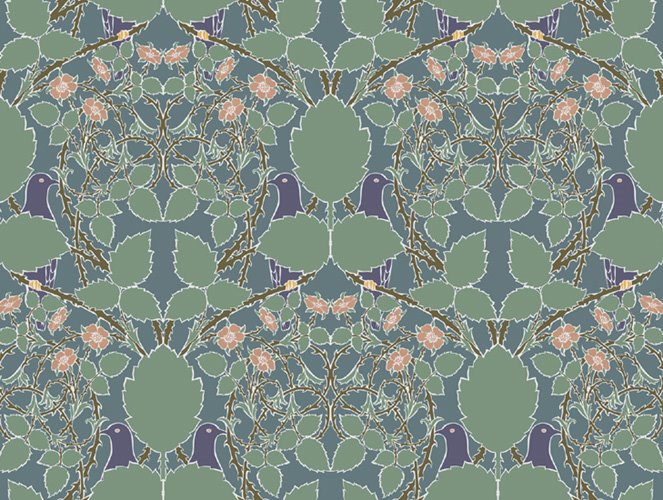
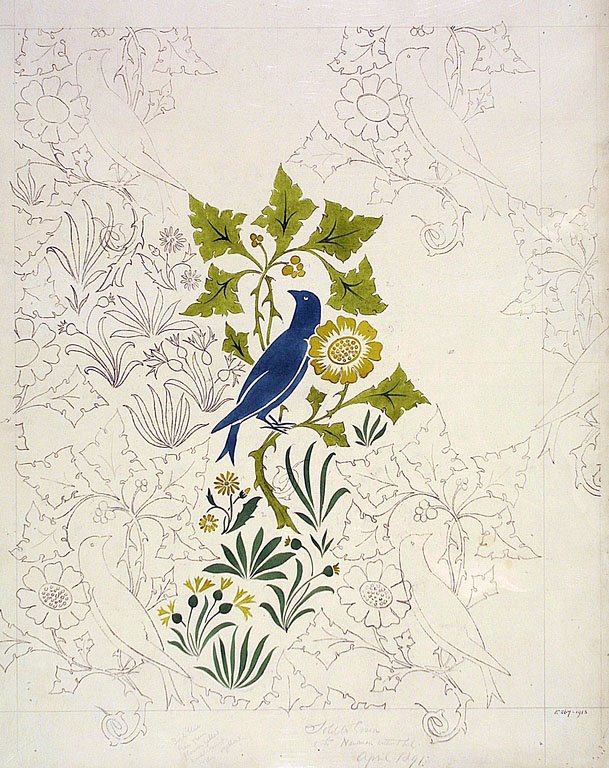
before he became one of great britian's best known architects, cfa voysey designed wallpaper and fabric patterns, many of which featured simply drawn plants and animals -- most frequently birds. most frequently blue ones.

so imagine my surprise when i learned that this one is not by voysey at all but by sugiura hisui, an artist from japan working right around the same time period.

i swear i have seen a voysey even closer to this than the ones i have pictured; i'll let you know if i find it!

but what sweet poetic justice: after being influenced and inspired by the japanese arts (one of his wallpaper designs was called 'tokio,' he was able to return the favor.

Labels: ,

older posts