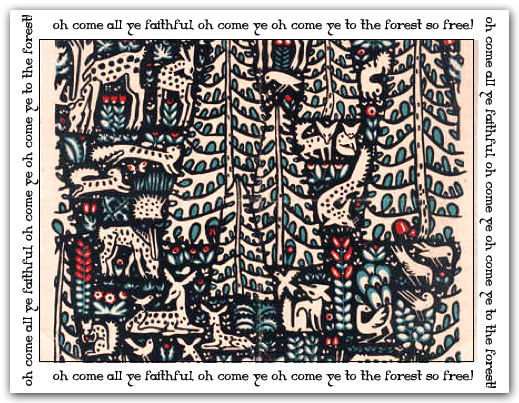
light years and light years

Labels: carl otto czeschka
posted by lotusgreen at 2:24 PM
5 comments



 VOICES OF TWO BELLS


 NONE BROKE THE SILENCE...
Labels: buson, edmund dulac, edward steichen, elizabeth shippen-green, gertrude kasebier, haiku, manuel robbe, peter henry emerson, ryota
posted by lotusgreen at 3:27 PM
2 comments
 Roses in December, for you.
 If you'd like the spring in the fall,
 Blue shadows never, sunshine forever,
 "God gave us memory so that we might have roses in December"
 .山吹に大宮人の薄着哉
 .古郷やよるも障るも茨の花
 In a pre- script to this haiku Issa reports that he entered his home village on the morning of Fifth Month, 19th day, 1810. First, he paid his respects at his father's gravesite, and then he met with the village headman.
  While the content of their meeting is not revealed, it plainly had to do with the matter of the poet's inheritance that his stepmother and half brother had withheld from him for years.
 See Issa zenshû (Nagano: Shinano Mainichi Shimbunsha, 1976-79) 3.61; 1.424. Shinji Ogawa assisted with the above translation. 2
Labels: georges barbier, haiku, michel dufet, ohara koson, paul poiret, toshi yoshida, vera lynn
posted by lotusgreen at 2:52 PM
2 comments
 we have looked at roses before, mackintosh, hunter, but the 20s saw some strange new develop- ments in the portrayal of flowers. they went all crazy, all wiggley, and more abstracted than ever! trace the change to mackintosh, to poiret (both of whom had stylistic ties to vienna), or the new guys, ruhlmann, brandt, or dufet? why did this happen??!!
 Rose is a rose is a rose is a rose

 A rose tree may be a rose tree may be a rosy rose tree if watered.
 JULIET:
 What's in a name? that which we call a rose
 Ruth visits her mother’s grave in
 Dorothy, Wife and Atheist;
 Ruth brings batches of
 she drifts instead to the roses,
Labels: charles rennie mackintosh, edgar brandt, edna boies hopkins, gertrude stein, margaret preston, michel dufet, paul poiret, poetry, ruhlmann, shakespeare, Suzanne Guiguichon, tony hoagland
posted by lotusgreen at 9:55 PM
0 comments
 we've looked at magazines here several times, but rarely looked into. often the people we've seen on the covers wear japanese clothes, or carry parasols, or lean against a painted screen. these all feature all japanese people. why are they on these particular covers? and what being talked about inside. i can answer a bit of that, here and there....
 truth is, there's more i don't know, or even understand, than i do. i'll just set out some stuff i found. the magazine success (below) is summed up by the magazine reviewer in the craftsman. "Success contains many good things, chief of which is Hosmer Whitfield's 'Why Japan Must Win.' There is a graphic picture of the Mikado and his influence, showing him to be an enlightened and progressive monarch, in the very front rank of the world's rulers. 2
 also in that issue one would find this quote from, in a piece about child labor. "Juliet Wilbor Tomkins writes, 'A great deal has been said about the immorality resulting from factory life. Perhaps there has been more or less exaggeration on this point, or, rather, a failure to make honest comparison with the morality of these same people when not employed in factories. Yet there is no denying that the indiscriminate herding of men and girls does not prompt modesty and virtue. I know a ramshackle old building in New York in which the top floor is used by a manufacturer of electrical shoes. On the floor beneath is a laundry, separated from the street by three long flights of stairs, which are utterly dark except for the gas jets insisted on by the authorities.
 At half-past five, every afternoon, the shoe men come trooping down just as the laundry girls are let out. tired with the hardest kind of work, and flushed and warm with the long day in a steaming, enervating atmosphere. And night after night the gas jets are mysteriously put out, so that all flock down together in pitch blackness. When you are tempted to believe that the evils of child labor are exaggerated, think what they are to a girl when she is too young to protect or even to understand herself. Terrible things have been begun on those stairs, yes, and happened there: and they are not the only dark flights of stairs in the New York factories. No one knows who turns the lights out: it may be, — heaven help them! — the girls themselves.
 The managers could easily find a way to prevent it, and they give glib promises; but they do not really care. It is the public at large that has to care, to demand better protection for its children. I have seen other conditions so wrong and so openly offensive to decency that they could scarcely be believed; and they persisted until an inspector, in righteous rage, stood on the spot while reform was inaugurated. Filth, with not even a pretense of privacy.— how long can immature modesty stand that unharmed?'" 3
 wondering about the illustration on the cover: does that cover both subjects, or just the one on japan? is this a father teaching a child -- to work? to know? or is child labor slightly different when you're talking about asians? what about these other covers? why was an asian woman chosen for an easter issue? (eastern issue?) we see two covers with japanese women with children on their backs, at a time when i'm sure that was never even imagined here. we then have women working, and playing; at least readers were given images that passed docility.
 a description of the issue of fortune reads: "July 1933 complete issue of Fortune magazine, profusely illustrated in color and black and white, 124 pages, 14 x 11 1/2 inches, color pictorial paper wrappers as issued. Light soiling to cover (including spot at lower left) otherwise very good condition. Interesting articles include: "The Reign of Meiji ...forty-five amazing years during which Japan jumped out of the feudal age into the industrial present"; article on silver with double page decorative color map by C. H. Appleton "Silver World Production and Consumption." The article on the Owens-Illinois company includes a black and white diagram by Richard Edes Harrison showing the bottle making process. The color cover illustration of a Japanese weaver is by Bertha Lum, whose Japanese woodblock prints are most sought after." 4
 i'm left with the predictable it was the best of times, it was the worst of times. like all times. seeing those things that haven't changed is balanced by learning of some things that have. and i'll repeat: i can understand the contents, meanings, contexts, and nuances, to the same degree as understanding literature in translation. not that that stops me from reading them.
Labels: bertha lum, illustration, magazines, sarah s stilwell
posted by lotusgreen at 7:24 PM
2 comments
 schjeldahl's way with a word every bit equals matisse's with a brush. one ogles, awed. as i amble through his 2005 review of hilary spurling's “Matisse the Master: The Conquest of Colour 1909-1954” in the new yorker, maybe you'll agree.
 "[His] art, whose glory was maintained and renewed in many phases until the artist’s death, in 1954: preternatural color, yielding line, boldness and subtlety, incessant surprise. Anyone who doesn’t love it must have a low opinion of joy. "
 "this book completes the job of giving us a living individual, as familiar as someone we have long known, who regularly touched the spiritual core of Western modernity with a paintbrush.... I don’t think it is possible to be more intelligent in any pursuit, or more serious and original, and with such suddenness, than Matisse was when he represented a reaching arm in “Dance I” (1909), or the goldfish that he painted as slivers of redness in a series of still-lifes in 1912. How can intellectual potency be claimed for an artist whose specialty, by his own declared ambition, was easeful visual bliss?"
 "His immense notoriety, which had been confirmed in 1905-06 by “Le Bonheur de Vivre,” a fractured fantasia that seemed to trash every possible norm of pictorial order and painterly finesse, was regularly exciting near-riots of derision in the public. (“My Arcadia,” Matisse called the picture, which established his career’s dizzying keynote: calm intensity or, perhaps, intense calm.) His huge-hipped, sinuous “Blue Nude,” of 1907, discomfited even Picasso, who complained, “If he wants to make a woman, let him make a woman. If he wants to make a design, let him make a design. This is between the two.”
 "Matisse told his students, One must always search for the desire of the line, where it wishes to enter, where to die away.... Colors enter the world through Matisse like harmonies through Mozart. Gertrude Stein (unlike her sister-in-law Sarah Stein, Matisse’s first major collector) enjoyed ridiculing him, reporting with satisfaction, Spurling says, that her French cook served M. Matisse fried eggs for dinner instead of an omelette because, as a Frenchman, he would understand that it showed less respect."
 "[Matisse] shielded his art from politics under all circumstances—he created the reverberant domestic idyll “The Piano Lesson” (my favorite twentieth-century painting) in the summer of 1916, while death swaggered at Verdun. But there seems to be no gainsaying his at least passive solidarity with the Resistance."
 "Among Matisse’s students was Olga Meerson, a Russian Jew who had studied with Wassily Kandinsky in Munich and, already possessed of an elegant style,... Spurling writes, She personified the pride, courage and resilience that he responded to all his life at the deepest instinctual level in his female models. She also epitomized a period type of 'self-reliant single girl,' an obsessive subject for Matisse in those years, which Spurling locates between the earlier heroines of Henry James and the later solitaries of Jean Rhys. Matisse’s 1911 portrait of Meerson shows a primly dressed and posed, tremblingly sensitive woman slashed with two fierce black arcs—plunging from neck to thigh, and from armpit to buttock,” which resist any explanation aside from their sheerly formal éclat."
 "The Nice odalisques, who loll on chairs or chaises amid flowers, fruits, and sumptuous fabrics. Indubitably erotic, the pictures diffuse arousal. Their sensuality never fixates on a breast or a thigh but dilates to every square inch of canvas. Such is the character of Matisse’s formal radicalism, early and late: distributed energy, suspended gesture, deferred climax. Might the tension have been so precious to him, as the engine of what gave his life meaning, that its only end could be exhaustion? It may count that, according to Matisse, he never ate even the fresh food that he used for still-lifes—including oysters, from a restaurant in Nice, that were returned in time for the lunch crowd." I
 both evan in his comments and thomas in his discussion of brunellleschi suggest various bits of evidence of the japanese influence's journey taking the next steps to modernism -- saying more and more with less and less. cubism (a name allegedly coined by matisse), art deco, bauhaus: simplify, simplify, simplify. in matisse's work we see his plunge into shape, and color, and even abstraction.
Labels: hilary spurling, matisse, Peter Schjeldahl
posted by lotusgreen at 5:07 PM
4 comments