japonisme

27 October 2006

dow unto others....

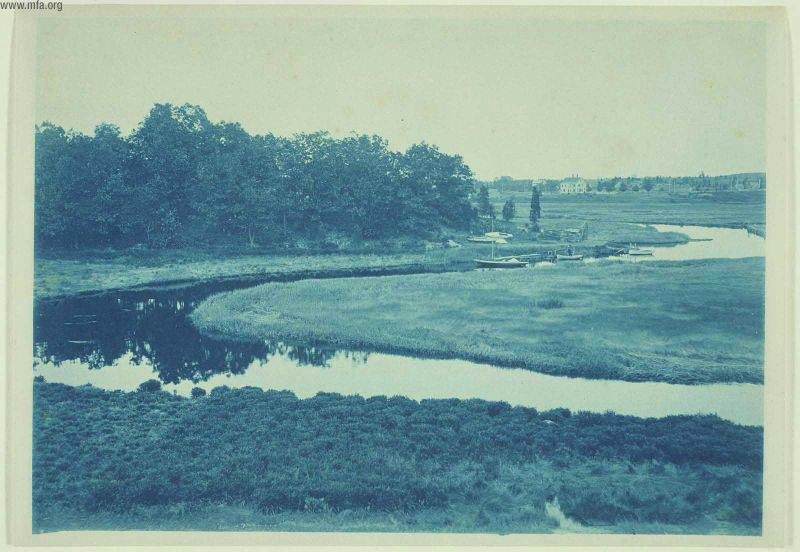
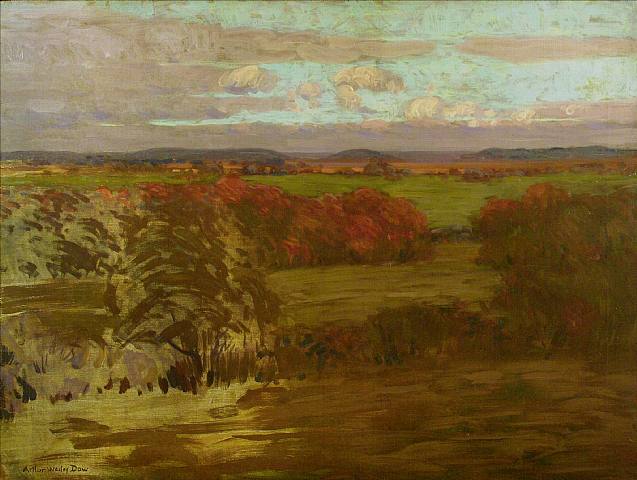
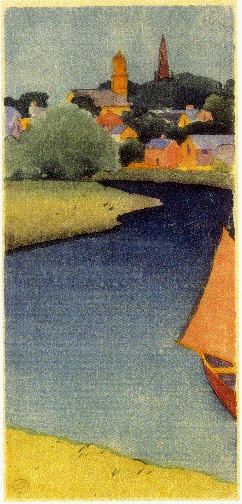
arthur wesley dow grew up in ipswich, massachusetts, which he ended up memorializing in woodblock prints and paintings.
having gone to paris to continue his art education, and to learn from other painters, dow eventually returned to ipswich somewhat disillusioned. though he had learned something about 'plein air' painting (the essential underpinning of impressionism), he felt dissatisfied.

in france, however, like everyone else at that turn of the century, became aware of the arts and
crafts of japan. when he

returned he continued, and intensified, his interest--so much so in fact that he was made assistant to ernest fenollosa in the asian art department of the mfa boston.


this study, and a long trip to japan revolu- tionized how dow thought about art, design, media.... and not only did it revolutionize his own work, but those of subsequent generations as dow began to teach, and his students began to teach, and so on.

follow- ing precepts he had gath- ered from long study of japanese art, asian concepts of space, balance, clarity, and simplicity became known as what he did, and what he taught.

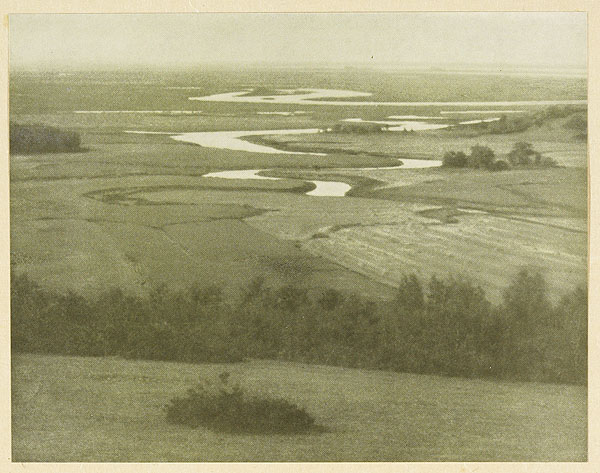
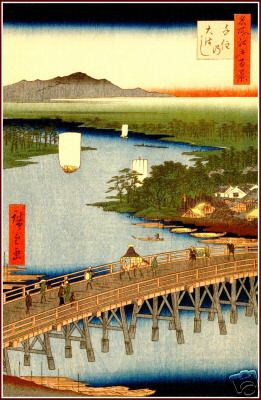
(left: arthur wesley dow, lilies, and 'the bend';
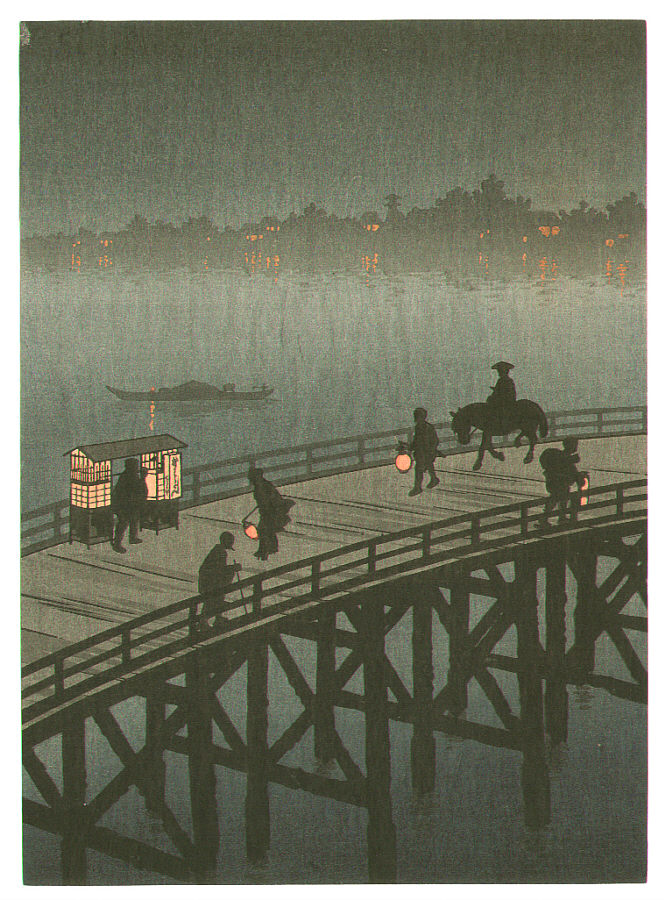
right: 'bridge
at senju' by utagawa hiroshige,
'lily garden' by shoun yamamoto)


blueinall

Labels: , ,

01 April 2012

don't believe a thing i say!

okay, april fools and all that, but i'm not completely kidding (and since i didn't finish this yesterday, it might not count anyway). sometimes in the mythologies i try to untangle for you i get some things seriously wrong for one main reason: i forget to check the dates. in fact i wouldn't be sur- prised if i haven't attributed some things to some artists that happened long before, or long after, they died. i hope you know what i mean!

let us begin with, for example, gustave courbet who died at age 58, in 1877. he was born in 1819. obviously. see his example above right? very natural clouds. no outlines. (they really tend to not have any outlines; i have been checking.) and then we have hokusai: all outlines, nothing realistic about them. while he was born in 1760, he was producing artwork until his death in 1849. quite an overlap in lives, these two. the moment of japonisme would have passed hokusai by completely, while all of courbet's training and experience, and the way he saw, were set by the time of the invasion.

now to put these generational questions into some context, may i mention that hiroshige lived from 1797 to 1858 (getting closer to courbet, aren't we?) and monet lived from 1840 to 1926. monet, the impressionists, were the first artists to imbibe from the teacup of the japanese, but the next gener- ation made things extremely interesting. there were the cowboy painters, painers of the mesas of utah and arizona, dixon, cassidy, and borg: realistic clouds with outlines.

they were the next generation; they, these brilliant western painters, were of the same generation as some of the artists we have gotten to know well over the years: henri riviere, pierre bonnard, frances gearhart, and, only slightly younger, hiroshi yoshida. yoshida did not even begin to make prints (he had been a western-style painter, as they were called then) until he was in his 40s -- one year before arthur wesley dow died!

what this boils down to is that any illustration i have given you of influences yoshida may have had on dow are completely erroneous! arthur wesley dow's birth (1857 - 1922) occurred one year before hiroshige died! dow was more a contemporary of monet than the many proponents of japonisme with whom i have linked him; dow was, as was monet, the first wave -- the primogenitor of influences of japonisme, and not any part of the gang.

henri riviere, pierre bonnard, carl oscar borg, maynard dixon, and hiroshi yoshida all died within four years of my birth. these donors of legacy are no further in the past than is world war II. these artists are of the generation of my grandparents, or great-grandparents. in other words, we still swim in their stream. there was no flood diverting it.

so with regard to clouds (and we have discussed them before; just click on the 'clouds' tag to see the other discussions), we now have a much clearer line of inheritance: it is obvious that the japanese gave us outlines and we gave them perspective. they gave us simplicity and we gave them the multi-pigmented shades of color of which the world is built.

see here the same cloud, albeit different times of day, as offered by frances gearhart and hiroshi yoshida. many similarities. yoshida's work presents far more subtleties than does hokusai's, and gearhart's far more outlining and simplifying than courbet's. but who learned from whom? do they more accurately owe each other a debt as do artists working at the same time? i think they do.

Labels: , , , , , , , ,

12 November 2006

the coburn and the dow

it's difficult for our eyes to even see it now, but the transition in art from depicting the literal to depicting the subjective was wildly revolutionary (as we've already seen). and this goes for photography as well as painting. for many years after their introductions both painting and photography were 'required' to reflect reality 'accurately.' at least that was true in the west.

in japan, it was different. it was just understood that the reality the artist produced was what he made of it. when arthur wesley dow suddenly realized this, supposedly while reading a book on japanese prints at the fine arts museum library in boston, it changed his work forever. he felt that this is what he had been looking for, what his work had been needing. dow realized that he did not want to be copying the prints, something he came to criticize whistler for doing, but rather creating his own style using the principles he had learned from viewing the japanese work.

it is our loss that dow spent far more time teaching, from his school in ipswitch to columbia, to the pratt institute in new york, with many stops in-between, than he did making art, and yet he bequeathed us the wonders of the work of his students.
one student, alvin langdon coburn, wasn't a true beginner when he came to ipswitch in 1903. (he would go


on to begin to photograph many of the 'men of mark' in europe the following year). he and dow became more than strictly student and teacher, as they twice went to the grand canyon together to shoot photographs, or paint.

coburn said of dow's ipswich school, "we were taught painting, pottery, and woodblock printing, and i also used my camera, for dow had the vision, even at that time, to recognize the possibilities of photography as a medium of personal artistic expression. i learned many things at his school, not least an appreciation of what the orient has to offer us in terms of simplicity and directness of composition....i think that all of my work has been influenced to a large extent and beneficially by the oriental background, and i am deeply grateful to arthur dow for this early introduction to its mysteries." the world was learning this from the japanese artists who, until being 'taught' otherwise by the westerners they were so enthusiastically trying to emulate, did not make a distinction between 'crafts' and 'art.' in europe the nabis embraced this philosophy (more on this later); additionally part of this was establishing photography's place as a fine art as well.

many thanks to pinholeman for turning me on to coburn!!

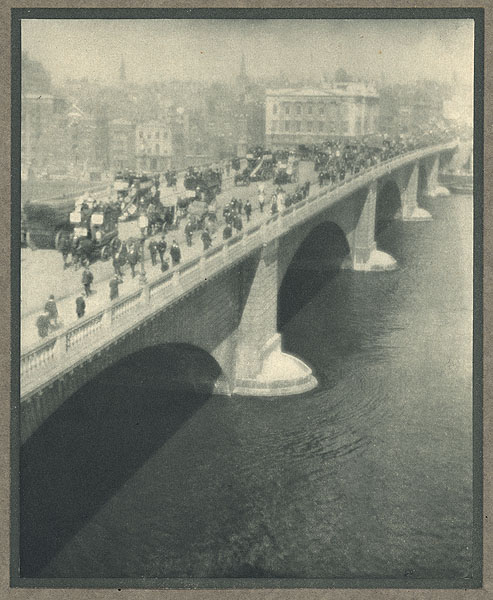
picture info: top right: 'salt marsh' dow; top left: 'moon over cherry trees' hiroshige. 2r: 'the blue dragon' dow's painting of the scene out his studio door; 2l: 'the dragon' coburn's photo of the same spot. (here i've stuck in dow's 'ipswitch meadows' because it struck me that this was essentially the same painting as his 'grand canyon'!) 3r: 'grand canyon' dow; 3l: 'grand canyon' coburn. 4l: 'oh-hashi bridge' koho shoda; 4r: 'london bridge' coburn.
blueinall

Labels: , , , , ,

02 February 2009

painting the boats: dow 1

Colour variation has always fascinated me. There is a peculiar pleasure in seeing the same design appear in different colours—the design seems to have a soul in each colour-scheme, said Arthur Wesley Dow.

The Ipswich sailors painted their boats in bright hues, using different colours for the inside, outside and streak. They had a limited palette—dark blue, canary yellow, orange, orange-red, several greens, black, and white. They were not content to keep a colour scheme very long, in fact they varied it from year to year, perhaps borrowing one another's paint pots when they freshened up the boats in the spring.

These boats were like colour prints as they lay on the shore in the dark shadow of the willows, or slanted in companies down the heaps of white clam shells—and the tide and the sailors always kept new combinations going.

Under the spell of these, and the old picture books, I tried to make wood engravings to colour by hand, but it was not until I became acquainted with Japanese prints that I found a simple way of creating colour variations. The Boston Museum's vast collection showed me every possibility of this art.


I experimented with the Japanese process, choosing as subjects the shore of Ipswich River with the boats, old houses, bridge and willows, printing many colour variations of each motif.

The special advantages of this art-craft are, first of all, colour quality, then colour variation. In painting, the water-colour settles into the paper, but in a wood-block print it lies upon the tops of the fibres allowing the luminous tone of the paper to shine through.

In this it is like the colour of the best pottery, say Chinese of the Sung dynasty, where the tones lie lightly over a luminous under colour. The old fresco paintings have a similar elusive glowing effect.

Colour variation I have already touched upon. Mr. Fenollosa remarked that this process "utilizes the lost chances." A painting shows forth a single colour-idea that the artist brings out of his mind. There may be many others floating there, but they cannot all be made visible without infinite labour.

With the wood blocks once cut he may seize them all—there is no limit. This is why some wood-block printers will not destroy them. No two prints need ever be exactly alike. The slight variations give a special personal character to each print.

From that day to this I have made wood-block colour prints.


dow's importance, during his lifetime, anyway, included his teaching. we'll look more at that soon, but first: the names of some of his students.

Alvin Langdon Coburn

Rachel Robinson Elmer

May and Frances Gearhart

Edna Boies Hopkins

Gertrude Kasebier

Dorothy Lathrop

Pedro Lemos (later working as Pedro DeLemos)

Georgia O'Keeffe

Mary Frances Overbeck

Margaret Jordan Patterson

Clarence H. White

...and Kate Cameron Simmons and Pamela Colman Smith and M. Louise Stowell and Max Weber (At the Pratt Institute, he studied with Arthur Wesley Dow from whom he learned to see forms as visual relationships rather than objects) and so many many more.

on his methods and influence? that's next....


blueinall

Labels:

07 February 2009

the first hippie

the more i read about arthur wesley dow, the more i find him reported to be as spiritual and ecumenical about everything, his art, his studies, as he is about his religion. a quiet man without whose presence, an art seminar was considered a failure.

"The prints exude a sense of serenity in keeping with Dow's larger philosophical agenda of educating the public to make choices, in life as in art, that deliver harmonious results." 1

after studying in all of the most upstanding and academic parisian schools, and meeting and learning from the nabis, dow returned home to ipswitch, deflated. he hadn't found what he had sought.


the academie dictated copying antiques, sketching models. "Truth in the form of representa- tional accuracy has no relevance in art, Dow came to feel. Only beauty matters, beauty realized through expression, not imitation.

To unlearn the rules drilled into him in France, Dow immersed himself in private study of art both foreign and ancient--Egyptian, African, Oceanic and Aztec. He found his inspiration in 1891 at the Boston Public Library, in a book of Hokusai prints. 'One evening with Hokusai,' Dow wrote to his wife, 'gave me more light on composition and decorative effect than years of study of pictures.'" 1

when i look at his photography, and then his prints, sometimes his paintings, the photos seem clearly to be 'sketches' for his prints, but his great-grand-daughter says that wasn't the case. at one point his photography became his primary focus -- "just a newer way of printmaking," he said. but since he wished neither to be known as a photographer rather than a painter, nor to compete with kasebier and stieglitz.

sometimes he would go out to attempt to recreate some of his prints and painting with his new tool, the camera.

i have to wonder though, still. really?

An impas- sioned advo- cate of synthesizing lessons from East and West in the teaching and practice of art, Dow proved himself adept at doing just that. Less an originator of ideas than a consolidator and popularizer, he channeled diverse tributaries of influence into one concentrated, easily navigable river.

"A tremendous social force, art had the power to usher in progress, but also to inhibit it, Dow felt. The future depended on a deeper appreciation of beauty in everyday life. Art was hailed as an inner, ethical necessity, primary nourishment for the soul. To Dow, alluding here to Emerson, art was "the expression of the highest form of human energy, the creative power which is nearest to the divine." 1

i promise we'll go into dow's book, composition, soon, but first, there he is sitting overlooking the marshes, in a photo taken by his brother dana, with such a sweet, young, flirtatious tree at the fore.

is it the same as the young cherry in the painting, are they the same as the one in the print? i like to believe so, and to see dow as the first hippie, in the very best, most honorable sense of the word.

Labels:

19 February 2009

remembering beauty

after all is said and done, and after i have considered dozens of different ways to conclude this series, i finally realized that it all comes down to focus. it had come to pass, perhaps as a form of hand-holding to the industrial revolution, that beauty was best seen and reproduced as the result of considered focus.

dow unfocused. and then quantified.

leading up to the close of the 19th century, a confluence of forces brought about widespread changes. the beginning of trade with japan was virtually simul- taneous with what is called the 'second industrial revolution,' which introduced mass- production, electricity, and motors. japan quickly availed itself of these developments, while the west availed itself of what japan represented as an antidote to them.

against the face of precise reproduction, dow, and, as we've seen, others around the world, began to unfocus. to stop seeing the trees. to find a harmony in what one saw. dow taught ways to consciously transfer that harmony to paper.

rather than a study of sunlight and shadows, dow taught seeing light and dark, and holding them in balance. rather than teaching rigidity and repetition, he taught flow.

by using japanese prints as regular references, dow man- aged to communicate the principles he was teaching by sight as much as by word; the learning was imbibed rather than concentrated upon. the asymmetry, the elimination of detail, the looking beyond the surface to reveal the essence: it was all there, as instruction but more, as inspiration.

but what of this explains dow's extraordinary success as a teacher, as a teacher of both students and of teachers as well? it was something more than can be gained by quoting his books or reading his letters. in order to begin to understand, we must unfocus ourselves.

we must let ourselves feel the deep spirituality of the man behind the teachings, the spirituality that can see a derelict boat in a river and understand the nature of all he witnesses. what, after all, is 'seeing' but 'not limiting,' or 'not defining'? is not the only way to see to allow what's in front of you to be?

for john ruskin, william morris, arthur wesley dow, and so many others, design reform was never on a physical level alone. like the japanese, and like so many cultures before them, spirit was seen as integral to nature and to humanity. to impose confinement on either, for whatever reason, is to lose them. to remove spirit from art is like removing air from the breath.

it's to suffocate beauty.... until one remembers.

Labels:

11 June 2007

towards less obscure....

a book i took out of the library today (great photographers--a time-life book, published in 1971) says this about the photo to the right:

'[clarence h.] white's preference for unassuming subjects is seen in this view of his home town, newark, ohio. with meticulous care, he creates a still life of geometric patterns, exaggerating the foreground for effect and cropping the width of the print to accentuate the tall, skinny telephone poles.'

ummm....

for some reason, there still seems to be very little recognition of the obvious japonisme in photographs, even when they are readily acknowledged in woodblock prints.

clarence h. white learned his style from arthur wesley dow; while the japanese prints themselves were hitting europe, it was dow who brought the design philosophy to americans.


gertrude kasebier studied with dow as well, and, obviously, in the same place.


as did margaret jordan patterson.


isn't it fascinating to note that what is so obvious to many of us now could have been so obscure as recently as 1971.

there will be a lot more on this, some wonderful photos.
blueinall

Labels: , , , , ,

older posts