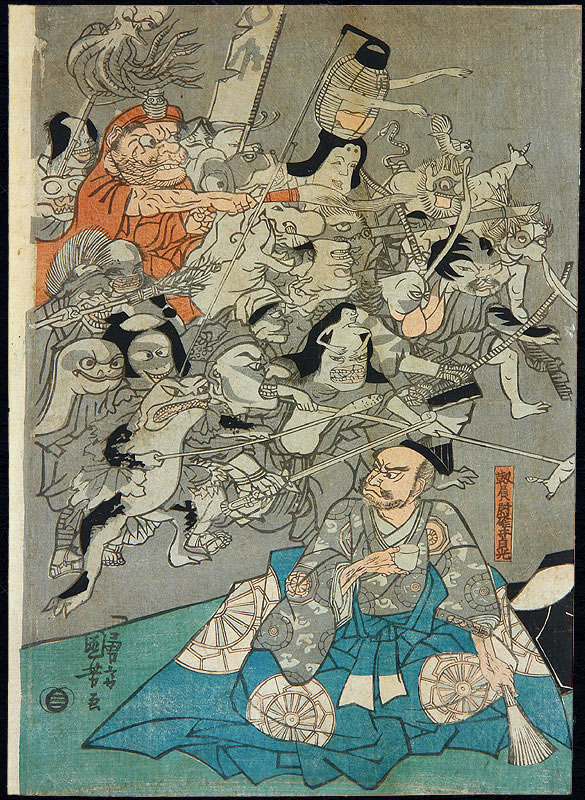
rain
posted by lotusgreen at 4:00 PM
2 comments


 i have long wondered about the dutch. now, we've talked here about twelve dozen times, at least, about the roots of japonisme as having begun after japan was opened to trade in the middle of the 19th century after around 200 years spent in chosen, peaceful, isolation. this gauguin image with a japanese print, for example, is from 1889.
 as we've also seen, japanese objects began appearing in artworks before truly inspirational and profound changes were to take place. we know that it wasn't until the end of the nineteenth century that europe began to be flooded with japanese goods, and we even know something of who facilitated the flooding.
 so then tell me. what is this kimono doing in the painting by vermeer??? 'that's not a kimono. it couldn't be,' you will respond. but you would be wrong. "The history of exchange between Japan and the Netherlands started when the Rotterdam ship de Liefde drifted ashore in Japan in 1600. From the end of the 16th to the beginning of the 17th century, during the warring states period, Japanese culture was strongly influenced by Portugal and Spain.
 In 1639, the Tokugawa Shogunate prohibited the Portuguese from visiting Japan and decided to continue official trade only with the Netherlands. In 1641, the Dutch Factory of the VOC was relocated from Hirado to Deshina [an island] in Nagasaki and trade between Japan and the Netherlands entered a new stage. At this time, the Netherlands was the only country that provided Japan with western culture." 1 [and vice versa]
 "The Dutch VOC envoy left the trading post on the island of Deshima once a year as he was allowed only one visit Edo [Tokyo]. The VOC United East India Company gave exquisite gifts to the Emperor in order to show its gratitude for the trade monopoly privilege. [In return] the very first silk kimono's were a gift from the Japanese emperor to the Dutch envoy.
 A 'Japonsche rok' chamber coat is padded and is designed to be worn inside the house during cold weather. That was quite necessary in winter as heating was sparse (foreign visitors remarked on it in their travel journals). Padded kimonos sent back to the Republic were exotic and very warm and thus became a hit when introduced in The Dutch Republic. The wide arms were often narrowed to fit Dutch requirements for use. The Japanese style chamber gown was often worn by wealthy traders and later on by scientists, authors and painters, sedentary people working at home." 2
 in fact, these wealthy traders were also responsible for 'subsidising' another major development in the world of art: the still life. "In general, the rise of still-life painting in the Netherlands reflects the increasing urbanization of Dutch and Flemish society, which brought with it an emphasis on the home and personal possessions, commerce, trade, learning—all the aspects and diversions of everyday life. Floral still-lifes were especially prominent in the early 1600s, and in their highly refined execution and in their subjects and symbolism were addressed to a cultivated audience." 3
 "While artists found limited opportunity to produce the religious iconography which had long been their staple — images of religious subjects were forbidden in the Dutch Reformed Protestant Church — the continuing Northern tradition of detailed realism and hidden symbols appealed to the growing Dutch middle classes, who were replacing Church and State as the principal patrons of art in the Netherlands.
 It was not until the decline of the Academic hierarchy in Europe, and the rise of the Impressionist and Post-Impressionist painters, who emphasized technique and design over subject matter, that still life was once again avidly practiced by artists." 4
 the new middle class having become the audience for still-lifes, the paintings themselves had a grand task: they had to announce the sophistication of their owners. "Japanese aesthetics were seen as signs of cultural distinction. Still-life paintings afforded the opportunity to evoke Asian cultures and the values associated with them, and thus Impressionists painted images of table settings that mingled Japanese, Chinese, and American objects. Japan was not simply a sign of chicness and exoticism: it was also a dream-image of utopia." 5
 and thus our treats from the dutch: still-lifes, and the very earliest glimpses of japan's cultural riches. from high-culture to low-, the inclusion of a japanese figurine or print as part of still-life spread across the globe. and we are reminded once again of the eye-opening necessary links between the finest of arts and the bourgeoisie.
Labels: Bernard Hall, Christian Schmidt, dj, dutch, elihu vedder, florence stevens, gauguin, Henri Privat-Livemont, lillian burk meeser, nat little, still life, vermeer, weir, William Shewell Ellis
posted by lotusgreen at 9:43 AM
6 comments
 She Who continues.
 She Who turns things over.
 own name, carrying She Who
 singing: I am the woman, the woman
 other first person.
Labels: frederick frieseke, harunobu suzuki, judy grahan, no on 8, sir john lavery, toni childs, william carqueville, yoshitoshi Taiso
posted by lotusgreen at 3:56 PM
8 comments
 fascination with the native americans, the indians, the indigenous peoples, began pretty much exactly the moment when europeans first hit the americas. and at the same time, not surprisingly, fear of them started too.
 but there were waves of artistic inspiration which always followed fear. during one of these, in 1855, longfellow joined many existing native myths into one epic poem (a form he wished to revive), and came out with hiawatha.
 the poem, which in my opinion is one of the most beautiful uses of the english language ever to have been written, is 22 chapters long, book-length -- much too long to post here. the entire work is here, though, and i shall try to find some passages so delectable your toes may curl. accompanied, of course, by another wave of artistic awe, at the time of japonisme, and its influences.
 Downward through the evening twilight,
  And Nokomis fell affrighted
 There among the ferns and mosses,
  And she called her name Wenonah,
  And the West-Wind came at evening,
  There the wrinkled old Nokomis
  Many things Nokomis taught him
  Then the little Hiawatha
  Of all beasts he learned the language,
  'In the land of the Dacotahs
  Still dissuading said Nokomis:
  Laughing answered Hiawatha:
Labels: frank glasier, frew, fritz scholder, Henry Wadsworth Longfellow gerald (ira diamond) cassidy, j hirt, karl petau, leslie ragen, native americans, poetry, starmer, utagawa kunimasa, winold reiss
posted by lotusgreen at 5:44 PM
10 comments

 Would you like to ride in my beautiful balloon
 Up, up and away
 Up, up and away
 Love is waiting there in my beautiful balloon
Labels: Burkhard Mangold, Jean D' Ylen, Jules de Praetere, martha cunz, paul scheurich, the fifth dimension, willi geiger
posted by lotusgreen at 3:10 PM
4 comments
 ella wheeler wilcox was a spiritualist and popular poet.
Labels: ella wheeler wilcox, poetry
posted by lotusgreen at 3:49 PM
11 comments

 before japanese prints arrived in the west, this on the left may have been what passed as riotous color; imagine the response to this on the right. nice girls didn't, but raoul dufy did.
 “I hate my verses, every line, every word.
 Oh pale and brittle pencils ever to try


 Unlucky hunter, Oh bullets of wax,
 —This wild swan of a world is no hunter’s game.
 Better bullets than yours would miss the white breast,
 Does it matter whether you hate your...self? At least
Labels: Chikanobu Toyohara, color, pattern, poetry, raoul dufy, robinson jeffers
posted by lotusgreen at 12:56 PM
8 comments