japonisme

26 September 2009

the panama-pacific, that is! • part 4


just gaze for a moment at this spot which really existed for a few short months, about a hundred years ago, as its city still reeled from its earthquake and fire, and while the rest of the world warred on.

can you imagine? wonderland indeed.

you've come to see the murals and the french painters, and now see the statues. there are more statues at this fair than you can look at in a week and a half, and that is just the beginning.

you can see the bathing beauties,

then fifteen minutes later you can go listen to john philip sousa and his band play a march.

you can visit, with- out leaving the fair, yellowstone, the grand canyon, or even mt fuji.

perhaps you're curious about panama itself -- well then visit there -- or maybe china, or samoa, or, other nations far and near.

or maybe, after visiting the national parks, and then japan, you decide to visit hawaii, as you've just heard hawiian music for the first time and you couldn't keep your those hips from swingin' to one of the many new songs introduced at the fair (even irving berlin had one) that then went on to make it big all over the world.


but the palace of fine arts keeps drawing you; you see some japonisme,

but maybe less than you had expected, given what you'd seen in europe just one year ago.


you love being introduced to tonalism and now that you have spent more than a week in san francisco with it's cover of fog all day, even in the summertime!, you understand why the tonalists use such muted colors.

and since you loved her husband's mural, you are thrilled to learn his wife's a painter too.

lots of etchings are exhibited, but nothing like the won- drous work from nabis or any of the other new-century art trends that you'd seen overseas.

and what they did show was usually without color and sometimes even appeared to have travelled back in time while the rest of the world moved forward. were the american judges classically trained and old-fashioned?

why were so few of the prints and paintings so far less colorful and free as the murals. certainly not that guerin guy.

and yet, is there any way to say that this has not been a dream with sincere magic? has not your heart been lifted and your mind eased and entertained?

and in the end you are grateful, very grateful, for all the colors
of the jewel city.


(tomorrow more references than you can shake a stick at)

Labels: , , , , , , , ,

06 May 2009

the ikebana bouquet

why do we in the west display flowers so differently from the styles of japan? why do we have nothing resembling bonsai? given that all people are the same, why are we different?

why bonsai and ikebana in one land, and bursting armsfull in another? this is not a rhetorical question.

why ballet, why butoh? or shakespeare or kabuki or no?

what role does the alphabet play? i've suggested before that calligraphy led easily to a simplified, focused art, but what of western capitals? in their straight lines, power? aggression?

is it the tendency of one-goddedness that's developed in the west v. a more diffuse worship? a separation between god and man v. an incorporation of all in all?


could it be the scientific method? the knowledge that the earth orbited the sun? a sense that the earth can be ruled v. the sense that what is, is? the process v. the outcome?


it is suggested that ikebana started with the practice of giving flowers to the buddha. of bonsai, it is said, "With Japan's adoption of many cultural trademarks of China, bonsai was also taken up, introduced to Japan during the Kamakura period (1185 - 1333) by means of Zen Buddhism, which at this time was rapidly spreading around Asia.

The exact time is debatable, although it is possible that it had arrived in AD 1195 as there appears to be a reference to it in a Japanese scroll attributed to that period. Once bonsai was introduced into Japan, the art was refined to an extent not yet approached in China. Over time, the simple trees were not just confined to the Buddhist monks and their monasteries, but also later were introduced to be representative of the aristocracy as a symbol of prestige and honour.

The ideals and philosophy of bonsai were greatly changed over the years. For the Japanese, bonsai represents a fusion of strong ancient beliefs with the Eastern philosophies of the harmony between man, the soul and nature." 1

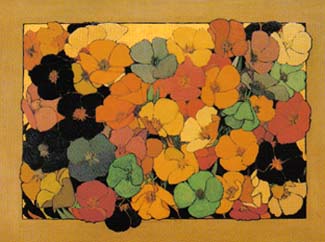
and though perhaps only charles rennie mackintosh painted flowers in a manner resembling those in the japanese culture (no accident there), certainly no one could suggest that an armful of wild flowers was any less an act of worship too.

Labels: , , , , , , , , ,

16 March 2007

from Spring Day

Bath

The day is fresh-washed and fair,
and there is a smell of tulips and narcissus
in the air.

The sunshine pours in at the bath-room window and bores through the water
in the bath-tub in lathes and planes of greenish- white. It cleaves the water
into flaws like a jewel, and cracks it to bright light.

Little spots of sunshine lie on the surface of the water and dance, dance,
and their reflections wobble deliciously over the ceiling; a stir of my finger
sets them whirring, reeling. I move a foot, and the planes of light
in the water jar. I lie back and laugh, and let the green-white water,
the sun-flawed beryl water, flow over me. The day is almost
too bright to bear, the green water covers me from the too bright day.
I will lie here awhile and play with the water and the sun spots.

The sky is blue and high. A crow flaps by the window, and there is
a whiff of tulips and narcissus in the air.

--Amy Lowell

(mathews; mucha; will source others later)
[note: somehow the images disappeared from this post completely so i put them back. now the first ones will probably come back and there'll be two. i'll come back and fix it again.]

Labels: , , ,

05 November 2006

oranges

i am very lucky, living in california, for many reasons, including its having been an area of great creative activity during the 'arts and crafts movement.' i put that in quotes because there is a tendency to block off all of these 'movements' into separate parts, as though they were truly distinct, without their tendrils and roots all tangled together, which of course they were.

in barcelona, they were called 'modernistas'! whatever they were called, an exhibition honoring them will be happening at the cleveland museum of art from october 15th 2006 until january 7 2007 (and from march 5 2007 to june 3 2007 at the metropolitan museum of art in new york). on the cma webpage i found this vase.

created in 1907 by antoni serra, one of catalonia's leading 'modernista' ceramists, this vase reminded me of something.

at the oakland museum in california is perhaps the world's best collection of california arts and crafts from this era. while they have an extraordinary tonalist painting collection (due in part to the work of harvey l jones, just retiring), they also have the largest collection of the work of arthur and lucia k mathews, and will be exhibiting it this year, october 28 2006 to march 25 2007. (pomegranate is putting out a mathews calendar as well.)

i think this is a huge and wondrous coincidence, because when i looked at that vase, i immediately thought of arthur and lucia mathews! the colors, the oranges, the leaves, these are exactly what you see on some of the work of the mathews, and i realized again how strongly what you find on these arts is what you find where they are made. this is why there are individual temperaments in the "different" movements, not because they are different, but because they are so wonderfully diverse.

Labels: , ,

older posts