

posted by lotusgreen at 6:24 PM
0 comments


26 July 2007
25 July 2007
silver
 PEAR TREE
 SILVER dust
lifted from the earth,
higher than my arms reach,
you have mounted.
O silver,

 higher than my arms reach
you front us with great mass;
no flower ever opened
so staunch a white leaf,
no flower ever parted silver
from such rare silver;


O white pear,
your flower-tufts,
thick on
the branch,
bring summer
and ripe fruits
in their
purple hearts.


"H. D." (Hilda Doolittle) 1886–1961
Labels: chikuha odake, emil orlik, gertrude kasebier, HD, hiroshige ando, imagist poetry, pedro de lemos, shunsen katsukawa, yoshimune arai
posted by lotusgreen at 8:37 AM
5 comments
23 July 2007
ranson's world

Paul Ranson (1861-1909)
Lustral
Tempera on canvas
H. 35.5; W. 24.3 cm
© photo RMN, Gérard Blot
Lustral
Tempera on canvas
H. 35.5; W. 24.3 cm
© photo RMN, Gérard Blot
Lustral
Paul Ranson, one of the Nabis, developed an original style with Symbolist and esoteric resonances. In 1891, he made two versions of Lustral, including this one, which belonged to his friend Maurice Denis.
Apart from its enigmatic title, the work can be classed as a genre scene. It can be seen as a female nude at her toilette. A sponge and bar of soap are laid on a mat at her feet alongside an ornate pottery pitcher. Ranson has multiplied details that give the scene a more symbolic meaning; the fabric which unfurls above the bather like a snake, the swan-necked fountain with its shell-shaped basin or the flower blooming on the wall invite a more erotic reading. The ablutions of the young women are a purification rite, as the title suggests. Apart from its esoteric connotations, the term "lustral" refers to medieval mysticism: lustral water is supposed to purify souls and drive out demons. It is still used for baptisms.
Ranson invites us to attend this intimate purification, almost by breaking and entering. The colour range is reduced to a palette of greens and blues conjuring up the night. The young woman's orange-brown body emerges sharply against this dark background. Keenly interested in decorative art, Ranson has surrounded his figure with arabesques and floral motifs. The deliberate flattening of form and the simplified treatment of the colour explain the nickname Ranson was given: "The Nabi who is more Japanese than the Japanese Nabi," an allusion to Bonnard. 1
(there is a very weird blogger thing wherein if you post an image either centered or 'not placed' it will not allow type to flow normally around it. i had had two images posted like that in the 'ducks post,' so i ended up changing them both. what i didn't know, until harlequinpan's question on that post, was that in doing so i would be making changes i didn't expect. knowing he wouldn't have asked unless he didn't have access to the information on the post, i checked it out. sure enough, all the images but the ones i had re-posted were no longer live. ie. you couldn't click them to see them larger, nor find out any information attached to them. fixed.)
Labels: nabi, paul ranson
posted by lotusgreen at 10:44 AM
0 comments
22 July 2007
chase
 william merritt chase was one of the most prolific of the western artists in presenting the 'stuff' of japan.
 his landscapes often exhibited structures and layouts inspired by japanese work, but his portraits, with some notable exceptions did not.

 In an earl[y] pastel, Shinnecock Studio Interior, ... in the Terra Foundation’s collection, Chase ... experimented with the motif of a child on the floor examining a book of Japanese prints arranged to lead the eye into the composition.
 This book and the large Oriental vase on a stand anchoring the view on the right announce Chase’s sympathy with Japonisme, the European and American passion for all things Japanese that rapidly followed the opening of trade between Japan and the West in the 1850s. The tipped-up perspective and casual asymmetry of the composition indicate that Chase had absorbed more than a collector’s interest in Japanese aesthetics. 1
 however, this is no exploitative fancy at japan's expense, but rather a love affair, like his friend whistler's, with forms, shapes, fabrics, patterns and designs that were new to him, and were inescapably lovely. and how better to celebrate that but to wrap in the beautiful goods and surround his most beloved people.
Labels: kimono, william merritt chase
posted by lotusgreen at 8:53 PM
1 comments
 i began to experiment with overlaying my own mountain, water, cloud photographs, with some from the japanese masters. here are some results.

if you click on the images to see them larger, you'll see who i'm combined with.

i have been doing what i call 'woodblock fotos' for a while now;
 sometimes the images are combined with those, sometimes with straight photographs.

one has actually seemed to have disappeared from my hard drive! so i'm hunting it....
posted by lotusgreen at 6:55 PM
8 comments
21 July 2007
famous last words

 japanese prints are certainly very interesting, as japanese prints -- in other words as long as they stay in japan.


a people should not appropriate what belongs to another race; in so doing, they are apt to make stupid mistakes.


there would soon be a kind of universal art, without any individual characteristics.
-- renoir 1
Labels: comment, hokusai, pierre brissaud, renoir, shoun yamamoto, umbrella
posted by lotusgreen at 3:26 PM
0 comments
20 July 2007
white ducks
 Darkening waves –
cry of wild ducks,
faintly white.

Ocean waves are dark,
only calls of ducks
faintly lighten in the sky.

Dusk falls upon the sea as
ducks call
faintly in the whiteness.
 The sea darkening . . .
oh voices of the
wild ducks
Crying, whirling, white.
 The sea darkens;
the voices of the wild ducks
are faintly white.

The sea grows dark.
The voices of the wild ducks
turn white.
The voices of the wild ducks
turn white.
Labels: bashô, ducks, gertrude kasebier, ohara koson, paul ranson, paula modersohn-becker, poetry, seiho takeuchi
posted by lotusgreen at 5:36 PM
6 comments
19 July 2007
 By that fallen house the pear-tree stands
full- blooming... an ancient battle site.
Shiki
The Groundfall Pear
It is the one he chooses,
Yellow, plump, a little bruised
On one side from falling.
That place he takes first.
Jane Hirshfield
 Study of Two Pears
I
Opusculum paedagogum.
The pears are not viols,
Nudes or bottles.
They resemble nothing else.
II
They are yellow forms
Composed of curves
Bulging toward the base.
They are touched red.
III
They are not flat surfaces
Having curved outlines.
They are round
Tapering toward the top.
Wallace Stevens
 May Day
A delicate fabric of bird song
Floats in the air,
The smell of wet wild earth
Is everywhere.
Red small leaves of the maple
Are clenched like a hand,
Like girls at their first communion
The pear trees stand.
Oh I must pass nothing by
Without loving it much,
The raindrop try with my lips,
The grass with my touch;
For how can I be sure
I shall see again
The world on the first of May
Shining after the rain?
Sarah Teasdale
Labels: bairei kono, edward steichen, haiku, jane hirshfield, poetry, seiho takeuchi, shiki, wallace stevens
posted by lotusgreen at 3:03 PM
2 comments
18 July 2007
lichts camera pattern
(via) (via)
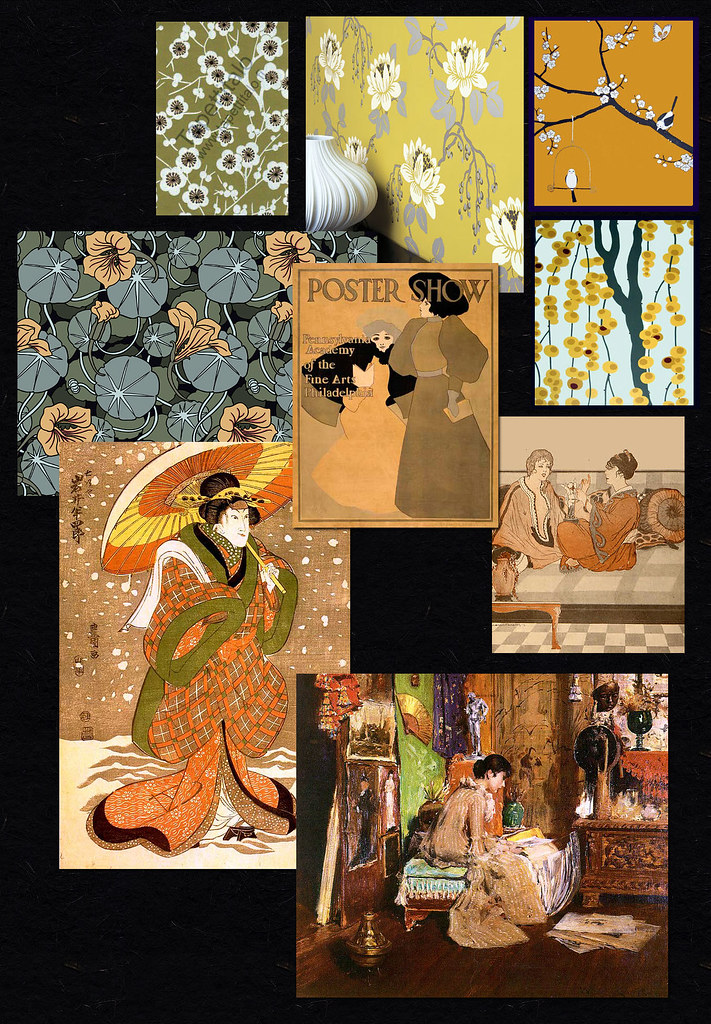
the prints are old and the wallpapers are new, then, as now, the designs, the colors wake us, warm us, cheer us and make us glad.
(artwork clockwise: maxfield parrish, marcel poncin, william merritt chase, and utamaro. wallpapers left to right tradeworth, ritva kronlund, romo, and two from fromental. please recognize that the colors here may be just plain darn wrong.)
Labels: maxfield parrish, pattern, Utamaro Kitagawa, william merritt chase
posted by lotusgreen at 10:29 AM
4 comments
17 July 2007

 an element always interesting to consider, but never wholly knowable, is intent. even the person who believes they know their own intent may not. so how to speak of the international flow and flux of art and ideas.

 to what extent, and i'm sure it was some, was the west's fascination with japan and all things japanese a search for (the illusion of) the simpler life. the industrial revolution had made cities louder and dirtier; how attractive then the 'peaceful'
(unencumbered by the last two century's innovations) images of that eastern nation, or even the coasts and countrysides of their own.

 even the japanese, meiji period on out, designed to that desire in the west, so here we have japanese art from that period, plus several, again, of the pictorialist photographers who, along with their leader stieglitz, were busy making a new branch of art.
how much of this all was 'conscious,' the grasp and re-creation of a more bucolic reality than ever may have existed? and to whom?
Labels: adolph fassbender, alfred stieglitz, arthur wesley dow, hiroshi yoshida, koitsu tsuchiya, peter henry emerson, photography
posted by lotusgreen at 1:44 PM
3 comments
16 July 2007
newer posts older posts
Previous Posts
- now we are six
- all messages: :all messengers: :same message
- The Music of Change
- no beauty's ever free I
- no beauty's ever free II
- the best novel beginning ever
- boys will be boys
- star to follow
- russe
- paper wonder cloth wonder
japonisme links
- lotusgreen's profile
- lotusgreen's outdated resume
- the japonisme timeline
- free calendars
- the hoytema calendars
- the other calendars
- the 36 views: hokusai, hiroshige, šimon & riviere
- the dutch connection
- 60s posters
- arthur wesley dow on japonisme
- haiku on japonisme
- gabriel weisberg
- musee d'orsay
- monet & japan
- ukiyo-e and european painters
- peacock room/dream worlds
- writers and the orient
- oriental ideas/american thought
- the met's japonisme timeline
- japan-in-america
- japanese dolls
- japonisme & photography
- art nouveau world server
- ukiyo-e and japonisme
- japan & the west: a history
- art nouveau 1890-1914
- the edwardians
- exposition de nancy 1900
- london/paris 1870-1910
- La photographie pictorialiste
resources
- japanese prints
- japanese prints too
- japanese prints 3
- japanese prints 4
- japanese prints 5
- japanese prints 6
- japanese prints 7
- the hokusai manga
- everything hiroshige
- hokusai::poems
- much kuniyoshi
- walter j phillips
- architecture
- frances gearhart
- emil orlik
- keramic studio
- tavik františek šimon
- theophile steinlen
- • the vienna secession
- • magazine art
- • magazine site
- • woodblock prints
- • william carl prints
- • annex galleries (prints)
- • catherine burns (prints)
- • sarah stocking (posters)
- • treadway galleries
- • modern printmakers blog
- • clive christy blog
- • linosaurus prints blog
- • vintage poster blog
- • golden age comix & illustration blog
- • sheet music
endless wonders
bibliography
lotusgreen links
subject links
- "almost every word is a different link" (1)
- "april fools" (4)
- 1915 (1)
- 1968 (1)
- 36 views (8)
- 60sposters (4)
- a e abbey (1)
- a e marty (4)
- a fiedler (1)
- a h brand (1)
- a morrow (1)
- a roller (1)
- a vallee (1)
- A. HENRY SAVAGE LANDOR (1)
- aaron neville (1)
- abel (1)
- Abraham Bloemaert (1)
- Abraham Efimovich Arkhipov (1)
- Achille Mauzan (1)
- ada matilda shrimpton (2)
- adachi (1)
- adams (1)
- Adelaide Crapsey (1)
- adolf bohm (2)
- adolf muenzer (2)
- adolf von menzel (1)
- adolph fassbender (1)
- adolph friedlander (1)
- Adriaen van de Velde (1)
- adrien barrere (2)
- advertising (5)
- ae beeton (1)
- ae cox (1)
- aesthetic movement (9)
- aesthetic movement. (1)
- age (4)
- ahugetsu tokan (1)
- aida mckenzie (1)
- al 'jazzbo' collins (1)
- Al Jarreau (1)
- albert (2)
- albert bergevin avranches (1)
- albert de belleroche (1)
- albert goldbarth (1)
- albert schmidt (1)
- albert weisgerber (3)
- alberto micheli pellegrini (1)
- alberto rios (1)
- Albrecht Durer (1)
- aldis dunbar (1)
- aleardo terzi (2)
- alex dobkin (1)
- Alex Katz (1)
- alexander dux (1)
- alexander pope (1)
- alexandre lunois (2)
- alfonse mucha (19)
- alfred henry maurer (1)
- alfred kabin (1)
- alfred roller (3)
- alfred stieglitz (5)
- alfredo hohenstein (2)
- alfredo muller (4)
- alice (2)
- alice b woodward (1)
- alice beard (1)
- alice glenny (2)
- alice smith (1)
- Alicia Ostriker (3)
- alison fell (1)
- alla nazimova (1)
- allan houser (1)
- allanazimova (1)
- allen w seaby (11)
- almeric walter (5)
- alois hanisch (1)
- alvin ailey (1)
- alvin coburn (5)
- alzheimer's (1)
- aman-jean (1)
- amphora (3)
- amy clampitt (3)
- amy lowell (4)
- Anders Christian Westergaard (1)
- ando jubei (1)
- andre helle (2)
- andrew hudgins (1)
- andrew loomis (1)
- andri ferdinand (3)
- andy tsihnajinnie (1)
- angie estes (1)
- anglo-japanese (1)
- anichini (1)
- Anita Parkhurst (2)
- anka krizmanic (1)
- ann macbeth (1)
- ann ronell (1)
- Ann Struthers (1)
- Anna Akhmatova (1)
- anna heyward taylor (2)
- anna katrina zinkeisen (1)
- anna sui (2)
- anne porter (1)
- anne sexton (1)
- annie finch (1)
- annie french (1)
- anthony hecht (2)
- anthony newley (1)
- anton albers (1)
- anton la paglia (1)
- anton seder (1)
- anton ziegler (1)
- antoni serra (1)
- apollinaire (1)
- archibald knox (2)
- architecture (8)
- argy-rousseau (1)
- arie zonneveld (2)
- armand lachaise (1)
- armand seguin (1)
- armfield maxwell (2)
- arnold genthe (2)
- arnost hoffbauer (1)
- arpas (1)
- art nouveau (1)
- art tatum (1)
- arthur atkins (1)
- arthur bagg (1)
- arthur henderson (1)
- arthur hoeber (1)
- arthur illies (2)
- arthur lazenby liberty (2)
- arthur mathews (5)
- arthur rackham (6)
- arthur rimbaud (1)
- arthur schwieder (1)
- arthur silver (3)
- Arthur Sze (1)
- arthur wesley dow (41)
- arthur whaley (1)
- artie shaw (1)
- artistic japan (1)
- arts and crafts (2)
- Artus Scheiner (1)
- ashiyuki gigado (2)
- associated artists (1)
- asymmetry (4)
- atalier martine (1)
- aubrey beardsley (4)
- aucoc (1)
- ault and wiborg (1)
- Aya Irizuki (1)
- b (1)
- b westmacott (1)
- baccarat (1)
- Baika jo (3)
- Baikôsai Shunkei (1)
- bairei kono (20)
- baixeras (1)
- ballet (1)
- ballets russes (2)
- baluschek (1)
- barack obama (5)
- barbara jordan (1)
- Barbara Ras (1)
- barnett freedman (1)
- barrows (1)
- bartezzi (1)
- bartow (1)
- bashô (6)
- batiste madalena (6)
- beach (5)
- beach boys (1)
- beauty (1)
- beer (1)
- beggarstaff bros (1)
- BELLAMY BROTHERS (1)
- bellocq (1)
- Ben Belitt (1)
- ben kaplan (1)
- ben sussan (1)
- benjamine c brown (1)
- Bernard Hall (1)
- bernard maybeck (3)
- Bernd Steiner (3)
- bernhard gutmann (1)
- bertha jaques (1)
- bertha lum (5)
- bertha stuart (1)
- bertram g goodhue (1)
- betty boop (1)
- betty dodson (1)
- bieler (1)
- biho hirose (3)
- bill jones (1)
- billy collins (1)
- bindings (11)
- birds (27)
- birth (1)
- bjo nordfeldt (4)
- blanche fisher wright (1)
- blanche mcmanus (4)
- blue eagle (2)
- blue murder (1)
- bly (1)
- bob dylan (1)
- bob fosse (1)
- bob masse (1)
- bobby darin (1)
- bobby mcferrin (2)
- bock and harnick (1)
- bodies (7)
- Bonnie MacLean (1)
- book review (11)
- bookbinding (14)
- borgoni (2)
- bosun (1)
- Boudin (1)
- bourdin (1)
- bourne and co. (1)
- boutet de monvel (1)
- bracquemond (2)
- branez (1)
- brecht (1)
- brenda fassie (1)
- Brenda Shaughnessy (1)
- brondert (1)
- Browne (1)
- bruce rogers (2)
- brynolf wennerberg (1)
- buddha (5)
- buffy sainte-marie (1)
- buhot (2)
- buncho (1)
- bungalow (1)
- bunnies (1)
- burgun (1)
- Burkhard Mangold (6)
- burl ives (1)
- burne jones (1)
- busby berkeley (1)
- buson (1)
- buttons (1)
- byam shaw (1)
- c b falls (4)
- c k agnew (1)
- c l bull (2)
- c pardee (1)
- c ray (1)
- c schuller (1)
- c szwedzicki (1)
- c yarnall abbott (2)
- c. a. lion-cachet (1)
- cab calloway (2)
- caldecott (1)
- calendar (34)
- california (2)
- calligraphy (1)
- callot soeurs (2)
- Cambon (1)
- camille (1)
- camille martin (2)
- camille pissaro (3)
- campbell grant (1)
- candace wheeler (3)
- carl kayser-eichberg (1)
- carl krenek (1)
- carl larsson (4)
- carl moll (3)
- carl moos (1)
- carl moser (8)
- carl oscar borg (3)
- carl otto czeschka (10)
- carl schmidt (2)
- carl thiemann (6)
- carlos schwabe (2)
- Carmen L. Browne (1)
- carmen miranda (1)
- carolyn s bailey (1)
- Carqueville (1)
- carton moore-park (2)
- cartoon (2)
- caspar david friedrich (1)
- castilla (1)
- cat stevens (1)
- cathy song (2)
- cats (23)
- cay (1)
- CAZALS (1)
- cecil aldrin (1)
- chadwick (1)
- Chaka Khan (1)
- chalee (1)
- chambers brothers (1)
- champillon (1)
- Charles and Ray Eames (1)
- charles baskerville (1)
- Charles Bukowski (1)
- charles burton (1)
- charles catteau (1)
- charles emile heil (2)
- charles guilloux (2)
- Charles Herbert Woodbury (3)
- charles james martin (1)
- charles kendrick (1)
- charles loupot (1)
- charles lovat fraser (1)
- charles martin (5)
- charles maurin (3)
- charles meunier (1)
- charles osborn (1)
- charles paine (2)
- charles pears (1)
- charles rennie mackintosh (13)
- charles robinson (3)
- charles sharland (1)
- charles tichon (1)
- charles tomlinson (1)
- charles verschuuren jr (1)
- charles w dahlgreen (1)
- charles w holloway (1)
- charles wirgman (1)
- charles wright (1)
- Chase Twichell (1)
- cheret (1)
- cheschka (1)
- Chikanobu Toyohara (30)
- chikudo gafu (1)
- chikuha odake (1)
- chikuseki (1)
- chikushin shoji (1)
- childe hassam (9)
- children's book illustration (10)
- chiyogami (1)
- chris johnson (1)
- christian krohg (2)
- Christian Schmidt (1)
- christopher benfey (1)
- christopher buckley (2)
- christopher dresser (2)
- chrysanthemums (5)
- chôbunsai eishi (1)
- Claes Jansz Visscher (1)
- clara bow (1)
- clara chipman (1)
- clara l brown (1)
- clarence h white (2)
- claude monet (9)
- Claudia Emerson (1)
- clement massier (1)
- clementine helene dufau (1)
- cleo de merode (2)
- clerice (1)
- Cliftonn Davis (1)
- clouds (4)
- clowns (1)
- cobalt blue (1)
- coburn (2)
- coco chanel (7)
- cole phillips (3)
- coleman barks (1)
- colette (3)
- colette inez (2)
- Collier (1)
- color (8)
- combs (4)
- comics (1)
- comix (1)
- comment (10)
- comparison (1)
- constable (2)
- constant puyo (1)
- cory (1)
- costume (2)
- coullaut (1)
- country joe (1)
- courbet (4)
- courtesans (1)
- courvoisier (1)
- cozens (1)
- craft (2)
- cranes (1)
- cravens (1)
- Creil and Montereau (1)
- crown devon (1)
- Cucuel (1)
- cuno amiet (14)
- customs (1)
- CXS (12)
- cyd charisse (2)
- cyndi lauper (1)
- cyril edward power (1)
- cyrus baldridge (1)
- d s walker (1)
- d'orzy (1)
- daan hoeksema (1)
- dagobert peche (2)
- damn yankees (1)
- dan may (1)
- dan sayre groesbeck (1)
- dance (19)
- danny kaye (1)
- daphne barry (1)
- dard hunter (1)
- dasha shtshkin (1)
- daum (3)
- dave sheridan (1)
- david (1)
- David Bryan (1)
- david byrd (1)
- david crosby (1)
- David G. Lanoue (15)
- david gauld (2)
- david goines (7)
- david w humphrey (1)
- davidson knowles (1)
- de beer (1)
- debi bender (1)
- debora l silverman (1)
- decorchemont (3)
- degas (18)
- delmore schwartz (1)
- delvanowski (1)
- delvaux (1)
- demetre h chiparus (1)
- denbac (1)
- denise levertov (2)
- design sample books (1)
- detective (24)
- deutsch (1)
- devambez (1)
- dewey bates (1)
- diaghilev (1)
- diagonals (5)
- Dietiko (1)
- dior (1)
- dj (5)
- dominic bugatto (1)
- don't monkey with me (1)
- donald hall (3)
- donovan (1)
- dorianne laux (1)
- doris boulton (1)
- doris day (1)
- Doris Dörrie (1)
- doris scull gregg (1)
- dorothy dunn (1)
- dorothy lathrop (3)
- dotking (1)
- doverbooks (1)
- dr john (1)
- dragonflies (1)
- Drian (1)
- duane michals (3)
- ducks (5)
- dudley hardy (3)
- dudley poore (1)
- dugald stewart walker (1)
- duke ellington (1)
- dumas (1)
- duncan grant (2)
- durand art glass (1)
- dutch (5)
- dylen (1)
- e berchmans (1)
- e boyd smith (3)
- e f pfeiffer (1)
- e h hubbard (1)
- e j kealey (1)
- e j wimmer (1)
- e m lilien (1)
- e paul champseix (1)
- e paul henry (1)
- e saglio (1)
- e t hurley (1)
- e w baule (2)
- e. cowell (1)
- e. gaillard (1)
- e. worsche (1)
- eartha kitt (1)
- eastman (1)
- edgar brandt (3)
- edgar lee masters (1)
- edgar wilson (1)
- edioth gruner (1)
- edith m prellwitz (1)
- edmund dulac (10)
- edmund edel (2)
- edmund tarbell (1)
- edna boies hopkins (10)
- Edna St. Vincent Millay (1)
- edna walker (1)
- edo (1)
- edouard benedictus (1)
- edouard halouze (1)
- edourd alexandre bernard (1)
- eduard theony (1)
- eduardo benito (1)
- edvard munch (4)
- edward atkinson hornel (1)
- edward c moore (2)
- edward e simmons (1)
- edward f strange (2)
- edward godwin (2)
- edward henry potthast (3)
- edward hirsch (1)
- edward lear (2)
- edward mcknight kauffer (2)
- edward morse (3)
- edward penfield (16)
- edward steichen (8)
- edward trumbull (1)
- edwin hawkins (2)
- ee cummings (4)
- EGMO (1)
- egon schiele (2)
- eihei dogen (1)
- eiho hirezaki (4)
- eileen gray (1)
- Eisen Ikeda (9)
- eisen tomioka (8)
- Eishi Hosoda (2)
- eisho hosoda (1)
- eishosai choki (4)
- elana luksch (1)
- Elbert Hubbard (1)
- elenore plaisted abbott (1)
- elihu vedder (1)
- Elinor Wylie (3)
- eliot weinberger (1)
- elisabeth nourse (1)
- eliza draper gardiner (5)
- elizabeth alexander (2)
- elizabeth keith (1)
- elizabeth norton (2)
- elizabeth shippen-green (7)
- elizabeth stanhope forbes (1)
- ella fitzgerald (1)
- ella wheeler wilcox (1)
- Elmar Wepper (1)
- elyse ashe lord (13)
- emanuel josef mangold (1)
- embroidery (1)
- emerson van gorder luther (1)
- emil biorn (1)
- emil cardinaux (7)
- emil grebs (1)
- emil orlik (12)
- Emil Pirchan (1)
- emil pottner (1)
- emil schuller (1)
- emile bernard (4)
- emile galle (2)
- emile reiber (1)
- emilie floge (2)
- Emilio Camilio (2)
- emily dickinson (4)
- emily warn (1)
- Emma Lazarus (1)
- endless wonders (2)
- ephraim faience (1)
- equinox (2)
- erich muller (1)
- erik satie (2)
- ernacchia (1)
- ernest batchelder (4)
- ernest carrier (1)
- ernest watson (2)
- Ernst Dryden (damals Ernst Deutsch) (2)
- ernst kutzer (1)
- ernst ludwig franke (1)
- ernst wiemann (1)
- erte (1)
- ethel franklin betts (1)
- ethel kirkpatrick (1)
- ethel larcombe (1)
- ethel mars (5)
- ethel reed (1)
- ethleen palmer (1)
- etienne alphonse dinet (1)
- etienne moreau-nelaton (1)
- ettore tito (1)
- eucalyptus (1)
- eugene delacroix (1)
- eugene franck (1)
- eugene grasset (8)
- eugene oge (1)
- Eugenio Montale (1)
- Eugène Rousseau (4)
- EULALIE OSGOOD GROVER (1)
- eva beve (1)
- evelyn paul (1)
- evenpoel (1)
- exposition (1)
- ezra pound (5)
- f castor hansen (1)
- F Gregory Brown (3)
- f roberts johnson (1)
- f s hossack (1)
- f schoen (1)
- f schuyler mathews (2)
- f scott fitzgerald (1)
- f w klukens (1)
- f. hass (1)
- fairytales (1)
- fashion (61)
- fat (7)
- federico zandomeneghi (2)
- felice rix (1)
- felix Albrech (1)
- felix braquemond (3)
- felix de gray (1)
- felix lorioux (1)
- feneker (1)
- fenniker (1)
- fenollosa (2)
- ferdinand hodler (18)
- ferenczi (1)
- Feuillâtre (1)
- fiestaware (1)
- fireworks (1)
- firmin (1)
- fish (3)
- fishes (1)
- florence edith storer (1)
- florence lundborg (2)
- florence stevens (1)
- foottet (1)
- for dom (1)
- fortuny (3)
- foujita (1)
- frances gearhart (13)
- francis delamare (2)
- francisco javier gose (1)
- francois jourdain (1)
- frank beatty (2)
- frank brangwyn (4)
- Frank Brinkley (1)
- frank dillon (1)
- frank glasier (1)
- frank h desch (2)
- frank king (1)
- frank lloyd wright (10)
- Frank Mason (1)
- frank morley fletcher (5)
- frank newbould (2)
- Frank R. Stockton (1)
- frank sinatra (1)
- frank w benson (3)
- Frank X. Gaspar (1)
- franz bischoff (2)
- franz hohenberger (1)
- franz karl devilla (1)
- franz marc (1)
- franz vonstuck (1)
- fred astaire (2)
- fred beaver (1)
- fred hyland (1)
- fred taylor (3)
- freda derrick (1)
- freda lingstrom (1)
- FREDERIC-AUGUSTE (1)
- frederick cayley robinson (3)
- frederick frieseke (13)
- frederick rhead (1)
- FREDERICK RICHARDSON (3)
- frederick sandys (1)
- Frederick William Harvey (1)
- frederico garcia lorca (1)
- fredrich konig (2)
- freedom (3)
- frew (1)
- friling (1)
- fritz capelari (1)
- Fritz Carl (1)
- fritz lang (3)
- fritz muller (1)
- Fritz Rumpf (1)
- fritz scholder (3)
- froelich (1)
- Fukazawa Shozo (2)
- fumeroy (1)
- g h broughton (4)
- g h evison (1)
- g howell-baker (1)
- g m mataloni (1)
- g pactal (1)
- g schaffer (1)
- G. Lebart (2)
- g. w. dijsselhof (1)
- gabriel Weisberg (1)
- gabriele fahr-becker (1)
- gabriele munter (1)
- gakoku (1)
- gakutei yashimaedo (2)
- galle (15)
- galliano (1)
- galliard (2)
- galway kinnell (1)
- garbage (1)
- garbo (1)
- gardens (1)
- gardiner (1)
- garric (1)
- Gary Gildner (1)
- gary snyder (2)
- gaston suisse (1)
- gatutei harunobu (2)
- gauguin (7)
- gay (3)
- geese (2)
- geisha (1)
- Gekko Ogata (17)
- gene buck (1)
- gene kelly (4)
- gene pressler (1)
- Genevieve Lacambre (1)
- genho (1)
- genjiro ito (1)
- genki raian (1)
- Georg Belwe (1)
- Georg Rumpf (1)
- georg tappert (2)
- george auriol (7)
- george bottini (1)
- george brandt (3)
- george delaw (2)
- george f kerr (1)
- george gershwin (1)
- george goursat (1)
- george hendrik breitner (1)
- george henry (1)
- george illian (1)
- george luks (1)
- george orwell (1)
- george rodenbach (1)
- george ward nichols (1)
- georges barbier (15)
- georges clarin (1)
- georges defeure (8)
- georges fouquet (3)
- Georges Lemmen (1)
- Georges Leonnec (2)
- georges lepape (6)
- georges redon (1)
- georges rochegrosse (1)
- georgia o'keeffe (1)
- gerald (ira diamond) cassidy (4)
- Gerard Manley Hopkins (1)
- gershwin (1)
- gertrud leistikow (1)
- gertrude hoffmann (1)
- gertrude kasebier (10)
- gertrude stein (2)
- gesso yoshimoto (5)
- geza farago (3)
- giacometti (1)
- gigi (1)
- gilbert adrian (1)
- gilbert and sullivan (1)
- gilbert atencio (1)
- giles (1)
- gina collia-suzuki (1)
- giovanni boldini (1)
- gisbert combaze (1)
- giuseppe de nittisouge (2)
- Gladys Knight (1)
- glasgow boys (6)
- glass (8)
- gloria estefan (1)
- goodbear (1)
- gose (1)
- goudy (1)
- grace dean (1)
- grace rhoads dean (1)
- graham nash (1)
- grainger johnson (1)
- grand canyon (1)
- granville redmond (2)
- grateful dead (1)
- greene and greene (6)
- grieg (1)
- gronowski (1)
- grueby pottery (3)
- guillaumin armand (1)
- gustav courbet (1)
- gustav mahler (1)
- Gustav Stickley (1)
- Gustave Adolphe Mossa (3)
- gustave baumann (26)
- gustave beers (1)
- gustave courtois (1)
- gustave flasschoen (1)
- guy rose (5)
- gwen john (1)
- gwen verdon (1)
- gwynedd hudson (1)
- Gwynned Hudson (1)
- gyosui kawanaba (4)
- h h richardson (1)
- h r eddy (1)
- H Rappin (1)
- h somm (1)
- h taylor (1)
- h thomas (1)
- h. frundt (1)
- habert-dys (5)
- haiku (36)
- hair (1)
- hakuin ekaku (1)
- Halbrans (1)
- haley lever (1)
- hall thorpe (4)
- Hanabusa Itchô (1)
- hanko kajita (1)
- hannah borger overbeck (6)
- Hans Christian Andersen (1)
- Hans Christian Anderson (1)
- Hans Christiansen (4)
- hans falk (1)
- hans frank (2)
- hans lindenstaedt (1)
- hans neumann (1)
- hans pfaff (1)
- hans rudi erdt (2)
- Hans Schließmann (1)
- harold arlen (1)
- harold cazneaux (3)
- harold von schmidt (1)
- harrison fowler (1)
- harry clarke (2)
- harry fenn (1)
- harry herzog (2)
- harry richardson (1)
- harry weisburd (1)
- harunobu suzuki (13)
- hashiguchi goyo (6)
- hasu midori (1)
- hats (3)
- HD (3)
- hector guimard (3)
- heinrich carl (1)
- heinrich lefler (1)
- heinrich otto (1)
- heinrich vogeler (4)
- helen alden knipe (1)
- helen dryden (5)
- helen hyde (6)
- helen turner (1)
- helene mass (4)
- Helene Schjerfbeck (1)
- hendee (1)
- Hendrick Goltzius (1)
- henri allouard (1)
- henri berge (2)
- henri boutet (1)
- henri cassiers (2)
- henri charles guerard (1)
- henri edmond cross (1)
- henri guerard (1)
- henri gustave jossot (1)
- henri lambert (1)
- Henri Meunier (1)
- Henri Privat-Livemont (1)
- henri riviere (32)
- henri thiriet (1)
- henri van de velde (1)
- henry david thoreau (2)
- henry de renavcourt (1)
- henry evans (1)
- henry francis cary (1)
- henry livingston bull (1)
- henry mancini (1)
- henry soulen (2)
- Henry Wadsworth Longfellow gerald (ira diamond) cassidy (1)
- Herbert Gurschner (4)
- herbert paus (2)
- Herbert S. Stone (1)
- herge. (1)
- herman dudley murphy (1)
- herman richir hamner (1)
- hermann-paul (1)
- herry perry (1)
- herter bros. (1)
- hhiroshige ando (1)
- hidekata (1)
- hilary spurling (1)
- hinagata (1)
- Hiroaki Sato. h van gael (1)
- hiroaki takahashi (3)
- hirokama utagawa (1)
- hirosada (1)
- hiroshi watanabe (1)
- hiroshi yoshida (39)
- hiroshige ando (75)
- hiroshige I (1)
- hirsch (1)
- hishikawa moronobu (2)
- hishikawa ryukoku (1)
- hodel (1)
- hodo nishimura (1)
- hoitsu sakai (2)
- hoja (1)
- Hokkei Totoya (2)
- Hokuei Shumbaisai (2)
- hokusai (50)
- holland day (1)
- Hon'ami Koetsu (1)
- honor moore (1)
- hotmail (1)
- houdard (1)
- howard chandler-christy (1)
- howard pyle (2)
- howe (1)
- hoyt axton (1)
- hudson (1)
- hugo amberg (1)
- Hugo von Hofmannsthal (1)
- hula (1)
- hunebelle (1)
- ian cheyne (1)
- ibels (3)
- ichijo narumi (1)
- ida rubenstein (2)
- ide gakusui (1)
- identity (7)
- ihara siakaku (1)
- iida takashima (1)
- Iida Takashimaya (1)
- illustration (14)
- imagist poetry (12)
- imari ware (1)
- imogen cunningham (1)
- inazo nitobe (1)
- incredible string band (1)
- iris (4)
- irvin (1)
- irving berlin (3)
- isabelle percy (1)
- isadora duncan (3)
- ishiguro masaaki (1)
- ishii hakutei (1)
- ishikawa toraji (3)
- isoda koryûsai (8)
- issa (28)
- issho (1)
- ito (1)
- ito jakuchu (1)
- ito shinsui (7)
- ito sozan (6)
- ivan bilibin (10)
- ivory soap (1)
- iwao akiyama (1)
- iwasa matabei (1)
- izumi shikibu (1)
- j bartolozzi (1)
- j bolegard (1)
- j dewar mills (1)
- j duncan gleason (1)
- j e gluck (1)
- j e muller (1)
- j h dowd (1)
- j hirt (1)
- J Martin Pollock (1)
- j prescher (1)
- j r witzel (1)
- j s wallace stevens (1)
- J.Vachal (1)
- jack kerouac (1)
- jack spicer (1)
- jacob spence (1)
- jacques emile blanche (1)
- jacques villon (2)
- james brown (1)
- james fennimore cooper (1)
- james hamilton hay (3)
- james jacques tissot (3)
- james pryde (1)
- James Russell Lowell (1)
- James Schuyler (1)
- james taylor (1)
- james whitcomb riley (1)
- james Wright (2)
- Jamie Newhard (1)
- Jan Brueghel the Elder (1)
- Jan Ferdinand Willumsen (1)
- jan saudek (1)
- jan sluijters (1)
- jan toorop (5)
- jan verhoeven (2)
- Jan Vermeer (1)
- jane avril (1)
- jane berry judson (3)
- jane cooper (1)
- jane hirshfield (6)
- jane kenyon (1)
- jane peterson (1)
- janet laura scott (3)
- jank (1)
- japanese chinese mythology (1)
- japanese history (1)
- japanese impressionism (3)
- javier (1)
- jc leyendecker (1)
- Jean D' Ylen (1)
- jean descomps (1)
- jean dunand (2)
- jean patou (1)
- jean paul gaultier (1)
- Jean-Auguste-Dominique Ingres (1)
- jean-gabriel domergue (4)
- jeanne thil (1)
- Jeffrey Yang (1)
- jeremiah (1)
- jerome henry rothstein (1)
- jessie m king (1)
- jessie newbury (1)
- jessie willcox smith (8)
- jesus (1)
- jewelry (5)
- jim steranko (1)
- jimmy durante (1)
- jmw turner (3)
- jnka (1)
- jo steiner (1)
- joan crawford (1)
- Joanna Trzeciak (1)
- Joanne Nesbit (1)
- joaquin sorolla (2)
- jody sperling (1)
- Joe DiPietro (1)
- joe loe (1)
- johan dahl (1)
- Johann baptist maier (2)
- johann von stein (1)
- john belushi (1)
- john dickson batten (1)
- john e sheridan (1)
- john edgar platt (1)
- John Engels (1)
- John Enright (1)
- john galliano (4)
- john graz (2)
- john h twachtman (1)
- John Hall Thorpe (1)
- john hassall (2)
- john henry twachtman (2)
- john holmgren (1)
- john hubbard rich (1)
- john kauffmann (1)
- john la farge (3)
- john lennon (2)
- john martinez (1)
- john philip sousa (1)
- john platt (2)
- john robert cozens (1)
- john ruskin (1)
- john singer sargent (2)
- johnny gruelle (1)
- Johnny Mathis (1)
- johnny mercer (2)
- jon stewart (1)
- Jonathan Chaves (1)
- joni mitchell (2)
- jorge de lima (1)
- josef bottlik paul leni (1)
- josef diveky (1)
- josef foshko (1)
- josef hoffmann (4)
- josef maria auchentaller (2)
- josef steiner (2)
- josef stoitzner (2)
- joseph damberger (1)
- joseph decamp (1)
- joseph gould (1)
- joseph kleitsch (1)
- joseph sattler (1)
- joseph stroud (1)
- josephine baker (1)
- josephine siccard redl (1)
- josetsu (1)
- jouve (1)
- jowett (1)
- joyce huff (1)
- jozsef rippl-ronai (2)
- jr burrows co. (1)
- judy garland (1)
- judy grahan (2)
- Jules de Praetere (1)
- JULES FEIFFER (1)
- Jules Guerin (1)
- jules-alexandre grun (2)
- Jules-Alexandre Grün (2)
- Julian Tuwim (1)
- julius gipkens (5)
- julius klinger (4)
- julius schulman (1)
- julius stewart (1)
- julius ussy engelhard (3)
- Junichiro Tanizaki (1)
- jupp weitz (1)
- János Vaszary (3)
- k nielson (1)
- k. shirayamadani (1)
- kabuki (1)
- kageyama (4)
- Kakuzo Okakura (1)
- kanae yamamoto (4)
- Kano Einô (1)
- Kano Eisen'in Michinobuj (2)
- kano enshin (1)
- Kano Motonobu (1)
- Kano Naonobu (1)
- Kano Sansetsu (3)
- Kano Toun Masunobu (1)
- kansai mori (1)
- Karasumaru-Mitsuhiro (1)
- karl albert buehr (2)
- karl bergmuller (1)
- karl marx (1)
- karl muller (1)
- karl petau (2)
- kason suzuki (2)
- katagami (1)
- katei taki (1)
- katharine sturges dodge (1)
- katherine anne porter (1)
- katherine h macdonald (1)
- katherine van dyke harker (1)
- kathryn hadley (1)
- kato (1)
- Katsukawa Shunchô (1)
- Katsukawa Shunshô (3)
- Kawabata Yasunari (1)
- kawakami shiro (1)
- Kawanabe Kyosai (5)
- kawase hasui (16)
- kay kyser (1)
- kay ryan (1)
- Kazuo Ishiguro (1)
- keiichi takasawa (1)
- keika hasegawa (3)
- keinen imao (12)
- keishu takeuchi (7)
- keith olbermann (1)
- Keith Ratzlaff (1)
- kelley (1)
- kenneth grahame (1)
- kenneth rexroth (1)
- kiesai eisen (6)
- kijiro kawai (1)
- kikaku (1)
- kikugawa eizan (8)
- Kim Fields (1)
- kimono (13)
- kinichika (1)
- kirchner (2)
- kitao masanobu (3)
- kites (1)
- kiyohiro torii (2)
- kiyokata kaburagi (4)
- Kiyokawa Morimitsuiip (1)
- kiyomitzu torii (1)
- kiyonaga torii (3)
- klimt (9)
- Knauf and Machow (1)
- knut hansen (2)
- kobayashi kiyochika (2)
- Koeeoaddi There (1)
- kogyo terazaki (2)
- kogyo tsukioka (1)
- kohn (1)
- koho shoda (5)
- koitsu tsuchiya (3)
- KOJIMA Torajiro (1)
- Kokunimasa Utagawa (4)
- koloman moser (11)
- Komeno Hakusui (1)
- konobu hasegawa (1)
- korin ogata (3)
- kosel herman (1)
- kroyer (1)
- kuniaki utagawa (1)
- Kunichika Toyohara (31)
- kunihisa (1)
- Kunikazu Utagawa (1)
- kunimasa (1)
- kunimori (2)
- kunisada toyokuni (1)
- Kunisada Utagawa (40)
- kunitero (2)
- kunitsuna utagawa (1)
- Kuniyasu Utagawa (2)
- Kuniyoshi Utagawa (35)
- kuon tsunkioka (2)
- kuroda seiki (1)
- KUROKAWA Suizan (1)
- kurt böttcher (1)
- kurt hansen (1)
- kurt opitz (1)
- Kurt Vonnegut (1)
- l n britton (2)
- l v carroll (2)
- L. Leslie Brooke (1)
- la traviata (1)
- lacquer (1)
- lady gaga (1)
- lafcadio hearn (2)
- landry and arcari (1)
- lartigue (1)
- lauger (1)
- Laura Ensor (1)
- laura knight (2)
- lauren matteo (1)
- lawrence (3)
- lawton silas parker (1)
- lazkoff (1)
- Leandre (1)
- Lee Gerlach (1)
- Lee Hankey (1)
- leff (1)
- leftwich (1)
- lehmann-steglitz (1)
- leigh conrad (1)
- leo gausson (1)
- leo kainrald (1)
- leo visser (1)
- leon bakst (13)
- leon liko amar (1)
- Leon Wyczolkowski (1)
- leonetto cappiello (5)
- leopold stolba (1)
- leopoldo metlicovitz (2)
- Leopoldo Tafani (1)
- lepere (3)
- les enfants du paradis (1)
- leslie bryan burroughs (1)
- leslie carr (1)
- leslie ragen (1)
- lewis carroll (1)
- Lewis Cook (1)
- Li K'ai-hsien (1)
- li po (1)
- li-young lee (1)
- liberty co (8)
- library (1)
- light (2)
- lilian gish (1)
- lilian miller (1)
- lillian burk meeser (3)
- lillian genth (1)
- lillian russell (1)
- limoges (1)
- Linda Hopkins (1)
- lion cachet (1)
- Lipót Sátori (2)
- litzco yamamiya (1)
- Livemont (1)
- loetz (1)
- loie fuller (3)
- Lorine Niedecker (1)
- lotusgreen (1)
- louis anquetin. (1)
- louis anquetin. ramon casas (1)
- louis armstrong (1)
- louis chalon (1)
- louis comfort tiffany (14)
- louis duchosal (1)
- louis oury (1)
- louis rhead (12)
- louise welsh (1)
- lucia mathews (4)
- lucian bernhard (5)
- lucien gaillard (1)
- ludwig heinrich jungnickel (4)
- ludwig hohlwein (14)
- ludwig kainer (1)
- Ludwig Mies van der Rohe (1)
- ludwig von hofman (1)
- ludwig von zumbusch (1)
- ludwigshafen (1)
- luise klempt (1)
- luneville (1)
- lusitania (1)
- m p brater (1)
- m t "penny" ross (1)
- m yendis (1)
- mabel alvarez (1)
- Mabel Lucie Atwell (1)
- mabel royds (4)
- macy (1)
- magazines (8)
- magic (1)
- maginel wright enright (4)
- magnolias (1)
- Makiko SEGAWA (1)
- manet (4)
- manuel robbe (9)
- marblehead pottery (1)
- Marcel Carné (1)
- marcello dudavich (5)
- margaret armstrong (2)
- margaret bourke-white (1)
- Margaret Calkin James (1)
- margaret curtis haythorn (1)
- margaret gibson (3)
- margaret jordan patterson (14)
- margaret preston (2)
- marge piercy (7)
- marguerite burnat-provins (1)
- marguerite kumm (1)
- marguerite pearson (1)
- mari tepper (1)
- maria likarz (6)
- maria oakley dewing (1)
- marie honre myer (1)
- marie-paule carpentier (1)
- Marilyn McCoo (1)
- Marion Wildman (1)
- mark doty (6)
- mark irwin (1)
- mark twain (1)
- mark v marshall (1)
- marte picaret (1)
- martha and the vandellas (1)
- martha cunz (5)
- Martha Pluviose (1)
- martha walter (1)
- martin jacoby-boy (2)
- maruyama ozui (1)
- mary brewster hazelton (1)
- mary cassatt (14)
- mary e wrinch (1)
- mary mackey (1)
- Mary McNeil Fenollosa (1)
- mary oliver (4)
- Masami Teraoka (1)
- masaoka shiki (1)
- masayoshi kitao (2)
- mason's ironstone (1)
- masriera (1)
- mata hari (1)
- mather and co (3)
- matisse (9)
- maud allan (1)
- maud squire (4)
- maud tousey fangel (1)
- maurice biais (4)
- maurice braun (2)
- maurice denis (16)
- maurice logan (3)
- Maurice Maeterlinck (1)
- Maurice Verneuil (7)
- mauzan (1)
- max buri (1)
- max hertwig (1)
- max klinger (3)
- max kuehne (1)
- max kurzweil (4)
- Max Laeuger (5)
- max liebermann (1)
- Max Schwarzer (1)
- max unold (1)
- maxfield parrish (6)
- maxime maufra (1)
- Maximilian Liebenwein (1)
- may gearhart (2)
- mayer lucas (1)
- maynard dixon (8)
- mayumi oda (2)
- McCloskey (1)
- mcgee (1)
- meeser (1)
- mela kohler (4)
- melissa etheridge (1)
- melkkan christofle (1)
- memphis (1)
- Meng Hao-jan (1)
- menzel (1)
- meta cohen hendel (1)
- metalwork (2)
- metivet (1)
- METLICOVITZ (2)
- michael jackson (1)
- michael smuin (1)
- michel dufet (2)
- michel revon (1)
- mickey mouse (1)
- miguel salmeron pellon (1)
- miho museum (2)
- mikado (2)
- Miki Suizan (1)
- mila von luttich (3)
- miles davis (1)
- mills brothers (1)
- minna vollnhals (1)
- minoru toyoda (1)
- minton (1)
- misia sert (1)
- molly brown (1)
- montmartre (1)
- moreau (1)
- moritake arakida (1)
- moriz jung (1)
- mortimer menpes (1)
- mosaic (1)
- mother goose (2)
- mr. adrian (1)
- muller bros. (1)
- munnoch (1)
- murals (1)
- muriel rukeyser (1)
- Muromachi era (1)
- museum exhibitions (8)
- music (3)
- muybridge (1)
- MWaterbury Watches (1)
- mythology (1)
- Młoda Polska (1)
- N. Scott Momaday (1)
- nabi (7)
- nakamura hochu (4)
- nakamura tsune (1)
- nana (1)
- nana mouskouri (1)
- nancy (31)
- Naomi Shihab Nye (1)
- Narihira (1)
- nat little (1)
- natasha trethewey (1)
- national parks (1)
- native (1)
- native americans (9)
- natoli (1)
- Nazim Hikmet (1)
- nc wyeth (4)
- neil young (1)
- nelson mandela (1)
- new year (1)
- newcomb (5)
- neziere (1)
- nieuwenhuis (2)
- nijinsky (1)
- nina simone (1)
- ninko tsukioka (1)
- nishikawa sukenobu (1)
- no on 8 (2)
- nobukazu watanabe (3)
- nonsense (1)
- nora exner (1)
- norbertine von bresslern-roth (14)
- norma bassett hall (3)
- Norman Dubiefont (1)
- norman lindsay (1)
- norman wilkinson (1)
- nouet (1)
- ntozake shange (1)
- nudity (11)
- o-calendar (2)
- ochoa (1)
- octavio paz (1)
- odilon redon (8)
- ohara koson (31)
- okamoto kiichi (1)
- okio (1)
- okumura masanobu (2)
- olbermann (1)
- old women (1)
- oliver bernard (1)
- oliver kemp (1)
- ono no komachi (3)
- oppenheim (2)
- ortmann (1)
- oscar de la renta (1)
- oscar droege (1)
- Oscar Rabe Hanson (2)
- oscar wilde (4)
- oskar graf (1)
- oskar laske (3)
- otero (1)
- otis redding (3)
- otto amtsberg (1)
- otto baumberger (3)
- otto eckmann (2)
- otto fischer (2)
- otto heintz (3)
- otto josef olbertz (1)
- otto weber (1)
- OWS (1)
- p balcock (1)
- pablo neruda (1)
- padilla (1)
- panama pacific international exposition (3)
- paper (3)
- paquin (2)
- parasol (1)
- paris (1)
- parrots (1)
- partridge (1)
- pasetti (1)
- pate-de-verre (1)
- patricia curtan (1)
- patricia fargnoli (3)
- patricia hooper (1)
- patricia mears (1)
- pattern (19)
- Patti Austi (1)
- pattiann rogers (7)
- paul berthon (3)
- paul binnie (1)
- paul bransom (2)
- paul bruno (1)
- paul colin (1)
- paul daschel (1)
- paul haviland (1)
- paul hermann (1)
- paul iribe (3)
- paul klee (1)
- paul leni (2)
- paul mccartney (1)
- paul poiret (16)
- paul ranson (4)
- paul revere pottery (1)
- paul rieth (2)
- paul scheurich (10)
- paul seurusier (1)
- paul verlaine (1)
- paula modersohn-becker (2)
- paxton (1)
- PB Cook (1)
- peacocks (1)
- pedro de lemos (7)
- peeter kippik (1)
- peggy bacon (2)
- peggy lee (1)
- pegot-ogier (2)
- pelicans (1)
- percy drake brookshaw (1)
- percy w gibbs (1)
- perham wilhelm nahl (1)
- pete seeger (3)
- peter de greef (1)
- Peter Handke (2)
- peter henry emerson (6)
- peter pan (1)
- Peter Pantzer (1)
- peter paul and mary (1)
- Peter Schjeldahl (1)
- petit (1)
- petitjean (1)
- pewabic tile (2)
- pfaff graf cacilie (1)
- philip johnson (1)
- philip larkin (1)
- philip levine (4)
- philippe swyncop (1)
- Philips Koninck (1)
- phillip wolfers (1)
- phillips (1)
- photography (14)
- Phylicia Rashad (1)
- picasso (5)
- pictorialism (1)
- piero de francesca (1)
- pierre bonnard (18)
- pierre brissaud (2)
- pierre loti (2)
- piet van der ham (1)
- Pieter Breughel the Elder (1)
- Pieter van der Hem (1)
- pinder (1)
- pine (1)
- plakatstil (1)
- Po Chü-i (1)
- pochoir (1)
- poetry (221)
- poiret (1)
- poland (1)
- posters (19)
- pottery (1)
- ppie (5)
- prang (3)
- preetorius (1)
- prostitutes (1)
- puccini (2)
- punch (4)
- purvis bamburgh (1)
- puvis de chavannes (4)
- qing (1)
- quierdo (1)
- quincy tahoma (3)
- quiz (2)
- r buckminster fuller (1)
- r van hoff (1)
- rabbits (2)
- rabier (1)
- rachel elmer (2)
- rachel maddow (1)
- rafael de penagos (3)
- rails (3)
- rain (1)
- Rainer Maria Rilke (5)
- ralph waldo emerson (1)
- rami kashou (1)
- ramon manchon (1)
- randal william borough (1)
- raoul dufy (7)
- Raoul Hynckes (1)
- raphael (1)
- rassenfosse (1)
- raul mantzola (1)
- reading (1)
- rebecca henry (1)
- red hair (1)
- redfern (1)
- reginald frampton (1)
- Reginald Gibbons (1)
- reinhard volker (1)
- religion (2)
- renato mayer grego (1)
- rene gruau (1)
- rene lalique (22)
- rene magritte (2)
- rene vincent (3)
- renoir (7)
- republicans (1)
- reynolds (1)
- ribera (1)
- ricardo garcia (1)
- richard amsel (1)
- richard halls (2)
- richard miller (7)
- Richard Neutra (1)
- richard ranft (1)
- richmond irwin kelsey (1)
- rick bartow (1)
- rick bonfils (1)
- ricketts (3)
- riichiro kawashima (1)
- riom (3)
- rita dove (2)
- robert austin (1)
- robert blum (2)
- robert c hardmeyer (1)
- robert dana (1)
- Robert Frederick Blum (2)
- Robert Frost (4)
- robert graves (1)
- robert henri (3)
- robert koch (1)
- robert kushner (1)
- robert leslie howey (1)
- robert lowe (1)
- robert pinsky (2)
- robert reid (7)
- robert wrigley (2)
- roberto fontano (1)
- robinson jeffers (2)
- rodgers and hammerstein (1)
- roger broders (2)
- roger fry (1)
- rogers and hammerstein (1)
- rolling stones (1)
- rookwood (6)
- ros (1)
- rosetsu nagazawa (2)
- rosetti (1)
- roseville pottery (2)
- Rossi and Myrbach (1)
- roth (1)
- roubille (2)
- rousseau (3)
- roussel (1)
- royal crown derby (1)
- royal doulton (2)
- rozenburg pottery (1)
- rudolf bacher (1)
- rudolf pick (1)
- ruhlmann (1)
- rumi (2)
- ruth l schwartz (1)
- ruth st denis (2)
- ryomi (1)
- ryota (1)
- s (1)
- s bing (2)
- s browne (1)
- s wood (1)
- s. bing (2)
- sachs (1)
- sada yacco (1)
- sadakichi hartmann (1)
- Sadanobu Hasegawa (4)
- sadie irvine (5)
- sadie wendell mitchell (1)
- sai baba (1)
- saigyō (1)
- saiman li (1)
- Saint-Saens (1)
- sakai hoitsu (4)
- sakuran (1)
- salome (2)
- sam bussy (1)
- sam longley (1)
- sam van beek (1)
- samuel beckett (1)
- Samuel Taylor Coleridge (1)
- san francisco (1)
- san francisco ballet (1)
- sanchi ogawa (1)
- sandberg? (1)
- sandy hook (1)
- santo kyoden (2)
- Sara R. Welsh (1)
- sara teasdale (4)
- sarah bernhardt (3)
- Sarah Getty (2)
- sarah s stilwell (1)
- sarah wyman whitman (3)
- satsuma (1)
- saturday evening girls (4)
- saturnino herran (1)
- sawa takeshi (1)
- scheid (1)
- schmied (1)
- schnackenberg (1)
- scholder (1)
- schuster (1)
- schwaberow (1)
- scotson-clark (1)
- scott heffer (1)
- scottish colourists (1)
- Sebastian Oesch (2)
- seche (1)
- seguy (7)
- seiho takeuchi (5)
- seitei (shotei) watanabe (15)
- seizo sugawara. (1)
- sekiko akashi (1)
- sekka kamisaka (1)
- SEM (1)
- sencho (1)
- sessai (1)
- Sesshu Toyo (1)
- Sesson Shukei (1)
- shades of blue (1)
- shakespeare (1)
- sharaku (2)
- shearwater (1)
- sheet music (4)
- Shiba Kokan (1)
- shigenobu (1)
- shigeru aoki (1)
- shiki (1)
- shinji ando (1)
- shiomi masanari (1)
- shiramaya shosai (1)
- Shiro Kasamatsu (5)
- shodo kawarazaki (4)
- shoka tujimura (1)
- shoso mishima (1)
- shotei hiroaki (2)
- shotei sento (1)
- shoun yamamoto (4)
- shugio hiromichi (1)
- shunkou (1)
- Shunkôsai Hokushû (1)
- shunsen katsukawa (1)
- Shuntei Miyagawa (9)
- shunzan katsukawa (1)
- shushiri (2)
- siegmund von suchodolski (1)
- sigismund righini (1)
- silver studio (6)
- sipkema (1)
- sir john lavery (2)
- sisley (1)
- sister sledge (1)
- sloan (1)
- smokes (1)
- smokey robinson (1)
- soga nichokuan (1)
- solstice (14)
- soulen (2)
- spam (1)
- speer (1)
- spring (1)
- staeders (1)
- stamps (1)
- stan freberg (3)
- Stanisław Wyspiański. (1)
- stanley c mitchell (1)
- stanley mouse (1)
- stanley plumly (3)
- starmer (1)
- stencils (1)
- stephane mallarme (1)
- stephen dunn (3)
- stephensons (1)
- steve allen (1)
- steven spurrier (1)
- steven stills (1)
- still life (1)
- stravinsky (1)
- structure (2)
- sugakudo nakayama (2)
- sui seki (1)
- susan griffin (2)
- Suzanne Guiguichon (1)
- suzanne valadon (1)
- sven brash (1)
- swami satchidananda (1)
- swans (1)
- sydney long (1)
- sylvian boxius (1)
- t browne (1)
- t'ao ch'ien (1)
- t. w. i. israels (1)
- tack (2)
- tadamuni torii (1)
- taikyu (1)
- taisho chic (1)
- takahashi biho (1)
- takahashi shotei (3)
- Takamura Kotaro (1)
- Take 6 (1)
- takehisa yumiji (2)
- takei takeo (1)
- Takeuchi Seiho (1)
- Talvikki Ansel (1)
- talwin morris (1)
- Tamara Platonovna Karsavina (2)
- tanaka kikuo (1)
- Tara Parker-Pope (1)
- tavik františek šimon (8)
- tea (2)
- ted koppel (1)
- tekagami (1)
- tengrim (1)
- tennessee williams (1)
- tennyson (1)
- terry tempest williams (1)
- terukata gyokudo (1)
- tessai tomioka (1)
- tetsugoro yorozu (1)
- tex avery (1)
- textiles (9)
- the beatles (3)
- the brilliant Frank Loesser (1)
- the byrds (1)
- the exciters (1)
- the fifth dimension (1)
- the fugs (1)
- the house of the rising sun (1)
- the lettermen (1)
- the line (2)
- the mills brothers (1)
- the moon (3)
- the sea (1)
- the stones (1)
- the studio (3)
- the temptations (1)
- the vapors (1)
- the wave (1)
- the who (1)
- thea proctor (1)
- theater (2)
- theda bara (1)
- theo matejko (3)
- theo molkenboer (1)
- theo van hoytema (39)
- theo van rhysselberghe (4)
- theodore etbauer (1)
- theodore roethke (1)
- theophile steinlen (21)
- they might be giants (1)
- thich nhat hahn (2)
- thomas dewing (3)
- thomas girtin (1)
- thomas hardy (1)
- thomas paquette (1)
- thomas watson ball (1)
- thor bogelund (2)
- thornton wilder (1)
- thorpe moeckel (1)
- three dog night (1)
- Théodore Chassériau (1)
- tiger lily (1)
- timeline (8)
- tinan (1)
- tintin (1)
- tn putilovoy (1)
- tobari kogan (3)
- tobei kamei (1)
- Tom Crawford (1)
- tom hanks (1)
- tom purvis (1)
- tomikichiro tokuriki (1)
- tonalism (4)
- toni childs (1)
- tony hoagland (1)
- Toolmnje or Yooluije (1)
- torii kirihiro (1)
- torii kiyonobu (1)
- torii kotondo (2)
- tornai gyula (1)
- torne esquius (2)
- toshi yoshida (20)
- toshihide migata (1)
- toshikata mizuno (17)
- toshimine tsutsui (1)
- toshinobu yamazaki (1)
- toshio nakanishi (1)
- toshusai sharaku (4)
- toulouse-lautrec (21)
- toyokuni II utagawa (3)
- toyonobu ishikawa (2)
- travel (11)
- trees (5)
- TREIDLER (1)
- ts eliot (2)
- tsaoke (1)
- Tsuchida Eisho (1)
- Tsukioka YOSHITOSHI (5)
- tsunami (2)
- tupke-grande (2)
- TV (1)
- TVH (4)
- typography (4)
- tyra banks (1)
- Ueda Akinari (1)
- umberto brunelleschi (2)
- umbrella (2)
- umekuni toyokawa (1)
- underarms (1)
- union of concerned scientists (1)
- urgelles (1)
- utagawa hiroshige I (7)
- utagawa kunimasa (3)
- utagawa toyohiro (3)
- utagawa toyokuni (9)
- utagawa yoshikazu (3)
- Utamaro Kitagawa (51)
- vallotton (25)
- Valzhyna Mort (1)
- van gogh (10)
- van goyen (1)
- vanessa bell (1)
- Vanessa Williams (1)
- variela (1)
- velvet underground (1)
- ver sacrum (2)
- vera bok (1)
- vera lynn (1)
- vera wang (1)
- vermeer (1)
- verney l danvers (2)
- Verwee (2)
- vever (1)
- victor mignot (1)
- Victor Moscoso (2)
- victor prouve (2)
- video (8)
- viktor oliva (1)
- vineland flint glass works (1)
- violet oakley (2)
- vionnet (6)
- virgil (2)
- virginia woolf (1)
- vitaldi babani (3)
- vittorio zecchin (1)
- vojtech preissig (1)
- volland (5)
- von stillfried (1)
- voysey (5)
- vuillard (11)
- w h bull (2)
- w heath robinson (2)
- w self (1)
- wada eisaku (2)
- wada sanzo (3)
- waiting (1)
- walasse ting (1)
- waldo chase (2)
- wallace stevens (4)
- wallace swanson (1)
- walt whitman (5)
- walter appleton clark (2)
- walter crane (5)
- walter de la mere (1)
- Walter E Spradbery (2)
- Walter Fürst (1)
- walter georgi (1)
- walter j phillips (25)
- walter klemm (8)
- walter leistikow (1)
- wanda gag (3)
- Wang Chiu-ssu (1)
- warwick goble (4)
- Wassili Wassiljewitsch Wereschtschagin (1)
- Watanabe Ikuharu (1)
- WATANABE Ryosuke (1)
- watanabe shozaburo (1)
- waterbabies (1)
- waterhouse (3)
- waves (1)
- we are not amused (1)
- wedgewood (2)
- wedgwood (1)
- weir (3)
- Weldon Kees (1)
- weller pottery (3)
- wes wilson (3)
- wg robertson (1)
- whistler (11)
- whores (1)
- wiener werkstatte (10)
- wilhelm f burger (2)
- wilhelm lehmann (1)
- wilhelm list (1)
- wilhelm schulz (1)
- wilkinson (1)
- will bradley (3)
- will carqueville (1)
- willa cather (1)
- Willard Frederic Elmes (3)
- willem witsen (1)
- willi geiger (1)
- William B. Post (2)
- william blake (1)
- william butler yeats (11)
- william carlos williams (10)
- william carqueville (1)
- william gorge (1)
- William J Cromie (1)
- William Makepeace Thackeray (1)
- william matthews (2)
- william merritt chase (13)
- william morris (1)
- william nicholson (7)
- william rice (13)
- william russell flint (2)
- William Shewell Ellis (1)
- William Stafford (2)
- william wendt (6)
- william wordsworth (2)
- willie nelson (2)
- willy engelhardt (1)
- willy pogany (3)
- willy ronis (1)
- willy sluiter (4)
- wim wenders (1)
- wind in the willows (1)
- winold reiss (7)
- winslow homer (1)
- winsor mccay (2)
- Wislawa Szymborska (3)
- witches (1)
- women (27)
- women writers (1)
- wonderland (1)
- wood and sons (1)
- woody crumbo (1)
- world war I (1)
- worth (2)
- wp tyson (1)
- wpa poster (3)
- wranitzky (1)
- writing (3)
- ws merwin (2)
- ww denslow (6)
- xaudaro (1)
- xavier martinez (1)
- Yamashita Kinsaku (1)
- yann fanch kemener (1)
- yasuko enjyoji (1)
- yellow bird (1)
- Yevgeny Yevtushenko (1)
- yone noguchi (4)
- yosano akiko (1)
- yoshikuni toyokawa (1)
- yoshimune arai (2)
- yoshitaki (2)
- yoshitora utagawa (2)
- yoshitoshi Taiso (23)
- yoshu chikanobu (1)
- young poland (1)
- yowsaku sekino (1)
- yvette guilbert (1)
- yyoshitoshi Taiso (1)
- zane gray (1)
- zeshin sabata (6)
- zimmerli (1)
- zola (1)
- zorn (1)
- Ôoka Shunboku (5)
Archives
- 12/25/05 - 1/1/06
- 1/1/06 - 1/8/06
- 8/6/06 - 8/13/06
- 8/27/06 - 9/3/06
- 9/3/06 - 9/10/06
- 9/10/06 - 9/17/06
- 9/17/06 - 9/24/06
- 9/24/06 - 10/1/06
- 10/1/06 - 10/8/06
- 10/8/06 - 10/15/06
- 10/15/06 - 10/22/06
- 10/22/06 - 10/29/06
- 10/29/06 - 11/5/06
- 11/5/06 - 11/12/06
- 11/12/06 - 11/19/06
- 11/19/06 - 11/26/06
- 11/26/06 - 12/3/06
- 12/3/06 - 12/10/06
- 12/10/06 - 12/17/06
- 12/17/06 - 12/24/06
- 12/24/06 - 12/31/06
- 12/31/06 - 1/7/07
- 1/7/07 - 1/14/07
- 1/14/07 - 1/21/07
- 1/21/07 - 1/28/07
- 1/28/07 - 2/4/07
- 2/4/07 - 2/11/07
- 2/11/07 - 2/18/07
- 2/18/07 - 2/25/07
- 2/25/07 - 3/4/07
- 3/4/07 - 3/11/07
- 3/11/07 - 3/18/07
- 3/18/07 - 3/25/07
- 3/25/07 - 4/1/07
- 4/1/07 - 4/8/07
- 4/8/07 - 4/15/07
- 4/15/07 - 4/22/07
- 4/22/07 - 4/29/07
- 4/29/07 - 5/6/07
- 5/6/07 - 5/13/07
- 5/13/07 - 5/20/07
- 5/20/07 - 5/27/07
- 5/27/07 - 6/3/07
- 6/3/07 - 6/10/07
- 6/10/07 - 6/17/07
- 6/17/07 - 6/24/07
- 6/24/07 - 7/1/07
- 7/1/07 - 7/8/07
- 7/8/07 - 7/15/07
- 7/15/07 - 7/22/07
- 7/22/07 - 7/29/07
- 7/29/07 - 8/5/07
- 8/5/07 - 8/12/07
- 8/12/07 - 8/19/07
- 8/19/07 - 8/26/07
- 8/26/07 - 9/2/07
- 9/2/07 - 9/9/07
- 9/9/07 - 9/16/07
- 9/16/07 - 9/23/07
- 9/23/07 - 9/30/07
- 9/30/07 - 10/7/07
- 10/7/07 - 10/14/07
- 10/14/07 - 10/21/07
- 10/21/07 - 10/28/07
- 10/28/07 - 11/4/07
- 11/4/07 - 11/11/07
- 11/11/07 - 11/18/07
- 11/18/07 - 11/25/07
- 11/25/07 - 12/2/07
- 12/2/07 - 12/9/07
- 12/9/07 - 12/16/07
- 12/16/07 - 12/23/07
- 12/23/07 - 12/30/07
- 12/30/07 - 1/6/08
- 1/6/08 - 1/13/08
- 1/13/08 - 1/20/08
- 1/20/08 - 1/27/08
- 1/27/08 - 2/3/08
- 2/3/08 - 2/10/08
- 2/10/08 - 2/17/08
- 2/17/08 - 2/24/08
- 2/24/08 - 3/2/08
- 3/2/08 - 3/9/08
- 3/9/08 - 3/16/08
- 3/16/08 - 3/23/08
- 3/23/08 - 3/30/08
- 3/30/08 - 4/6/08
- 4/6/08 - 4/13/08
- 4/13/08 - 4/20/08
- 4/20/08 - 4/27/08
- 4/27/08 - 5/4/08
- 5/4/08 - 5/11/08
- 5/11/08 - 5/18/08
- 5/18/08 - 5/25/08
- 5/25/08 - 6/1/08
- 6/1/08 - 6/8/08
- 6/8/08 - 6/15/08
- 6/15/08 - 6/22/08
- 6/22/08 - 6/29/08
- 6/29/08 - 7/6/08
- 7/6/08 - 7/13/08
- 7/13/08 - 7/20/08
- 7/20/08 - 7/27/08
- 7/27/08 - 8/3/08
- 8/3/08 - 8/10/08
- 8/10/08 - 8/17/08
- 8/17/08 - 8/24/08
- 8/24/08 - 8/31/08
- 8/31/08 - 9/7/08
- 9/7/08 - 9/14/08
- 9/14/08 - 9/21/08
- 9/21/08 - 9/28/08
- 9/28/08 - 10/5/08
- 10/5/08 - 10/12/08
- 10/12/08 - 10/19/08
- 10/19/08 - 10/26/08
- 10/26/08 - 11/2/08
- 11/2/08 - 11/9/08
- 11/9/08 - 11/16/08
- 11/16/08 - 11/23/08
- 11/23/08 - 11/30/08
- 11/30/08 - 12/7/08
- 12/7/08 - 12/14/08
- 12/14/08 - 12/21/08
- 12/21/08 - 12/28/08
- 12/28/08 - 1/4/09
- 1/4/09 - 1/11/09
- 1/11/09 - 1/18/09
- 1/18/09 - 1/25/09
- 1/25/09 - 2/1/09
- 2/1/09 - 2/8/09
- 2/8/09 - 2/15/09
- 2/15/09 - 2/22/09
- 2/22/09 - 3/1/09
- 3/1/09 - 3/8/09
- 3/8/09 - 3/15/09
- 3/15/09 - 3/22/09
- 3/29/09 - 4/5/09
- 4/5/09 - 4/12/09
- 4/12/09 - 4/19/09
- 4/19/09 - 4/26/09
- 4/26/09 - 5/3/09
- 5/3/09 - 5/10/09
- 5/10/09 - 5/17/09
- 5/17/09 - 5/24/09
- 5/24/09 - 5/31/09
- 5/31/09 - 6/7/09
- 6/7/09 - 6/14/09
- 6/14/09 - 6/21/09
- 6/21/09 - 6/28/09
- 6/28/09 - 7/5/09
- 7/5/09 - 7/12/09
- 7/12/09 - 7/19/09
- 7/19/09 - 7/26/09
- 7/26/09 - 8/2/09
- 8/2/09 - 8/9/09
- 8/9/09 - 8/16/09
- 8/16/09 - 8/23/09
- 8/23/09 - 8/30/09
- 8/30/09 - 9/6/09
- 9/6/09 - 9/13/09
- 9/20/09 - 9/27/09
- 9/27/09 - 10/4/09
- 10/4/09 - 10/11/09
- 10/11/09 - 10/18/09
- 10/18/09 - 10/25/09
- 10/25/09 - 11/1/09
- 11/1/09 - 11/8/09
- 11/8/09 - 11/15/09
- 11/15/09 - 11/22/09
- 11/22/09 - 11/29/09
- 11/29/09 - 12/6/09
- 12/6/09 - 12/13/09
- 12/13/09 - 12/20/09
- 12/20/09 - 12/27/09
- 12/27/09 - 1/3/10
- 1/3/10 - 1/10/10
- 1/10/10 - 1/17/10
- 1/17/10 - 1/24/10
- 1/24/10 - 1/31/10
- 1/31/10 - 2/7/10
- 2/7/10 - 2/14/10
- 2/14/10 - 2/21/10
- 2/21/10 - 2/28/10
- 2/28/10 - 3/7/10
- 3/7/10 - 3/14/10
- 3/14/10 - 3/21/10
- 3/21/10 - 3/28/10
- 3/28/10 - 4/4/10
- 4/4/10 - 4/11/10
- 4/11/10 - 4/18/10
- 4/18/10 - 4/25/10
- 4/25/10 - 5/2/10
- 5/9/10 - 5/16/10
- 5/16/10 - 5/23/10
- 5/23/10 - 5/30/10
- 5/30/10 - 6/6/10
- 6/6/10 - 6/13/10
- 6/13/10 - 6/20/10
- 6/20/10 - 6/27/10
- 7/4/10 - 7/11/10
- 7/11/10 - 7/18/10
- 8/1/10 - 8/8/10
- 8/22/10 - 8/29/10
- 9/12/10 - 9/19/10
- 9/19/10 - 9/26/10
- 9/26/10 - 10/3/10
- 10/3/10 - 10/10/10
- 10/10/10 - 10/17/10
- 10/17/10 - 10/24/10
- 10/24/10 - 10/31/10
- 10/31/10 - 11/7/10
- 11/14/10 - 11/21/10
- 11/21/10 - 11/28/10
- 11/28/10 - 12/5/10
- 12/19/10 - 12/26/10
- 12/26/10 - 1/2/11
- 1/9/11 - 1/16/11
- 1/16/11 - 1/23/11
- 1/30/11 - 2/6/11
- 2/6/11 - 2/13/11
- 2/13/11 - 2/20/11
- 2/20/11 - 2/27/11
- 2/27/11 - 3/6/11
- 3/6/11 - 3/13/11
- 3/13/11 - 3/20/11
- 3/20/11 - 3/27/11
- 3/27/11 - 4/3/11
- 4/3/11 - 4/10/11
- 4/17/11 - 4/24/11
- 4/24/11 - 5/1/11
- 5/1/11 - 5/8/11
- 5/15/11 - 5/22/11
- 5/22/11 - 5/29/11
- 5/29/11 - 6/5/11
- 6/5/11 - 6/12/11
- 6/12/11 - 6/19/11
- 6/19/11 - 6/26/11
- 6/26/11 - 7/3/11
- 7/3/11 - 7/10/11
- 7/17/11 - 7/24/11
- 7/24/11 - 7/31/11
- 7/31/11 - 8/7/11
- 8/7/11 - 8/14/11
- 8/14/11 - 8/21/11
- 8/28/11 - 9/4/11
- 9/11/11 - 9/18/11
- 9/18/11 - 9/25/11
- 9/25/11 - 10/2/11
- 10/2/11 - 10/9/11
- 10/9/11 - 10/16/11
- 10/16/11 - 10/23/11
- 10/23/11 - 10/30/11
- 10/30/11 - 11/6/11
- 11/6/11 - 11/13/11
- 11/20/11 - 11/27/11
- 11/27/11 - 12/4/11
- 12/4/11 - 12/11/11
- 12/11/11 - 12/18/11
- 12/18/11 - 12/25/11
- 12/25/11 - 1/1/12
- 1/1/12 - 1/8/12
- 1/8/12 - 1/15/12
- 1/15/12 - 1/22/12
- 1/22/12 - 1/29/12
- 1/29/12 - 2/5/12
- 2/5/12 - 2/12/12
- 2/12/12 - 2/19/12
- 2/19/12 - 2/26/12
- 3/11/12 - 3/18/12
- 4/1/12 - 4/8/12
- 4/8/12 - 4/15/12
- 4/22/12 - 4/29/12
- 4/29/12 - 5/6/12
- 5/13/12 - 5/20/12
- 5/20/12 - 5/27/12
- 5/27/12 - 6/3/12
- 6/3/12 - 6/10/12
- 6/10/12 - 6/17/12
- 6/17/12 - 6/24/12
- 6/24/12 - 7/1/12
- 7/1/12 - 7/8/12
- 7/8/12 - 7/15/12
- 7/15/12 - 7/22/12
- 7/29/12 - 8/5/12
- 8/19/12 - 8/26/12
- 8/26/12 - 9/2/12
- 9/2/12 - 9/9/12
- 9/16/12 - 9/23/12