japonisme

09 August 2007

instant assemblage

(the following poem and images was assembled by an astonishing woman, imani. her discussion accompanying the poem is fascinating as well. she has clearly taken a lot of time and care with her choices; i, however, give you one or two from each post to which she linked. thank you.)

POEM

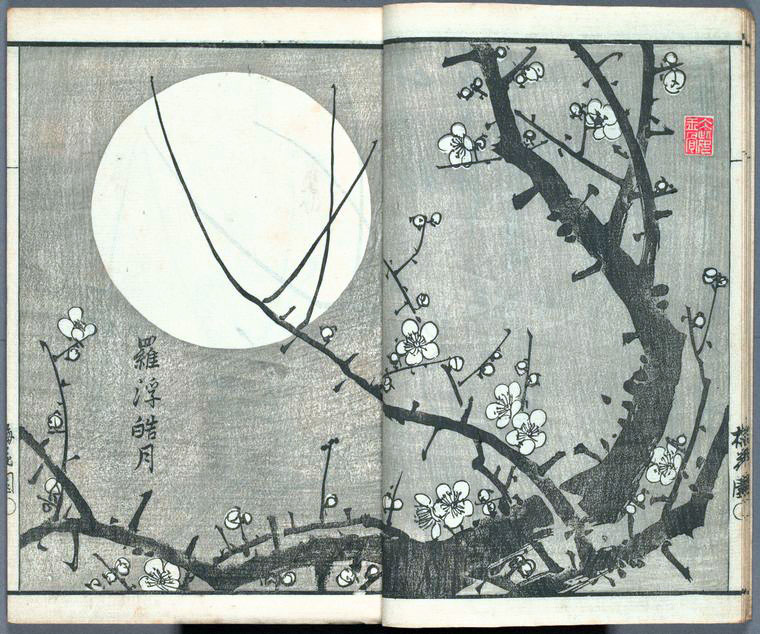
This beauty that I see

– the sun going down

scours the entangled

and lightly henna

withys and the wind


whips them as it

would ship a cloud –


is passing so swiftly


into night. A moon,


full and flat, and stars


a freight train passing


passing it is the sea


and not a train. This


beauty that collects


dry leaves in pools


and pockets and goes


freezingly, just able


still to swiftly flow


it goes, it goes.

--James Schuyler


Labels: , , , , , , , , ,

08 August 2007

on realities and illusions

let us be clear. this is what the real mikado looked like at the time of the mikado. emperor at 15, emperor meiji stressed the importance of wearing western clothing, as he is wearing here, in his 20s.

right around that same day, had you been seeing a new operetta back in new england, you might have gotten the idea that a mikado looked like this, where actually it is Frederick Federici.

through the following decades, you might have seen something near to this model; here ...

or here ...


or maybe here....


or maybe even here....

interesting, though, this was not a point of conflict.

perhaps moreso (though who cannot relate?) were his 'punishments to fit the crime":

All prosy dull society sinners,
Who chatter and bleat and bore,
Are sent to hear sermons
From mystical Germans
Who preach from ten till four.
The amateur tenor, whose vocal villainies
All desire to shirk,
Shall, during off-hours,
Exhibit his powers
To Madame Tussaud's waxwork.
The lady who dyes a chemical yellow
Or stains her grey hair puce,
Or pinches her figure,
Is painted with vigour
And permanent walnut juice.
The idiot who, in railway carriages,
Scribbles on window-panes,
We only suffer
To ride on a buffer
In Parliamentary trains.
1

what caused a major uproar among trad- itionalists were the wonderful, new, 1926 designs charles ricketts devised for the d'oyly carte production.

The admitted refurbishing consisted of new scenery, new dresses, and new properties designed by Mr. Charles Ricketts, which in the mass made a highly effective scheme of colour. The Mikado dressed like that may or may not be more Japanese than the old setting; it is certainly less English. Again, the faithful may complain that it is less "Gilbertian," that Yum-Yum and her companions should remain pretty girls according to thoroughly Western notions, whatever their dresses may be, and that the Japaneseness should not be allowed to go further than the bric-à-brac of the mid-Victorian drawing-room. 2

even punch lampooned the changes.

what more serious conflicts did occur, at the time, and over the years in response are covered very interestingly here.

Labels: , ,

07 August 2007

all blues

ALL BLUES

Miles Davis


The sea, the sky, the you and I
The sea, the sky, for you and I
I'll know we're all blues
All Shades, all hues, all blues


Some blues are sad
But some are glad,
Dark-sad or bright-glad
They're all blues
All shades, all hues, all blues


The color of colors
The blues are more than a color
They're a moan of pain
A Taste of strife
And a sad refrain


A game which life is playin'
Blues can be the livin' dues
We're all a-payin'
Yeah, Oh Lord

In a rainbow
A summer day that's fair
A parayer is prayed
A lament that's made

(break)

Some shade of blues is there;
Blue heaven's hue,
They're all blues!

(instrumental)

Talkin' 'bout the sea and the sky
And i'm talkin' 'bout you and I
The sea, the sky
For you and I

And I know we're all blues
All shades,
All hues,
All blues

Sea, sky, you and I
See the sky, you and I
All Blues
All shades, all hues, all blues

Labels: , , , , , , , , ,

06 August 2007

japan as text in western advertising

to the extent that adver- tising creates needs, one way to accomplish that is to portray something you can never become: the other.

western adver- tising em- braced the image of a very foreign japan, despite the fact that japan had modernized by the time most of these ads came out.

from tea-drinking to travel, from perfume to floor furnaces -- picturing kimono, parasols, fans, or picture scrolls in your ad lent your graphic both an aura of exoticism and one that was très au courant.

many of the citi- zens of japan were seri- ously embracing western clothing, manners, fields of study and work, all to forgo being seen as a backward country, and to be treated equ- ally by the west. western clothing was required by law at many official functions. still, the west remained too "charmed" by this quaint people to let go of the images of the western fantasy of what japan was.

as today, we see many western women in the japanese ads, also the other, we wonder, again, about where the line falls between exploitation and admiration.

Labels: , , , ,

05 August 2007

sex with ghosts

UNDER THE PEONY LANTERN:
A Cautionary Tale of Sex with the Dead


Long ago, on the first night of Obon, a widowed samurai named Ogiwara Shinnojo sat on his porch, watching the day fade into night. To his surprise, a beautiful young woman and her maid, who was carrying a lantern emblazoned with a peony, walked near. The pair paused to speak with Ogiwara, and he found the young woman's name to be Otsuyu. An instant attachment was formed, and Otsuyu promised to return the following night, at the same time.

From that night onward, always at dusk, she would arrive with her maid, carrying the same Peony Lantern. Ogiwara and Otsuyu rapidly progressed in their affair, and she took him for her lover, always leaving before dawn. This relationship continued on as seasons changed, and both were very happy.


A sus- pi- cious neighbor, wondering at Ogiwara's new habit of staying awake all night and sleeping all the day, hid outside his house, peeking through a small hole in the wooden wall in order to observe the old man's nightly shenanigans. Much to his surprise, he discovered the widowed samurai passionately entwined with a skeleton, adorned with only scarce, clinging bits of rotting flesh and cobweb-infested long black hair. Half-mad, the neighbor fled screaming from the scene.

The next day he con- front- ed Ogi- wara, bringing with him a Buddhist priest who warned of the danger facing his soul. One cannot dally with the dead. Ogiwara took this to heart, and vowed to free himself from the spell of Otsuyu. With the priest's help, he surrounded his house with ofuda, strips of paper upon which are written Buddhist sutras, offering protection from the supernatural. That night, Otsuyu and her maid came as always, but they cried at the steps of his porch, unable to enter the house.

Night after night she returned, begging Ogiwara to remove the ofuda so that they may be lovers again. Slowly, the lonely old man's resistance slipped away, and one night he left his house to join his beloved.

The next morning, he was nowhere to be found. His friends looked far and wide, until the neighbor suggested they search the cemetery. At long last, they found the graves of Otsuyu and her maid, emblazoned with the same peony as on her lantern. Opening the crypts, no one was surprised to see the corpse of Ogiwara, still passionately entwined with his skeletal lover.

So they say. 1

Labels: , , , , , , , , , , ,

newer posts older posts