japonisme

03 January 2008

cross-cultural studies II

Queen Victoria said: "I am most anxious to enlist everyone who can speak or write to join in checking this mad, wicked folly of 'Women's Rights', with all its attendant horrors, on which her poor feeble sex is bent, forgetting every sense of womanly feelings and propriety.

"Feminists ought to get a good whipping.

"Were woman to 'unsex' them- selves by claiming equality with men, they would become the most hateful, heathen and disgusting of beings and would surely perish without male protection." 1

During the Edo and Meiji (1868-1912 A.D.) periods, women were considered worthy of a certain amount of education.

Every girl, except those in the lower classes, was trained in the domestic and aesthetic arts.

This education included learning the Japanese written language, the Chinese classics, poetry, music, etiquette, flower arrangement, tea ceremony, calligraphy and painting, and in some areas, dancing.

Such talents were considered suitable for a proper woman and wife. 2

The Tal- mud- ists aver that teach- ing women to read is tiflut “unbe- coming behavior, sexual license, [and] a waste of time.”

The strictures they instituted blocking women from access to reading literacy, the minimum needed for participation in religious ritual was, until the seventh- century and only in Europe, carefully adhered.

Before that time few women in any Jewish population were reading much less writing literate.

Without the ability to record their lives for posterity, including their very much needed participation in holy days such as Passover, the experiences of half of the Jewish people have been and to a large extent continue to be ignored. 3

Surveys consistently find that women read more books than men, especially fiction. Explanations abound, from the biological differences between the male and female brains, to the way that boys and girls are introduced to reading at a young age. 4

throughout time and cultures, the idea that women should be taught to read has been suspect at best. but once again one thing becomes increasingly clear. in japan you really don't need to have red hair to read.

Labels: , , , , , , , , , , ,

02 January 2008

cross-cultural studies

(click)
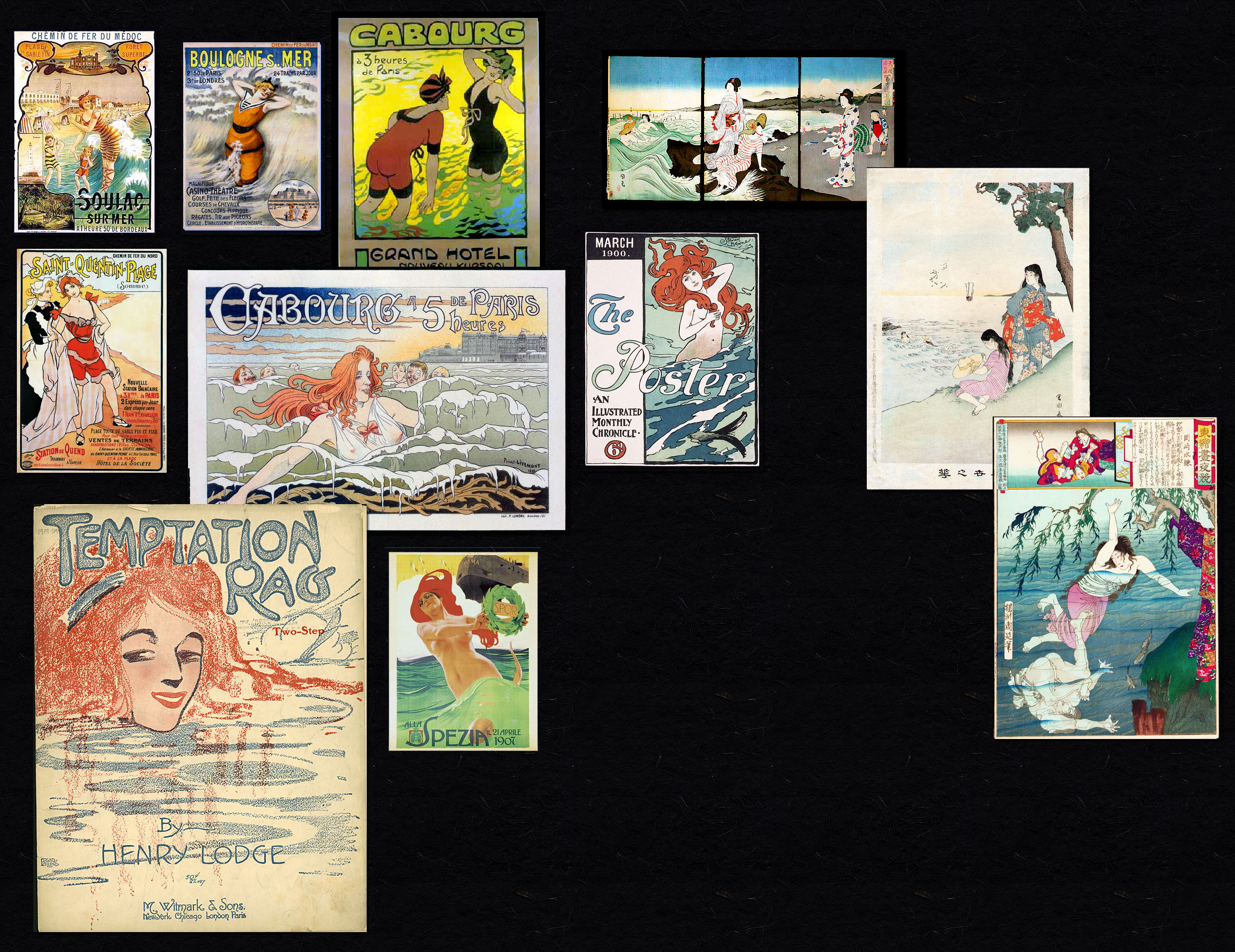
as one can easily see, the history of pleasure swimming has been pretty much the same in the west and in japan.

only in japan you do not need red hair to participate.

Labels: , , , , , , ,

01 January 2008

sing in the year

maggie and milly and molly and may


maggie and milly and molly and may

went down to the beach(to play one day)


and maggie discovered a shell that sang

so sweetly she couldn't remember her troubles,and


milly befriended a stranded star

whose rays five languid fingers were;


and molly was chased by a horrible thing

which raced sideways while blowing bubbles:and


may came home with a smooth round stone

as small as a world and as large as alone.


For whatever we lose(like a you or a me)

it's always ourselves we find in the sea


E. E. Cummings

from The Complete Poems: 1904-1962 by E. E. Cummings; Copyright © 1991

(perhaps from all this you can make a perpetual january. at least this year january 1907 seems to fit. i have some mays and i will look for other months. i wonder if we'll ever have a year.)

happy new year everyone.

Labels: , , ,

happy sunrise to you all

Labels:

31 December 2007

have a good one tonight, folks

THE LADY IN THE TUTTI-FRUTTI HAT
(Sheet music version)

CHORUS 1:

I wonder why does ev'rybody look at me
And then begin to talk about a Christmas tree?
I hope that means that ev'ryone is glad to see
The lady in the tutti-frutti hat.
The gentlemen, they want to make me say, "Si, si,"
But I don't tell them that, I tell them, "Yes, sir-ee!"
And maybe that is why they come for dates to me,
The lady in the tutti-frutti hat.
Some people say I dress too gay,
But ev'ry day, I feel so gay;
And when I'm gay, I dress that way,
Is something wrong with that?
Americanos tell me that my hat is high,
Because I will not take it off to kiss a guy;
But if I ever start to take it off, ay, ay!
I do that once for Johnny Smith
And he is very happy with
The lady in the tutti-frutti hat.

CHORUS 2:

You hear a lot of people shouting, "There she goes!"
You see a seсorita dressed in flashy clothes,
In Rio de Janeiro, ev'rybody knows
The lady in the tutti-frutti hat.
When she begins to sing a song in Portuguese,
The temp'rature goes up a hundred more degrees;
Although they're freezing prices, they would never freeze
The lady in the tutti-frutti hat.
It isn't any wonder that
She likes her native habitat,
'Cause when she has to pick a hat,
She picks it off the trees.
She always has a half a dozen Romeos,
And when they come to sing a serenade, she throws
A lemon or banana like you throw a rose,
But Casanovas still prefer
That hep and happy character,
The lady in the tutti-frutti hat.

Lyric by Leo Robin
Music by Harry Warren

(one thing i found most interesting is that the only real equivilent to western hats i could find in the japanese prints were on the men playing women in kabuki, and not on women themselves.)

Labels: , , , , , , , , , ,

30 December 2007

they can't take that away from me

29 December 2007

luxe, calme et volupté

WHITE KIMONO

Sleeves of oyster, smoke and pearl,
linings patterned with chrysanthemum flurries,
rippled fields: the import store's

received a shipment of old robes,
cleaned but neither pressed nor sorted,
and the owner's cut the bindings

so the bales of crumpled silks
swell and breathe. It's raining out, off-season,
nearly everything closed,

so Lynda and I spend an hour
overcome by wrinkly luxuries we'd never wear,
even if we could: clouds of--

are they plum blossoms?--
billowing on mauve, thunderheads
of pine mounting a stony slope,

tousled fields of embroidery
in twenty shades of jade:
costumes for some Japanese

midsummer's eve. And there,
against the back wall, a garment
which seems itself an artifact

of dream: tiny gossamer sleeves
like moth wings worrying a midnight lamp,
translucent silk so delicate

it might shatter at the weight
of a breath or glance.
The mere idea of a robe,

a slip of a thing
(even a small shoulder
might rip it apart)

which seems to tremble a little,
in the humid air. The owner--
enjoying our pleasure, this slow afternoon,

in the lush tumble of his wares--
gives us a deal. A struggle, to narrow it
to three: deep blue for Lynda,

lined with a secretive orange splendor
of flowers; a long scholarly gray for me,
severe, slightly pearly, meditative;

a rough raw silk for Wally,
its slubbed green the color of day-old grass
wet against lawn-mower blades. Home,

we iron till the kitchen steams,
revealing drape and luster.
Wally comes out and sits with us, too,

though he's already tired all the time,
and the three of us fog up the rainy windows,
talking, ironing, imagining mulberry acres

spun to this unlikely filament
--nearly animate stuff--and the endless
labor of unwinding the cocoons.

What strength and subtlety in these hues.
Doesn't rain make a memory more intimate?
We're pleased with our own calm privacy,

our part in the work of restoration,
that kitchen's achieved, common warmth,
the time-out-of-time sheen

of happiness to it, unmistakable
as the surface of those silks. And
all the while that fluttering spirit

of a kimono hung in the shop
like a lunar token, something
the ghost of a moth might have worn,

stirring on its hanger whenever
the door was opened--petal, phantom,
little milky flame lifting

like a curtain in the wind
--which even Lynda, slight as she was,
did not dare to try on.

Mark Doty

from Sweet Machine by Mark Doty. All rights reserved, HarperCollins Publishers.

Labels: , , , , , , , , , , , , ,

26 December 2007

for mary ellen robertson

FIRE AND RAIN

Just yesterday morning they let me know you were gone
Suzanne, the plans they made made put an end to you
I walked out this morning and I wrote down this song
I just can't remember who to send it to

I've seen fire and I've seen rain
I've seen sunny days that I thought would never end
I've seen lonely times when I could not find a friend
But I always thought that I'd see you again

Won't you look down upon me Jesus
You got to help me make a stand
You just got to see me through another day
My body's achin' and my time is at hand
And I won't make it any other way

Oh I've seen fire and I've seen rain
I've seen sunny days that I thought would never end
I've seen lonely times when I could not find a friend
But I always thought that I'd see you again

Been walkin' my mind to an easy time
My back turned towards the sun
Lord knows when the cold wind blows
It'll turn your head around
Well, there's hours of time on the telephone line
To talk about things to come
Sweet dreams and flying machines in pieces on the ground

Oh, I've seen fire and I've seen rain
I've seen sunny days that I thought would never end
I've seen lonely times when I could not find a friend
But I always thought that I'd see you, baby, one more time again now
Thought I'd see you one more time again
There's just a few things comin' my way this time around now
Thought I'd see you, thought I'd see you
Fire and rain

James Taylor

(i just learned last night that a very
dear friend from high school had died.)

Labels: , , ,

24 December 2007

for you and yours


to turn radio down: slider, off: box; next tune: arrows

Labels:

23 December 2007

skin love sun water god and skin

MARINE SURFACE, LOW OVERCAST

Out of churned aureoles
this buttermilk, this
herringbone of albatross,
floss of mercury,
déshabille of spun
aluminum, furred with a velouté
of looking-glass,

a stuff so single
it might almost be lifted,
folded over, crawled underneath
or slid between, as nakedness-
caressing sheets, or donned
and worn, the train-borne
trapping of an unrepeatable

occasion,
this wind-silver
rumpling as of oatfields,
a suede of meadow,
a nub, a nap, a mane of lustre
lithe as the slide
of muscle in its

sheath of skin,
laminae of living tissue,
mysteries of flex,
affinities of texture,
subtleties of touch, of pressure
and release, the suppleness of long and
intimate association,

new synchronies of fingertip,
of breath, of sequence,
entities that still can rouse,
can stir or solder,
whip to a froth, or force
to march in strictly
hierarchical formation

down galleries of sheen, of flux,
cathedral domes that seem to hover
overturned and shaken like a basin
to the noise of voices,
from a rustle to the jostle
of such rush-hour
conglomerations

no loom, no spinneret, no forge, no factor,
no process whatsoever, patent
applied or not applied for,
no five-year formula, no fabric
for which pure imagining,
except thus prompted,
can invent the equal.

Amy Clampitt

from What the Light Was Like © 1983


with his wife marthe as his muse, the very spiritual denis painted women bathed in sunlight's gold, goddesses is the wrong word, creations is possibly closer. holy. we are healed by the sight of women, and i think that as long as we are suckled at women's breasts, we all, men and women alike, will love the sight. and clampitt could not compare anything so beautifully to skin without also loving it herself. and who could not. sun, light, water, children, skin, who needs more prayer than this?

Labels: , , , ,

newer posts older posts