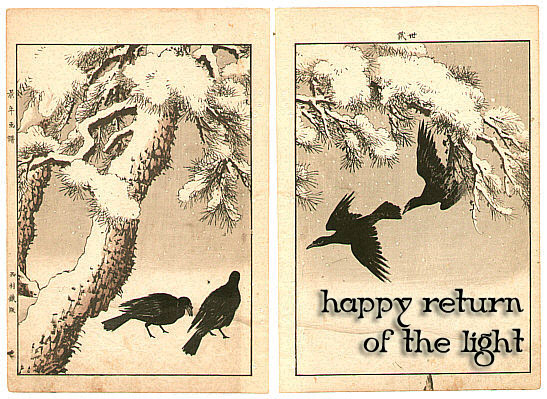
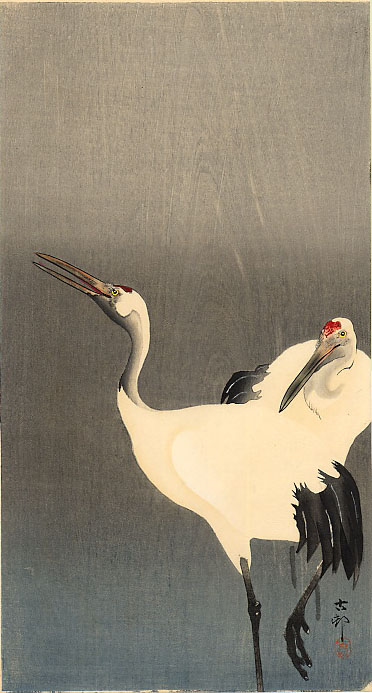
fear not the night, dears


with no pattern but beauty!

but
joy!
welcome the light!
Labels: bairei kono, biho hirose, chikuseki, edna boies hopkins, ethel kirkpatrick, ito sozan, kogyo tsukioka, seitei (shotei) watanabe, solstice


Labels: bairei kono, biho hirose, chikuseki, edna boies hopkins, ethel kirkpatrick, ito sozan, kogyo tsukioka, seitei (shotei) watanabe, solstice
thanks to nathako at cosmopolitan stories. i always feel slightly tipsy when i try to read a french site, even with a translator. so i can't tell for sure if this is from a film, or from the period (the quality of the photograph, and her make-up, don't look like they're as old as the painting).
since we are so used to seeing it, i would like to remind you that pattern-printed, colorful clothing on women was not the stuff of illustration, nor of, well, clothing.
but in rhead we have an unconscious, or subconscious, or just plain exuberant exploration of color and design unseen in western illustration until the influence of japanese art.
an interesting question might be, what is it in the japanese culture (pictured here by masanobu kitao) that the vibrant fabric was the norm? prints are so often awash with what to our eyes might be considered wildly competing motifs, with ornament and hue brought together in what to us may seem confection; what then, to the japanese?Labels: fashion, illustration, kitao masanobu, louis rhead

in all the websites, books and articles i've read, i can't find anyone saying, those rhead brothers sure had a great collection of japanese prints, or, they sure went to japan a lot.
the brothers' family, originally from england, was made up of potters, and incorporating japanese designs into their work was well-known internationally. both moved to the us where frederick rhead continued the family tradition and became a potter.
louis rhead was one of the three illustrators (with will bradley and edward penfield) to lead the procession when it came to japanese influences to the graphic arts in the us. in addition to being a poster maker, he was the editor of the japanese special issue of 'the art interchange,' a popular magazine devoted to arts and decor.Labels: Eisen Ikeda, frederick rhead, imari ware, isoda koryûsai, louis rhead
"Two common embodiments of the cat in Japanese mythology are at two extremes. There is the cat god of lightning, a frenzied creature called Raiju, who leaps frantically from tree to tree in a thunderstorm, scratching the trees with its razor-sharp claws and creating the sound of thunder.
Then, there is the cat god of good luck—Maneki Neko, who sits beneficently with its paw raised, and has become absolutely ubiquitous in countless shops and homes. In the complex history of this myth, the gesture of the raised paw may be based on images of cats washing their face—an action they sometimes perform in the company of strangers. At some point, a link was made between a cat washing its face and the presence of visitors; as time went on, it became causal—the sight of a cat washing its face could actually mean visitors were coming. From there came the next step: that a cat washing its face would invite visitors, much like an inviting hand." 1
i am readying the houseLabels: cats, Kuniyoshi Utagawa, theophile steinlen
edward penfield (collier's cover here; plus many harper's covers), will bradley and louis rhead were illustrators, designers and poster makers at the turn of the century. their work was exhibited with the japanese prints that were being imported to the us, and the style of each became strongly influenced by the prints. we see the same flat expanses of color interceded by rich pattern, and the asymmetrical layouts.
bairei kono was a printmaker/painter who lived and worked in kyoto during the meiji period. he was also an influential teacher.Labels: bairei kono, louis rhead
okay, after going through all 1,007 images that one pulls up when doing a search for 'snow' on artelino, i am of the conclusion that.... there are no shadows in japan!!!
or maybe it's that part of the look of the japanese prints during most of the time we're talking about here that shadows were not displayed.
of course it was the posts on the 18th and 19th that got me started looking (and here i'm using different william rice (above right) and walter j phillips (above left) images which illustrate the same fondness we westerners seem to have with blue shadows).Labels: ito, walter j phillips, william rice
(seitei watanabe; francois & victor clerice; leonetto cappiello; maria likarz; theophile-alexandre steinlen; biho takahashi)Labels: clerice, leonetto cappiello, maria likarz, seitei (shotei) watanabe, takahashi biho, theophile steinlen
i am struck by the similarity between this walter j phillips image and the william rice image just below. well, same times, same motiva- tions. can't find a japanese print from which these could be a direct descen- dant, but there's time....Labels: walter j phillips
William Seltzer Rice began his art career as a watercolorist. At the Panama Pacific International Exposition of 1915, in San Francisco, Rice became interested in the art of Japanese prints. From that time on he worked almost exclusively with woodblocks, though he relied on watercolors and pastels for sketching on location. In the studio he would carve the blocks, apply oil based inks with a sable brush, and press the Japanese paper by hand.
He was the author of three books - Block Prints: How to Make Them (1929), Block Printing in the School (1941), and Portfolio of Block Prints (1932). He taught in the public school systems of the Bay area, and he also taught at the many art societies, including the San Francisco Art Association, the California Society of Print Makers, and the Prairie print Makers.
Rice wrote about his philosophy of printmaking and said:
...the viewpoint of the artist differs from that of the commercial printer. In hand printing, each print has a beauty and individuality of its own. The aim is not to produce editions in large quantities, all alike and uniform, but to obtain slight variations which give a personal character to each print. The making of color prints of this type is essentially a painter's performance. There is a great fascination about color experimentation. The real pleasure comes from seeing the same subject appear in different colors, the design gaining in interest with each new color scheme. Wonderful color effects may be obtained by continual experiments. It would almost seem, sometimes, that no block has ever spoken its last word when it comes to its final color scheme.1
rice was clearly not the only one who felt that way, as these charming images by arthur wesley dow, and yoshida hiroshi illustrate.


Labels: arthur wesley dow, hiroshi yoshida, william rice

by the time he done this image of shichiri beach in soshu, kawase had already lost everything once: in a 1923 earthquake that killed 140,000 people, and that had destroyed everything in watanabe's publishing house (along with the work of many other shin hanga artists as well.)Labels: arthur wesley dow, kawase hasui

Labels: cats, Kuniyoshi Utagawa, manet

Labels: book review

for seventeen and a half years, every time i ate an orange, i never touched it with my hands. i figured out a way to do the whole peeling and separating part through a plastic bag.
robert just hated that smell on my hands.
while i buried him, a white- crowned sparrow pecked around in the spilled niger thistle seed under the gold- finch feeder. his friend sang. i was grateful.
over time, after once leaving me the gift of a hummingbird in my bedroom slipper, robert learned not to chase and catch birds. he was very smart.
i am going to go and eat an orange with my bare hands.Labels: carl moser, otto eckmann, theo van hoytema, walter klemm, yoshitoshi Taiso