japonisme

09 July 2011

Where am I standing, if I'm to stand still now?


1795

.朧々ふめば水也まよひ道
oboro-oboro fumeba mizu nari mayoi michi

in hazy night
stepping into water...
losing my way

Issa
David G. Lanoue


The season word in this haiku, oboro, refers succinctly to a hazy night of spring. In this uncertain, dreamlike light, Issa steps off a path into water. Hiroshi Kobori notes that the poet's state of mind is like the misty night. He feels insecure and bewildered, aware of the uncertainty of his own future.


According to Lewis Mackenzie, this haiku alludes to the death of one of Issa's friends, a Buddhist priest. On a journey, Issa went to visit him only to find that he had been dead for several years. Mackenzie translates the last phrase, "Ways of delusion!" See The Autumn Wind: A Selection from the Poems of Issa (London: John Murray, 1957; rpt. Tokyo: Kodansha International, 1984), 30.

In Saigoku kikô ("Western Provinces Travel Diary") there is an explanatory prescript of which Shinji Ogawa offers this paraphrase: After hearing of his priest friend Sarai's death, Issa begged his replacement for a night's stay at the temple but was refused. Counting on Sarai, he had come over 300 ri (732 miles), "without a soul to lean on, going over the fields and the yards..." See Issa zenshû (Nagano: Shinano Mainichi Shimbunsha, 1976-79) 5.36.

Makoto Ueda reports that Issa found a place to stay that night "just one hundred feet away"; Dew on the Grass: The Life and Poetry of Kobayashi Issa (Leiden/Boston: Brill, 2004) 33.


Debi Bender likes the repetition and alliteration in the opening phrase (oboro-oboro). To preserve this subtle music, she suggests this translation:

misty, misty moon
stepping into water
losing my way

Issa, Debi Bender

THE BROKEN SANDAL

Dreamed the thong of my sandal broke.
Nothing to hold it to my foot.
How shall I walk?
Barefoot?
The sharp stones, the dirt. I would
hobble.
And–

Where was I going?
Where was I going I can't
go to now, unless hurting?
Where am I standing, if I'm
to stand still now?

Denise Levertov
Labels: , , , , , , , , , , , , ,

06 July 2011

revolution by simplicity

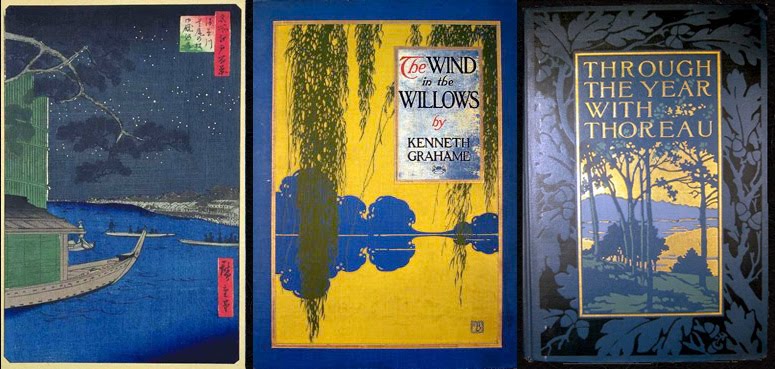
Many developments in 19th century art reflect the influence of Japan. Artists such as Manet experimented with flattened forms after seeing Japanese prints. Vincent van Gogh collected hundreds of Japanese prints, and they influenced his use of brilliant colors and heavy outlines. Larger artistic movements such as Arts and Crafts and Art Nouveau have a great deal of Japonisme at their root. Though the primary Japonisme craze was in the 1880's and 90's, artists and designers continued to use elements of the style for some time, particularly when dealing with Japanese themes.

With respect to book-binding, cover designers employed a variety of techniques that reflected an interest in Japanese style. In the Victorian period, covers that didn't necessarily look Japanese showed the influence through the use of asymmetrical design, strong diagonals, oriental typefaces and motives, and a variety of fill patterns.

In the move away from more gaudy Victorian covers, many designers appreciated the simplicity of some of Japanese style. Some covers mimicked the binding style of Japanese books, or Japanese paper. Others used an oriental style typeface or actual Japanese characters. Asymmetrical design continued to be popular as well as imitations of the flat Japanese landscape style. Many of the covers of books by author Lafcadio Hearn are done in these styles, reflecting his subject matter and immigration to Japan.

Certain known cover designers showed influence by Japonisme. Some of Sarah Wyman Whitman's simple elegant designs have evidence of roots in Japonisme, while others use more explicit Japanese motifs, although she herself denounced the gaudy 1880s eclectic covers that "represented a combination of bad French art mixed with Japanese art; scrolls and arabesques, which had to do with some debased form of book cover mixed with a bit of Japanese fan." Several covers by Bertha Stuart, who designed primarily between 1903 and 1911 show a strong Japanese influence as well.

not, i will admit, wholly new, but i believe all of these extraordinary images are, new to this blog. much much more at the website where these words come from, HERE. these designers, they take my breath away. see more from this blog (including links) HERE.

Labels: , , , , , , , , ,

04 July 2011

no wedgies either

No ironic commentary on their clothing, their religion, their customs, shall be done, and no rude or insulting words shall be sent them.


We will not use the words keto (Chinese hairy) akahige (red beard), and ijin (barbaric).


One should not face them with impert- inence.


When we visit a strange house, one should be wearing clean shoes.


Foreign missionaries must be respected as equal to Japanese priests.


Avoid disturbing the games or rides strangers by throwing tiles, stones or sticks, or spitting, throwing fruit peels and scraps of cigars on trains or boats where you find them.


oddly, these words appear just under that lovely photo of the horikiri iris garden. if there is a larger context, neither my french skills nor my translating (google) patience give me any real context. it may surprise you (it surprised me) to learn that the photograph was taken in 1915, and hiroshi yoshida's print of the same place is from 1928. and the book is HERE.

Labels: ,

02 July 2011

firebird


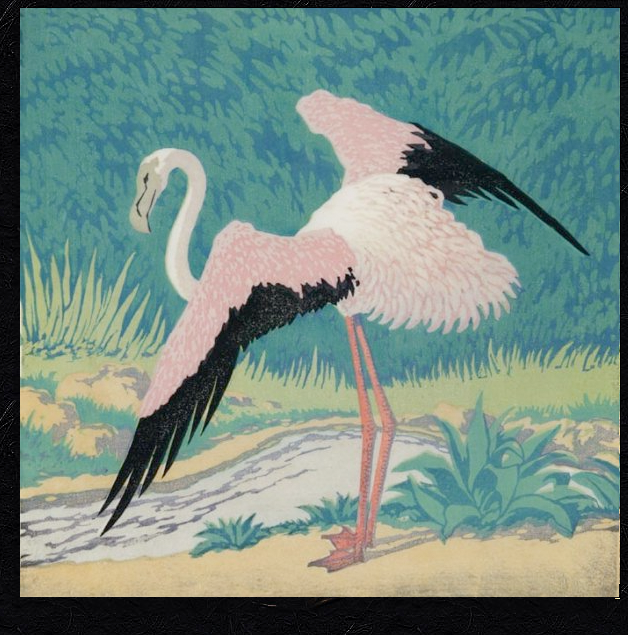
FLAMINGO WATCHING

Wherever the flamingo goes,
she brings
a city’s worth
of furbelows.
She seems


unnatural by nature—
too vivid and peculiar
a structure to be pretty,


and flexible to the point
of oddity. Perched on


those legs,
anything she does
seems like an act. Descending
on her egg or
draping her head


along her back, she’s
too exact and sinuous


to convince an audience
she’s serious.
The natural elect,
they think,
would be less pink,


less able to relax
their necks,
less flamboyant
in general.
They privately expect
that it’s some


poorly jointed bland
grey animal
with mitts for hands
whom God protects.

Kay Ryan

Kay Ryan, “Flamingo Watching” from Flamingo Watching (Copper Beech Press, 1994). Copyright © 1994 by Kay Ryan.

(over to you, m. ghost)

Labels: , , , , , , , , , ,

29 June 2011

hanging

i'd been considering this post for a good while now, smart and politically savvy, with videos that make today's washing machines look like miraculous sea creatures, and doing laundry appear similar to dancing the ballet. oh give me a break, i'd think. a chore is a chore. etc. then i saw this poem, and my vision was changed.

THE WASH

A round white troll with a black, greasy
heart shuddered and hummed "Diogenes,
Diogenes," while it sloshed the wash.
It stayed in the basement, a cave-dank
place I could only like on Mondays,
helping mother. My job was stirring
the rinse. The troll hummed.
Its wringer stuck
out each piece of laundry like a tongue--

socks, aprons, Daddy's shirts, my brother's
funny (I see London) underpants.
The whole family came past, mashed flat
as Bugs Bunny pancaked by a train.
They flopped into the rinse tub and learned
to swim, relaxing, almost arms and legs
again. I helped the transformation
with a stick we picked up one summer

at the lake. Wave-peeled,
worn to gray, inch
thick, it was a first rate stirring stick.
Apprenticed on my stool, I sang a rhyme
of Simple Simon gone afishing
and poked the clothes around the cauldron
and around. The wringer was risky.
Touch it with just your fingertip,
it would pull you in and spit you out

flat as a dishrag. It grabbed Mother
once--rolled her arm right to the elbow.
But she kept her head, flipped the lever
to reverse, and got her arm back, pretty
and round as new. This was a story
from Before. Still, I seemed to see it--
my mother brave as a movie star,
the flattened arm pumping up again,

like Popeye's. I fished out the rinsing
swimmers, one by one. Mother fed them
back to the wringer and they flopped, flat,
into baskets. Then the machine peed
right on the floor; the foamy water
curled around the drain and gurgled down.
Mother, under the slanting basement
doors, where it was darkest,
reached up that

miraculous arm and raised the lid.
Sunlight fell down the stairs, shouting
"This way out!" There was the day, an Easter
egg cut-out of grass and trees and sky.
Mother lugged the baskets up. Too short
to reach the clothesline, I would slide down
the bulkhead or sit and drum my heels
to aggravate the troll (Who's that trit-

trotting...) and watch.
Thus I learned the rules
of hanging clothes: Shirts went upside down,
pinned at the placket and seams. Sheets hung
like hammocks; socks were a toe-bitten
row. Underpants, indecently mixed,
flapped chainwise, cheek to cheek. Mother
took hold of the clothespole like a knight
couching his lance and propped the sagging

line up high, to catch the wind. We all
were airborne then, sleeves puffed out round
as sausages, bottoms billowing,
legs in arabesque. Our heaviness
was scattered into air, our secrets
bleached back to white. Mother stood easing
her back and smiled, queen of the backyard
and all that flapping crowd. For a week

now, each day, we'd put on this jubilee,
walk inside it, wash with it, and sleep
in its sweetness. At night, best of all,
I'd see with closed eyes the sheets aloft,
pajamas dancing, pillow cases
shaking out white signals in the sun,
and my mother with the basket, bent
and then rising, stretching up her arms.

Sarah Getty

From The Land of Milk and Honey, by Sarah Getty,
published by the University of South Carolina Press, 1996.
Copyright © 1996 by Sarah Getty. All rights reserved.

Labels: , , , ,

26 June 2011

released

RELEASE

With rod and tackle box,
I'm slogging through soft sand,

a red sun going down in the surf,
swag-belly clouds drifting in

with Ray, only two months dead,
going on about girls that summer

we studied French in Québec and
guzzled Labatts at the Chien d'Or,

about how he'll marry again, keep
at it until he gets it right—
Pas vrai
?

Above the tide wrack, a woman
in a two-piece with half my years

kneels struggling in the sand
with a pillow of feathers,

one wing flapping—a pelican
tangled in fish line, treble hook

in the bill pouch,
the other in its wing.
Ray says, Ask her out for a drink

but she says,
Could you give me a hand?
I drop the tackle and secure the wing

while she croons to calm him and
with one free hand
untangles the line.

With pliers from the tackle box,
I expose the barbs and carefully clip,

a total of six loud snaps.
Then I hold
the bird while she frees
the last tangle

and we step back,
join the onlookers,
a father explaining care to his kids.

The pelican now tests his wings, rowing
in place. He looks around and seems

to enjoy the attention, just as Ray did
in bars, buying drinks and telling jokes.

But this college boy with a can of Bud
is no joke and says they watched it flap


all afternoon
from that deck on the dune.
His buddy agrees with a belch

that buys a round
of frat boy laughter.
Ray tells me the kid needs his clock cleaned

just when the pelican waddles up
and puts his soft webbed foot on mine.

He tilts his head to
catch my look, then
flapping runs into the air,
tucks his feet,


and climbs, turning over our small circle,
before heading west. Dazzled and dumb,

I'm faintly aware of the woman,
then gone,
weightless and soaring over water, looking

down on myself slogging through sand,
certain that I'm being watched,


if only by another self
who will have to tell how it happened.

Peter Makuck

From Long Lens by Peter Makuck. Copyright © 2010 by Peter Makuck.

Labels: , , , , , , , , ,

24 June 2011

birds of a feather....

...can now
get married


in New York!

it just got better

Labels: , , ,

23 June 2011

second hand rose

simultaneous with ukiyo-e, was chiyogami, printed with woodblocks, just like the prints.


one story has it that the prints were "discovered" as they were used as wrapping paper; chiyogami was created as wrapping paper!


considered as decorative rather than narrative, the collections and comments are far rarer than are those for ukiyo-e. i'll recommend some great books; if you want the whole story, it really is all over the internet.


it was used for bookbinding and toy-making as well as for wrapping gifts. when i first saw chiyogami, i felt aha! i have found the missing link.

but researching this post, at this moment in my life (of which there is always one), has opened up in me more questions than i would ever answer.

and i ask, should i always want to? the brain may wonder, and allow that to be it. does everyone have to be a scholar?

perhaps i will list some of the questions: why is all of the western design i see so orderly? do the japanese prints seem orderly to the japanese?

why do color combinations and print pairings seem so often off-kilter to my eyes; we would never wear that print with that one. see all the kimono prints. do the japanese see the west as having an odd sense of color and coordination in a look?

what about the wiener werkstatte allowed more chaos in design than other western styles of the time? why do a blog? to look things up in wikipedia or books? to parrot informative information?

why have we insisted upon answers and orderliness? have we understood anything about the japanese at all? stop thinking.

just.


stop.

Labels: , , , , , , ,

newer posts older posts