japonisme

29 December 2006

robert doisneau

thanks to nathako at cosmopolitan stories. i always feel slightly tipsy when i try to read a french site, even with a translator. so i can't tell for sure if this is from a film, or from the period (the quality of the photograph, and her make-up, don't look like they're as old as the painting).

nevertheless, it's an interesting glimpse, this photo, into some of the effect this 'nouveau' movement might have been having on the not-so-nouveau people.

(Exposition de ses photos parisiennes à l'Hotel de ville, jusqu'au 17 février 2007 (salle St-Jean / rue Lobeau / tous les jours sauf dimanches et fêtes de 10h à 19h) : un grand plongeon dans le Paris des années 50-70, vu par Doisneau.)

28 December 2006

cacophany or harmony?

since we are so used to seeing it, i would like to remind you that pattern-printed, colorful clothing on women was not the stuff of illustration, nor of, well, clothing.

nor were highly stylized images of nature. here in the 1850s image we have some sketching in of nature, but with an eye towards 'natural,' sort-of.

but in rhead we have an unconscious, or subconscious, or just plain exuberant exploration of color and design unseen in western illustration until the influence of japanese art.

an interesting question might be, what is it in the japanese culture (pictured here by masanobu kitao) that the vibrant fabric was the norm? prints are so often awash with what to our eyes might be considered wildly competing motifs, with ornament and hue brought together in what to us may seem confection; what then, to the japanese?

Labels: , , ,

27 December 2006

rheading japonisme

in all the websites, books and articles i've read, i can't find anyone saying, those rhead brothers sure had a great collection of japanese prints, or, they sure went to japan a lot.

it was no longer necessary to be 'specifically' a collector, a specialist, or an expert about japanese art because japanese art had become part of the water in which we fish swim. the lessons learned had jumped

from theoretical to 'how things are.'

"Asian aesthetics, transmitted in part through Japonisme—the vogue for Japanese art, architecture, and decorative arts—reinforced a respect for the inherent properties of natural materials and encouraged the use of simplified forms, flattened perspectives, and asymmetry."1

the brothers' family, originally from england, was made up of potters, and incorporating japanese designs into their work was well-known internationally. both moved to the us where frederick rhead continued the family tradition and became a potter.

louis rhead was one of the three illustrators (with will bradley and edward penfield) to lead the procession when it came to japanese influences to the graphic arts in the us. in addition to being a poster maker, he was the editor of the japanese special issue of 'the art interchange,' a popular magazine devoted to arts and decor.


the rheads' british education had given them a broad introduction to the arts & crafts style (which, along with 'liberty style,' was england's 'art nouveau"), which translated well to the design aesthetics spreading across the world.

(koryusai isoda, louis rhead; frederick rhead--left, meiji period imari ware--right; louis rhead, eisen ikeda.)

Labels: , , , ,

24 December 2006

the coming of the cats

"Two common embodiments of the cat in Japanese mythology are at two extremes. There is the cat god of lightning, a frenzied creature called Raiju, who leaps frantically from tree to tree in a thunderstorm, scratching the trees with its razor-sharp claws and creating the sound of thunder.

Then, there is the cat god of good luck—Maneki Neko, who sits beneficently with its paw raised, and has become absolutely ubiquitous in countless shops and homes. In the complex history of this myth, the gesture of the raised paw may be based on images of cats washing their face—an action they sometimes perform in the company of strangers. At some point, a link was made between a cat washing its face and the presence of visitors; as time went on, it became causal—the sight of a cat washing its face could actually mean visitors were coming. From there came the next step: that a cat washing its face would invite visitors, much like an inviting hand." 1

i am readying the house
for her arrival on tuesday

(i believe the first one is by kuniyoshi, and the second is steinlen.
the third, i think her name may be ruby belle but i have to wait until she tells me.)

Labels: , ,

23 December 2006

birds in our transitions

edward penfield (collier's cover here; plus many harper's covers), will bradley and louis rhead were illustrators, designers and poster makers at the turn of the century. their work was exhibited with the japanese prints that were being imported to the us, and the style of each became strongly influenced by the prints. we see the same flat expanses of color interceded by rich pattern, and the asymmetrical layouts.

speaking of penfield (though they could have been speaking of any of the three), publisher's weekly said,
"
The advertising poster has within recent years actually soared into the regions of art." Penfield is also credited with bringing abstraction to commercial art through his boldly simplified shapes. This and other stylistic trademarks resulted from a distillation of a number of influences, including the compositional precepts and casual poses found in Japanese prints, the hand-craftsmanship of the Arts and Crafts movement, the impressionistic approach of Parisian poster-making, and British poise and directness. "*

bairei kono was a printmaker/painter who lived and worked in kyoto during the meiji period. he was also an influential teacher.

his two main bodies of work for which he is remembered are the seasonal documenting of birds and flowers, and another, called 'one hundred flowering plants,' published after his death.

just as penfield was being influenced by bairei's magpie, bairei as well was being influenced by western art, or so i hear. personally, i don't find a shadow in sight.

Labels: ,

20 December 2006

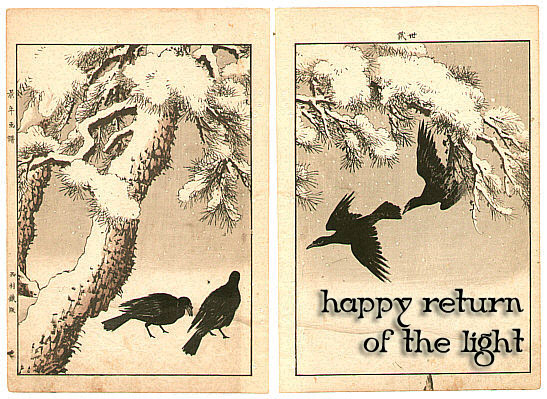
solstice


(Keinen Imao 1892)

Labels:

the shadowless land

okay, after going through all 1,007 images that one pulls up when doing a search for 'snow' on artelino, i am of the conclusion that.... there are no shadows in japan!!!

or maybe it's that part of the look of the japanese prints during most of the time we're talking about here that shadows were not displayed.

of course it was the posts on the 18th and 19th that got me started looking (and here i'm using different william rice (above right) and walter j phillips (above left) images which illustrate the same fondness we westerners seem to have with blue shadows).

the shadowless one on top is by takashi ito.

Labels: , ,

which came first...?

(seitei watanabe; francois & victor clerice; leonetto cappiello; maria likarz; theophile-alexandre steinlen; biho takahashi)

Labels: , , , , ,

19 December 2006

snow shadows

i am struck by the similarity between this walter j phillips image and the william rice image just below. well, same times, same motiva- tions. can't find a japanese print from which these could be a direct descen- dant, but there's time....

Labels:

18 December 2006

color

He was the author of three books - Block Prints: How to Make Them (1929), Block Printing in the School (1941), and Portfolio of Block Prints (1932). He taught in the public school systems of the Bay area, and he also taught at the many art societies, including the San Francisco Art Association, the California Society of Print Makers, and the Prairie print Makers.

Rice wrote about his philosophy of printmaking and said:

...the viewpoint of the artist differs from that of the commercial printer. In hand printing, each print has a beauty and individuality of its own. The aim is not to produce editions in large quantities, all alike and uniform, but to obtain slight variations which give a personal character to each print. The making of color prints of this type is essentially a painter's performance. There is a great fascination about color experimentation. The real pleasure comes from seeing the same subject appear in different colors, the design gaining in interest with each new color scheme. Wonderful color effects may be obtained by continual experiments. It would almost seem, sometimes, that no block has ever spoken its last word when it comes to its final color scheme.1

rice was clearly not the only one who felt that way, as these charming images by arthur wesley dow, and yoshida hiroshi illustrate.
blueinall

Labels: , ,

17 December 2006

between the earthquake and the war


arthur wesley dow created this work several decades before hasui kawase created his, but perhaps both were responding to the onrush of modernity, gatekeepers, both of them, of an imagined past.

or perhaps both just reporting on what they saw. like the impressionist painters, hasui didn't create his images in a studio, but rather on his constants travels in search of beautiful vistas. still preferring a kimono, he wandered the countryside, staying at inns and hunting for "live" views.

by the time he done this image of shichiri beach in soshu, kawase had already lost everything once: in a 1923 earthquake that killed 140,000 people, and that had destroyed everything in watanabe's publishing house (along with the work of many other shin hanga artists as well.)

everything was lost again in the bombing of tokyo in WWII. as they had once before, hasui kawase and watanabe shozaburo rebuilt again.
blue apple pie

Labels: ,

15 December 2006


kuniyoshi, cat lover, cat artist, portrays himself, with his cats, at home.

i realize that kuniyoshi has drawn himself as a cat as well.


Labels: , ,

14 December 2006

the gift of light


thomas paquette's new book: gouaches.

almost more a book of poetry
than one
of paint.

http://www.thomaspaquette.com/books.html

Labels:

13 December 2006

eating oranges


for seventeen and a half years, every time i ate an orange, i never touched it with my hands. i figured out a way to do the whole peeling and separating part through a plastic bag.

robert just hated that smell on my hands.


while i buried him, a white- crowned sparrow pecked around in the spilled niger thistle seed under the gold- finch feeder. his friend sang. i was grateful.

over time, after once leaving me the gift of a hummingbird in my bedroom slipper, robert learned not to chase and catch birds. he was very smart.


for the last seventeen and a half years it has been just me and robert living alone together. monogamous. this now feels unreal.

i am going to go and eat an orange with my bare hands.


(ohara koson; yoshitoshi; hoytema; walther klemm; carl moser; otto eckmann; carl moser again; totoya hokkei.)

Labels: , , , ,

12 December 2006

till there was you

from The Music Man, by Meredith Wilson

There were bells....on the hill,
but I never heard them ringing
No, I never heard them at all,
Till there was you.

There were birds....in the sky,
but I never saw them winging,
no, I never saw them at all
Till there was you.

And there was music,
and there were wonderful roses,
they tell me, in sweet fragrant
meadows of dawn and dew.


There was love, all around

but I never heard it singing,
no, I never heard it at all
Till there was you.

Then there was music and wonderful roses
they tell me, in sweet fragrant meadows
of dawn and dew

There was love all around
But I never heard it singing
No, I never heard it at all
Till there was you
Till there was you

isn't it strange, isn't it interesting, that "we," well, the west anyway, didn't seem to see plum blossoms, or cherry, until they saw japan see plum blossoms and cherry. also interesting, though, is that i rarely see ornamental design being used the same way in both cultures; if it's on pottery in the west, it generally isn't in the east.


(top is by toshi yoshida, for dom; ohara koson; eiho hirezaki; royal doulton.)

Labels: , , , ,

11 December 2006

thanks, folks.

can't respond personally right now.

will resume when i can.

09 December 2006

flight


robert died this morning about an hour before it started getting light. as soon as i could see i went out and began to dig a space for him under a tree where he used to like to hang out. he's had other spots since then, but none for as long.

i wrapped him in his red towel and carried him outside and found i hadn't made it deep enough. it was kind of difficult because of all the roots, but i finally made it okay.

nine and a half years ago he developed kidney disease and i was told he wouldn't live much longer. i have been giving him kitty dialysis since then, so feel like i got ten extra years. about a year ago his heart began to fail, and for a year he's been on all these meds.

in the last month or so his eyesight really went, he lost a lot of weight, his legs really began bothering him. each change, he would adjust to, and he's spend as much time in the sun, or drinking from the pond as he could.

this morning he was hurting, i could tell, and when he didn't seem to want anything i offered him, and he was crying this pitiful little yow that he had always only done specifically get my attention.

i took him back on the bed with me and scratched his head and his chest to try to help him relax. i paused at one point and he put his head back to my hand. we stayed like that for ten or twenty minutes. i didn't stop scratching. and then found myself wondering if he were still breathing. i kept scratching for a long while after, not knowing, not caring, knowing it didn't matter--it would be good for him in any case.

putting the dirt back felt rude, but it was very important that noone, not squirrel, racoon, nor possum dig him up.

i wanted peace for him, and for the garden around him.

i herringboned mossy bricks over him, and felt guilty for doing this before his body was completely cold. but he had been gone for over an hour, and it also didn't feel right not to. it's easier, i learned a long time ago, to feel guilt than to feel grief.
08 December 2006

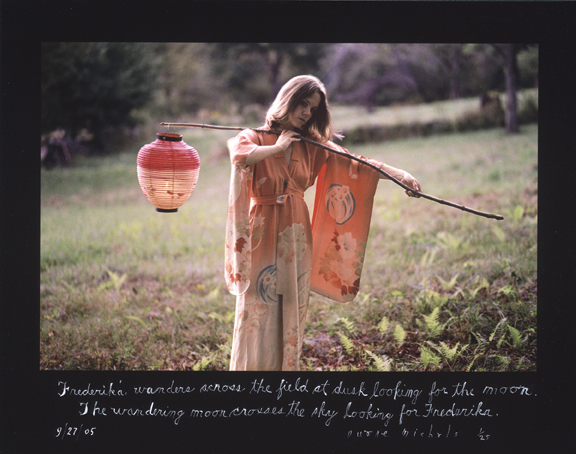
Frederika wanders across the field at dusk looking for the moon

DUANE MICHALS
Japonisme: Photographs From the Floating World

November 9 through December 30, 2006
Opening reception with the artist:
Thursday, November 9, 6-8pm

This exhibition is accompanied by a lecture at the Photographic Resource Center at Boston University on Wednesday,
November 8. Please call the PRC for more information (617) 975-0600

38 Newbury StreetFourth Floor Boston, MA 02116

Inquiry@RobertKleinGallery.comThis email address is being protected from spam bots, you need Javascript enabled to view it
Phone: 617.267.7997
Fax: 617.267.5567

Labels: ,

07 December 2006

100 views of carl otto czeschka


die nibelungen, again, by czeschka

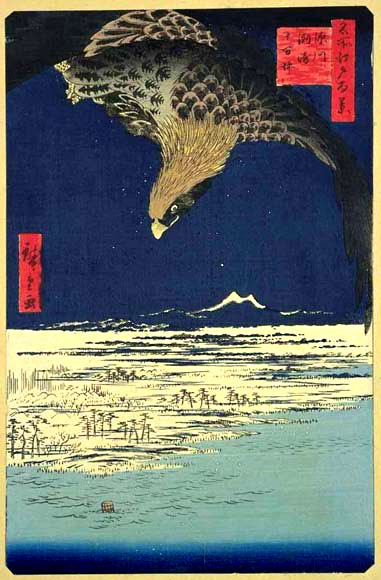
and then one of hiroshige's 100 views of edo.

Labels: , ,

newer posts older posts