japonisme

01 August 2011

disagree with awe

In our narrow-minded fuss over progress -- while displaying an artistic hubris that only listens to its own voice -- we would have already reached complete bankruptcy, despite the short duration of the modern movement, if Japanese art had not served it as a pillar. With few exceptions, every innovation we wanted to achieve in the realm of natural forms here in Europe had already been done as well, or often much better in Japan -- imparted to us with a certain deviation from its national style.

In Japan all the preconditions were at hand for a tendency toward this quasi-naturalistic sort of art: not organically-arranged forms in the manner of Greek art, but rather effects with completely smooth surfaces; instead of monumental structures, playful, simple forms whose only function is to be held in the hand and to be tenderly observed by an individual.

A rich technique, and nonetheless one which at times rests in the quality of handwork. A loving examination of nature, a measured stylization, one that has been practiced for centuries. A sensitivity for color, taken to its extreme, besides a good deal of plain childlikeness, a joy in the bizarre, in the wonderful ways of nature. It is an art from which one can learn an infinite amount and which could just as easily lead one astray.

Whoever is used to see art forms as something not coincidental -- as we should all be, the devotees of Winkelmann's art history -- who ever sees them instead as the necessary historical result of the general development of art, will find it unlikely that our century, which experienced a complete crisis of all views and lifestyles as a result of the appearance of the natural sciences, would be able to create its artistic expression purely from the reserve of the past.

A period that sets itself so strongly apart from the past, must, and will create for itself a new sphere of shapes, which one day will be recognized as the style of the natural scientific age.

Julius Lessing, "What's Modern in Art?" Berlin, 1898


here i offer a few more images from the book/exhibition in my last post, and some extrapolations. we've seen before the design inspirations that were the triangle of glasgow, vienna, and poiret with japan but more is offered: the hoffmann at the bottom left, the moser in the middle, and the japanese on top. was the comb made for expert? we'll never know, but if it was, it might lessen its inspirational value. we'll never answer these questions. as we've seen, people constantly disagreed at the time as well. but nobody can disagree with awe.

see the whole year of 1898 of "ver sacrum" from which many of the images these two posts were taken.

Labels: , , , , ,

28 July 2011

Verborgene Impressionen : Hidden Impressions

these images and the comments below are from the exhibition and catalogue of the same name as this post, held in vienna in the spring of 1990. again, we can see how the perspective and the artwork itself changes from country to country.

[commercial trade between austria and japan did not begin until 1869, as no treaties had yet been signed. at last the ships from austria were in japanese waters, and mercantile interests were being pursued.]

Art was included in their planning only to a minor extent -- at first. Export, import, commercial profits in the account-books, that was the motto. However, through its industrial products and handicrafts, Japan, only just linked to world trade connections, provided this very thing -- art, and did so in a fascinating way. In massive numbers and for prices that were as unprecedented as they were horrendous, china, lacquered works, bronzes, silk, all sorts of dyed textiles and other handicrafts were leaving the country en masse.

In a remarkably short time discriminating connoisseurs and artists in the west discovered in an art which up until now had been practically inaccessible, an expression of bourgeois culture that was comparable to theirs, highly cultivated, and refined, one that would maintain the search for new means of artistic expression, and, even more important, enrich it. "In every field", summarised the preface to the catalogue of the great Japanese exhibition in the Vienna Secession in the year 1900 "new experiments were taking place, a searching and feeling for new means of expression, which nature was not going to render simply by a naive enjoyment of the world of appearances.

The intention to simplify, to find the quintessence of things became the criterion. The pioneers of art were searching for models they could build on, that they could develop within themselves. They found what they were looking for in the age-old culture of the East, in the art of the Japanese." "Japonisme", as it was called, meaning the sum total of all the very varied influences of Japanese style, moved in to conquer western creativity and sensibility.

First of all it overtook western Europe and then, after a certain lapse of time, moved from there to central and eastern Europe as well. In its more narrow sense Japonisme is a phenomenon that can be explained according to its own aesthetic principles; indeed, taking an example from the graphic arts or painting, this can be seen most clearly wherever the accustomed, almost mathematical exactness of perspective is sacrificed in favour of an emphasis on decorative surface. As well as this, the fact that the ornamentation can be repeated arbitrarily may well diminish individuality but the elements of timelessness and universality this adds are equally valid.

Europe discovered these principles most of all in the woodcuts and engravings, which were cheap and easy to get hold of. In spite of strict decorative composition and an equal emphasis on line, form and colour in these works the whole area of the page, whether painted on or left free was endowed with the utmost vitality. Exterior characteristics, such as the choice of extremely wide or high formats or fan-forms, which would have been incomprehensible without the Japanese were eagerly exploited by our artists as well.

This art, which had spread all over Europe, which had been welcomed mostly with exultation but also with occasional biting criticism, had become a special stylistic medium enabling it to satisfy not only the expressive needs of many artists, but also to correspond to a certain "Zeitgeist" in public taste. For Japonisme was more than just the transference of aesthetic feeling into works of art; above all it was a phenomenon in the history of intellectual development and taste.

In its broadest sense Japonisme was encountered in almost every livingroom, an exotic spice which had become an integral part of almost every area of domestic and social life, whether in the sugar and tea tins decorated with Geishas, or mocca-cups from Karlsbad and Schlak-kenwerth, who set themselves up in competition with Imari and Satsuma; from ball-dresses a la kimono to postcards with blond "musumes"; from travelogues and novels, written by more authors than one Loti, to the first collections of Japanese art in our museums; from Viennese and Budapest educated classes, the Bildungsbiirger, citizens hungry for culture, who became Japan-connoisseurs and fanatics; from artists between Bleiberg and Prague, who wanted to see Nikko and Kyoto with their own eyes, to the dozens of manufacturers who produced Nippon knick-knacks for mantlepieces and glass-cabinets.

"Japonisme" was a motley if pretty miscellany, where understanding and imagination, art and kitsch, the genuine and the pretended were often uneasy bedfellows; out of this emerged, in its own radical and independent potency, the art of the Viennese Secession, or of a Gustav Klimt, and went on to attain an overriding significance; all this came from the same soil and humus, the intensive cultivation of the fashion for things Japanese.

Peter Pantzer, Österreichisches Museum für Angewandte Kunst - 1990

Labels: , , , , , , , ,

23 July 2011

the music of wallpaper

while actually reading the text in my copy of 'hidden impressions,' the catalogue for the exhibition of the same name at the MAK in vienna, of instances where the japanese influenced the austrian arts. we'll get back to that catalogue in a future post, but for now, let's follow this little adventure.

i was wildly taken with the two images of japanese endpapers, the cranes on the salmon background and the puppies. sure i had seen a western equivilent, i searched for days to no avail. all of the western endpapers, even those from childrens' books, were, to my eyes anyway, far more rigid by design.

refusing to give up, i started perusing some others of my books. i double-checked the catalogue and all of my other books about design in vienna at that time: nothing. why, i asked myself, and still do, have japanese endpapers in the catalogue with no japonisme version for comparison?

i started on my other books about paper, wallpaper, and had myself an aha moment. i recalled having noticed so many times how actually un-equivalent these matches-up usually are. rarely does a japanese design form get re-interpreted in some into something comparable back and forth. usually, it, like some inherited traits, skips a generation.

but once i found these, not only didn't they surprise me, but they gave me deeper understanding in both sides of the equation. first, we've discussed the lesson that the west learned that caused them to question the validity of any differences between art, decoration, and craft.

no one embraced this concept more strongly than the nabis, for whom there was no less a creative act in creating wallpaper than in painting a painting. much of what we know as paintings are actually bits of a wall-hanging or a screen (see here), but even when the item was a painting itself, it was covered with wallpaper, and, or, the sort of design that hangs in an invisible balance between subject and surround.

in fact, the more one looks at the work of the nabis (here represented by maurice denis, pierre bonnard, and vuillard), the more one sees rhythm, pulse. these pieces do not make a statement, they make a song.

and the songs have continued out in ever widening circles. whistler sued over it; the right to see a surface as something other than flat, the right to name a painting a symphony, a rhapsody, a song.

Labels: , , , , , , , ,

17 July 2011

ワードが広がっている

if you google-image emile reiber, you will find only, or almost only, items of domestic use and decor, clocks, vases, and the like covered, each of them, with gorgeous, elaborate, asianesque embellishments. preceding these, however, was leiber's Premier Volume (of which, as far as i could see, there was no Deuxieme) of his albums.
following, you will find a lame, google assisted, translation of a bit of Le Japonisme, the catalogue for l'Orsay's landmark exhibition of the same name in 1989.
i hope the translation makes some sense, and will gladly provide the french to anyone who asks.

In this time of new explorations, style-books for artists began to appear. These presented samples of Japanese ornament for craftsmen to study, or simply copy, thus adding to their repertoires examples of the Japonesque: The books featured replicated objects, as in Albums-Reiber, or, more often, the designs of objects or books found in valuable collections.


An attempt was made as well to feature each in its original context. The artists and designers who created the style-books had as a goal the reproduction of the arts of one spot of the world that they may travel off in any and all unexpected directions.


Japanese art, rapidly becoming more and more popular, began to become the subject of books.

In 1877, the first volume of Albums-Reiber appeared. Emile Reiber, a Japonisant from the start, choose almost half of his images from the items of daily life in the Japanese culture, like tea, combs, or items in bronze.

He also featured caricatures drawn from the Manga of Hokusai (see the little mice), which quickly found themselves being used to decorate plates in the factory Vieillard à Bordeaux. Wisely, Reiber gives these Hokusai manga the figurative title of Encyclopedia so as to ensure that they will be appreciated as valuable for as long as interest in Japonisme continued.

It was also regularly reprinted in Japan. After 1880 M. Blanc du Vernet published a series of pieces on Japanese art, and in 1876 the painter Gustave Moreau did the same.

There are also, in Reiber, entries about Japanese costume; a note on one reads "the head-covering of silken crepe in turquoise blue, recalls the fashionable women of Brittany," thus adding important context. That context can be seen easily in the work of the artists of Pont-Aven, Gauguin or Sérusier, when they paint the Breton in the manner of the Japanese.


In the 1880s, collections devoted solely to Japanese motifs multiplied; editions appeared from Thomas Cutler and George Audsley (A Grammar of Japanese Ornament), and Christopher Dresser (Japan, its Architecture, Arts and Art-Manufacture).

Among the other early books covering Japanese art history were Louis Gonse's L'Art Japonaise in France in 1883, and William Anderson's The Pictorial Arts of Japan in London in 1886. The apotheosis of this movement was the luxurious publication by S. Bing's "Artistic Japan," (1888-1891), a vast collection of images and short articles on Japan by the best specialists of the moment. The range of the nationalities of the contributors revealed the existence of a true international society of lovers Japanese art.

translated by me from the French essay by Genevieve Lacambre

to my eyes, generally depictions of anything japanese by one is not japanese is always marked by it's non-japaneseness. reiber's reenactments are so charming. the same, i should add could be said of any two artists of different cultures; you've seen the japanese portrayals of the westerners who barged in in the 1850s. i want to look at this more fully.

Labels: , ,

09 July 2011

Where am I standing, if I'm to stand still now?


1795

.朧々ふめば水也まよひ道
oboro-oboro fumeba mizu nari mayoi michi

in hazy night
stepping into water...
losing my way

Issa
David G. Lanoue


The season word in this haiku, oboro, refers succinctly to a hazy night of spring. In this uncertain, dreamlike light, Issa steps off a path into water. Hiroshi Kobori notes that the poet's state of mind is like the misty night. He feels insecure and bewildered, aware of the uncertainty of his own future.


According to Lewis Mackenzie, this haiku alludes to the death of one of Issa's friends, a Buddhist priest. On a journey, Issa went to visit him only to find that he had been dead for several years. Mackenzie translates the last phrase, "Ways of delusion!" See The Autumn Wind: A Selection from the Poems of Issa (London: John Murray, 1957; rpt. Tokyo: Kodansha International, 1984), 30.

In Saigoku kikô ("Western Provinces Travel Diary") there is an explanatory prescript of which Shinji Ogawa offers this paraphrase: After hearing of his priest friend Sarai's death, Issa begged his replacement for a night's stay at the temple but was refused. Counting on Sarai, he had come over 300 ri (732 miles), "without a soul to lean on, going over the fields and the yards..." See Issa zenshû (Nagano: Shinano Mainichi Shimbunsha, 1976-79) 5.36.

Makoto Ueda reports that Issa found a place to stay that night "just one hundred feet away"; Dew on the Grass: The Life and Poetry of Kobayashi Issa (Leiden/Boston: Brill, 2004) 33.


Debi Bender likes the repetition and alliteration in the opening phrase (oboro-oboro). To preserve this subtle music, she suggests this translation:

misty, misty moon
stepping into water
losing my way

Issa, Debi Bender

THE BROKEN SANDAL

Dreamed the thong of my sandal broke.
Nothing to hold it to my foot.
How shall I walk?
Barefoot?
The sharp stones, the dirt. I would
hobble.
And–

Where was I going?
Where was I going I can't
go to now, unless hurting?
Where am I standing, if I'm
to stand still now?

Denise Levertov

Labels: , , , , , , , , , , , , ,

06 July 2011

revolution by simplicity

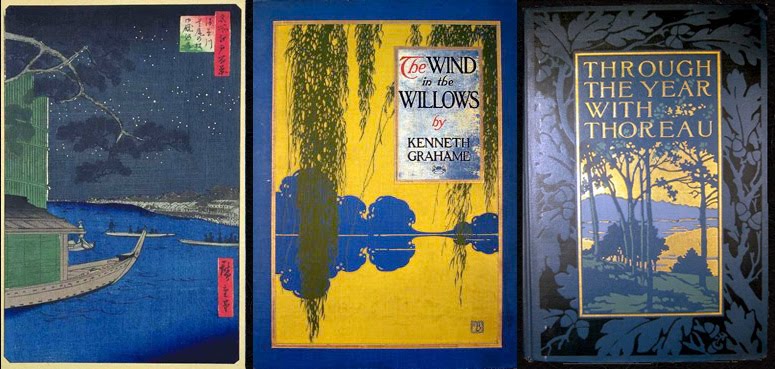
Many developments in 19th century art reflect the influence of Japan. Artists such as Manet experimented with flattened forms after seeing Japanese prints. Vincent van Gogh collected hundreds of Japanese prints, and they influenced his use of brilliant colors and heavy outlines. Larger artistic movements such as Arts and Crafts and Art Nouveau have a great deal of Japonisme at their root. Though the primary Japonisme craze was in the 1880's and 90's, artists and designers continued to use elements of the style for some time, particularly when dealing with Japanese themes.

With respect to book-binding, cover designers employed a variety of techniques that reflected an interest in Japanese style. In the Victorian period, covers that didn't necessarily look Japanese showed the influence through the use of asymmetrical design, strong diagonals, oriental typefaces and motives, and a variety of fill patterns.

In the move away from more gaudy Victorian covers, many designers appreciated the simplicity of some of Japanese style. Some covers mimicked the binding style of Japanese books, or Japanese paper. Others used an oriental style typeface or actual Japanese characters. Asymmetrical design continued to be popular as well as imitations of the flat Japanese landscape style. Many of the covers of books by author Lafcadio Hearn are done in these styles, reflecting his subject matter and immigration to Japan.

Certain known cover designers showed influence by Japonisme. Some of Sarah Wyman Whitman's simple elegant designs have evidence of roots in Japonisme, while others use more explicit Japanese motifs, although she herself denounced the gaudy 1880s eclectic covers that "represented a combination of bad French art mixed with Japanese art; scrolls and arabesques, which had to do with some debased form of book cover mixed with a bit of Japanese fan." Several covers by Bertha Stuart, who designed primarily between 1903 and 1911 show a strong Japanese influence as well.

not, i will admit, wholly new, but i believe all of these extraordinary images are, new to this blog. much much more at the website where these words come from, HERE. these designers, they take my breath away. see more from this blog (including links) HERE.

Labels: , , , , , , , , ,

newer posts older posts