japonisme

24 September 2007

the prankster flatters

Pen- field was at the fore- front of the poster art form. His particularly American approach to the Art Nouveau movement downplayed the dramatic curving lines of the European version and emphasized flat, simple areas of form and color as seen in Japanese prints and the work of the Post-Impressionists, especially Henri de Toulouse-Lautrec. Penfield’s posters became a means by which he could introduce avant-garde aesthetics to the American public. He is, in fact, credited with bringing abstraction to American commercial art. He had an art director’s understanding of what was required for a successful advertisement. As he noted, “It is more a question of what to leave out than what to put in.” 1

a little while back i posted the two images above, penfield's 'salute' to bairei kono, as mentioned in meech and weisberg's japonisme comes to america. then, a couple of days ago i came across penfield's poster to the right, on a website that stated it was his homage to steinlen's illustration to the left.

then i came across one of his illustrations i hadn't really noticed before, below, and the row of carriages reminded me of something.


i went and checked the bonnard painting i had remembered (above), and just really had to smile.


a wonderful (if unfinished) website all about penfield pointed out this penfield/ toulouse- lautrec similarity.


naturally, this got up my curi- osity. i feel like if i only were a little bit more knowledgeable about art history, having memorized all of the japanese and french artists of the last century or so, i would find many more of these. but in the meantime i offer.... (both penfield/steinlen pairings)

similar? coincidence? hat doffing? i love all this stuff. anyone out there know of any more of penfield's playful posters?

Labels: , , , , , ,

23 September 2007

redemption

THE WATER'S CHANT

Seven years ago I went into
the High Sierras stunned
by the desire
to die. For hours I stared
into a clear
mountain stream that fell down
over speckled rocks, and then I
closed my eyes and
prayed that when
I opened them I would be gone
and somewhere a purple and golden
thistle would overflow with light.
I had not prayed since I was a child
and at first I felt foolish saying
the name of God, and then it became
another word. All the while
I could hear the water's chant
below my voice. At last I opened
my eyes to the same place, my hands
cupped and I drank long from
the stream,
and then turned for home
not even stopping
to find the thistle
that blazed by my path.
Since then
I have gone home to the city
of my birth and found it gone,
a gray and treeless one now in its place.
The one house I loved the most
simply missing in a row of houses,
the park where I napped on summer days
fenced and locked, the great shop
where we forged, a plane of rubble,
the old hurt faces turned away.
My brother was with me, thickened
by the years, but still my brother,
and when we em- braced
I felt the rough
cheek and his hand
upon my back tapping
as though to tell me, I know! I know!
brother, I know!
Here in California
a new day begins. Full dull clouds ride
in from the sea, and this dry valley
calls out for rain. My brother has
risen hours ago and hobbled to the shower
and gone out into
the city of death
to trade his life for nothing because
this is the world.
I could pray now,
but not to die,
for that will come one
day or another. I could pray for
his bad leg or my son John
whose luck
is rotten,
or for four
new teeth, but
instead I watch my eucalyptus,
the giant in my front
yard, bucking
and swaying in the wind
and hear its

tidal roar. In the
strange new light
the leaves overflow
purple and gold,
and a fiery dust showers
into the day.

Philip Levine

Labels: , , , , , ,

22 September 2007

wild swans

THE WILD SWANS AT COOLE

THE trees are in their
autumn beauty,
The woodland paths are dry,
Under the October twilight
the water
Mirrors a still sky;
Upon the brimming water
among the stones
Are nine-and-fifty Swans.
The nineteenth autumn
has come upon me
Since I first made my count;
I saw, before I had well finished,
All suddenly mount
And scatter wheeling
in great broken rings

Upon their clamorous wings.
I have looked upon
those brilliant creatures,
And now my heart is sore.
All's changed since I,
hearing at twilight,
The first time on this shore,
The bell-beat of their wings above my head,
Trod with a lighter tread.
Unwearied still, lover by lover,
They paddle in the cold
Companionable streams
or climb the air;
Their hearts have not grown old;

Passion or conquest, wander
where they will,
Attend upon them still.
But now they drift
on the still water,
Mysterious, beautiful;
Among what rushes
will they build,

By what lake's edge or pool
Delight men's eyes when I awake some day
To find they have flown away?

William Butler Yeats

Labels: , , , , , , , , , ,

21 September 2007

in the balance

and yet.....


..... so much is to be said for loveli- ness....

Labels: , , ,

20 September 2007

the angel & the fisherman

[A]lthough all the visible and audible elements of nō are aimed at creating this other-worldly atmosphere, and this is the element that everybody who ever witnessed a nō performance always is excited about, nō is really a literary art form. The texts are written in an archaic and poetic Japanese full of references to older Japanese and Chinese literature, making it very hard to understand fully by a modern audience. To give you some idea about the texts, here follows an excerpt from the play Hagoromo, about a fisherman who finds the feathered robe of an angel, and is only willing to give it back to her after she danced for him. The place where this is supposed to have happened, the beach at Mio, is still visited by tourists today.

David van Ooijen

Fisherman: Now I have landed at the pine-wood of Mio and am viewing the beauty of the shore. Suddenly there is music in the sky, a rain of flowers, unearthly fragrance wafted from all sides. These are no common things; nor is this beautiful cloak that hangs upon the pine-tree. I come near to it. It is marvellous in form and fragrance. This surely is no common dress. I will take it back with me and show it to the people of my home. It shall be a treasure in my house.

Angel
: Stop! That cloak is mine. Where are you going with it?

Fisherman: This is a cloak I found here. I am taking it home.

Angel
: It is an angle’s robe of feathers, a cloak no mortal man may wear. Put it back where you found it.

Fisherman
: How? Is the owner of this cloak an angel of the sky? Why, then, I will put it in safe keeping. It shall be a treasure in the land, a marvel to men unborn. I will not give back your cloak.

Angel: Oh pitiful! How shall I cloakless tread the wingways of the air, how climb the sky, my home? Oh, give it back, in charity give it back.

Fisherman: No charity is in me, and your moan makes my heart resolute. Look, I take your robe, hide it, and will not give back.

Angel: Like a bird without wings, I would rise, but robeless

Fisherman: To the low earth you sink, an angel dwelling in the dingy world.

Angel
: This way, that way. Despair only.

Fisherman
: But when she saw he was resolved to keep it …

Angel
: Strength failing.

Fisherman
: Help none …

Chorus
: Then on her coronet, jewelled as with the dew of tears, the bright flowers drooped and faded. O piteous to see before the eyes, fivefold the signs of sickness corrupt an angel’s from.

Angel: I look into the plains of heaven, the cloud-ways are hid in mist, the path is lost.

Chorus
: Oh, enviable clouds, at your will wandering for ever idle in the empty sky that was my home! Now fades and fades upon my ear the voice of Kalavink [bird of heaven], daily accustomed song. And you, oh you I envy, wild-geese clamorous down the sky-paths returning; and you, O seaward circling, shoreward sweeping swift seagulls of the bay: even the wind, because in heaven it blows, the wind of Spring I envy.

Translation: Arthur Waley 1

(the two images of the angel are by hiroshige. the pine tree upon which the feathered robe hung was near one of the stations on the tokaido road, and he created many images of each station on that road. in the hokusai manga selection, you can see the robe on the tree, but the fisherman has been distracted by the reflection of fuji in his wine.

this legend has been translated into english by many poets, including ezra pound who was long feuding with whaley over who was the most accurate translator.

the interesting thing is that what started this all off was my noticing how rarely women in images from either culture seemed to exhibit strength, confidence, self-possession. artists in both cultures featured women who were coy, or hesitant, or timid. perhaps humble.
i wondered about images of women who were their own people, women who could stand their own ground without wholly deriving a sense of their own worth through their sexual appeal. i could only find it in fairy tales.)

Labels: , , , ,

19 September 2007

cross purposes

Japan's aesthetic conceptions, deriving from diverse cultural traditions, have been formative in the production of unique art forms. Over the centuries, a wide range of artistic motifs developed and were refined, becoming imbued with symbolic significance. Like a pearl, they acquired many layers of meaning and a high luster. Japanese aesthetics provide a key to understanding artistic works perceivably different from those coming from Western traditions.

Within the East Asian artistic tradition, China has been the acknowledged teacher and Japan the devoted student. Nevertheless, several Japanese arts developed their own style, which can be differentiated from various Chinese arts. The monumental, symmetrically balanced, rational approach of Chinese art forms became miniaturized, irregular, and subtly suggestive in Japanese hands. Miniature rock gardens, diminutive plants (bonsai), and ikebana (flower arrangements),

in which the selected few represented a garden, were the favorite pursuits of refined aristocrats for a millennium, and they have remained a part of contemporary cultural life.

The diagonal, reflecting a natural flow, rather than the fixed triangle, became the favored structural device, whether in painting, architectural or garden design, dance steps, or musical notations. Odd numbers replace even numbers in the regularity

of a Chinese master pattern, and a pull to one side allows a motif to turn the corner of a three-dimensional object, thus giving continuity and motion that is lacking in a static frontal design. Japanese painters used the devices of the cutoff, close-up, and fade-out by the twelfth century in yamato-e, or Japanese-style, scroll painting, perhaps one

reason why modern filmmaking has been such a natural and successful art form in Japan. Suggestion is used rather than direct statement; oblique poetic hints and allusive and inconclusive melodies and thoughts have proved frustrating to the Westerner trying to penetrate the meanings of literature, music, painting, and even everyday language.

The Japanese began defining such aesthetic ideas in a

number of evocative phrases by at least the tenth or eleventh cent- ury. The courtly refinements of the aristocratic Heian period evolved into the elegant simplicity seen as the essence of good taste in the understated art that is called shibui. Two terms originating from Zen Buddhist meditative practices describe degrees of tranquility: one, the repose found in humble melancholy (wabi), the other, the serenity accompanying the enjoyment of subdued beauty (sabi). Zen thought also


contributed a penchant for combining the unexpected or startling, used to jolt one's consciousness toward the goal of enlightenment. In art, this approach was expressed in combinations of such unlikely materials as lead inlaid in lacquer and in clashing poetic imagery. Unexpectedly humorous and sometimes grotesque images and motifs also stem from the Zen
koan (conundrum). Although the arts have been mainly secular since the Tokugawa period, tradi- tional aesthetics and training methods, stemming generally from religious sources, continue to underlie artistic productions. 1

(i have just copied part of a wiki entry, links and all, as part of the discussion on the diagonal structure in these prints. i haven't yet followed all the links, and goodness knows i offer nothing as definitive.)

Labels: , , , , , ,

18 September 2007

beauty is not pretty

Gei literally trans- lates as "art," and although these women were once expected to have sex with loyal patrons, they were predomin- antly known for their skills at storytelling, dancing, painting and musicianship, as well as their exotic looks.

Their bodies were and are their art, but screenwriter [of 'memoirs of a geisha'] Robin Swicord says there is an innate pain to their beauty. "All of it is a kind of interesting torture that results in this image of perfection," Swicord says. "Perfect dancing, perfect music, perfect face, perfect figure, perfect walk."

The ribcage is cinched tight with a sash, called an obi, to achieve a rail-thin look in the kimono. "It's like a bondage situation, in which your midriff is wrapped very tightly with these cords that cut into you," Swicord says. "Then the obi is very heavy and you can only sit in a certain way." But it can also help the women maintain good posture. Dalby says geisha eventually find it comfortable, "because they wear it every day. If it is loose and slips at all, it will give her a backache." (the rest is fascinating.)

[T]o achieve the hour glass figure Edward VII favoured [women] dis- torted their figures into the exagger- ated S-bend shape associated with the fashions of the era.

The hostess achieved this stately movement as much by the restrictive nature of her clothes as by years of deportment and dancing lessons. Skirts were confining, being tight waisted and 'bell' shaped, with every aspect of the skirt presenting a concave curve. They followed the same sinuous lines of art nouveau.

The grace-fullness of the elliptical curve which passed from hips to hem depended on the skirt length and the height of the wearer. This fashion favoured the taller woman. It also favoured the wealthier woman. Many skirts had trains which swept the ground, indicating that their owners belonged to the carriage class and could afford to employ servants to valet them.

Many an Edwardian society hostess in middle age was in urgent need of the help of cosmetics and by 1900 face enamelling was once again beginning to be accepted among society ladies. (again, the rest is fascinating.)


(what the heck is face enamelling???)

Labels: , , , , , ,

17 September 2007

volland ◆ redux & farewell

In 1914, Rachael Elmer, a successful artist and book illustrator, decided to create post cards for the city she loved and had adopted as her home. Her efforts would result in the first American published, artist-drawn post cards.

Before ... marriage, Rachael had studied for several semesters at the New York Art Students League with eminent professors, the likes of Childe Hassam, Winston Cox, and John Henry Twachtman [and arthur wesley dow!]. Now she was using what she learned from the giants of American Impressionism to create her own views of New York City.


In 1914, after an exhausting search, Mrs. Elmer found the P. F. Volland Company of Chicago as a publisher for her post cards. The twelve-card set named the New York Art Lover's series, was packaged in an oaktag folder with a twist-string tie, and within weeks of publication the cards were selling in many upscale New York City boutiques and souvenir shops for 25 cents.

Mrs. Elmer's second set of post cards was published in Burlington, Vermont, in 1916 as part of the Biennial Celebration of the Association of Women Painters, Artists and Sculptors. The set included six creative woodcut block prints, each with a unique post card back. The views are the Times Building, the Stadium at City College, the Statue of Liberty, Grant's Tomb, the Woolworth Building and a very imaginative image of the Brooklyn Bridge.


Eighteen post cards—the sum total of Rachael Elmer's post card artistry. With that effort she changed the world of American post cards.

Along with others in the Robinson family, Mrs. Elmer is considered an American pioneer in the truest sense. She brought beauty to the black and white world of the American post card. She died on February 12, 1919, a victim of the Spanish Influenza epidemic. 1


E. B. White, "TERSE VERSE," The New Yorker, April 20, 1935, p. 32 April 20, 1935 Issue

ONWARD & UPWARD WITH THE ARTS about the greeting card business. A little old lady who lived in Louisiana, set out from her home in the south and journeyed all the way to Joliet to see Mr. P. F. Volland, of the Volland Co. She presented him with a motto for Washington's Birthday. Mr. Volland, impressed with the length of the journey, accepted it and drew up a contract on royalty basis. The motto flopped. The authoress, back in Louisiana, received no pay and began to suffer from delusions of fraud. After some months she again entered the office of Mr. Volland, and shot him dead. 2

Labels: ,

16 September 2007

volland

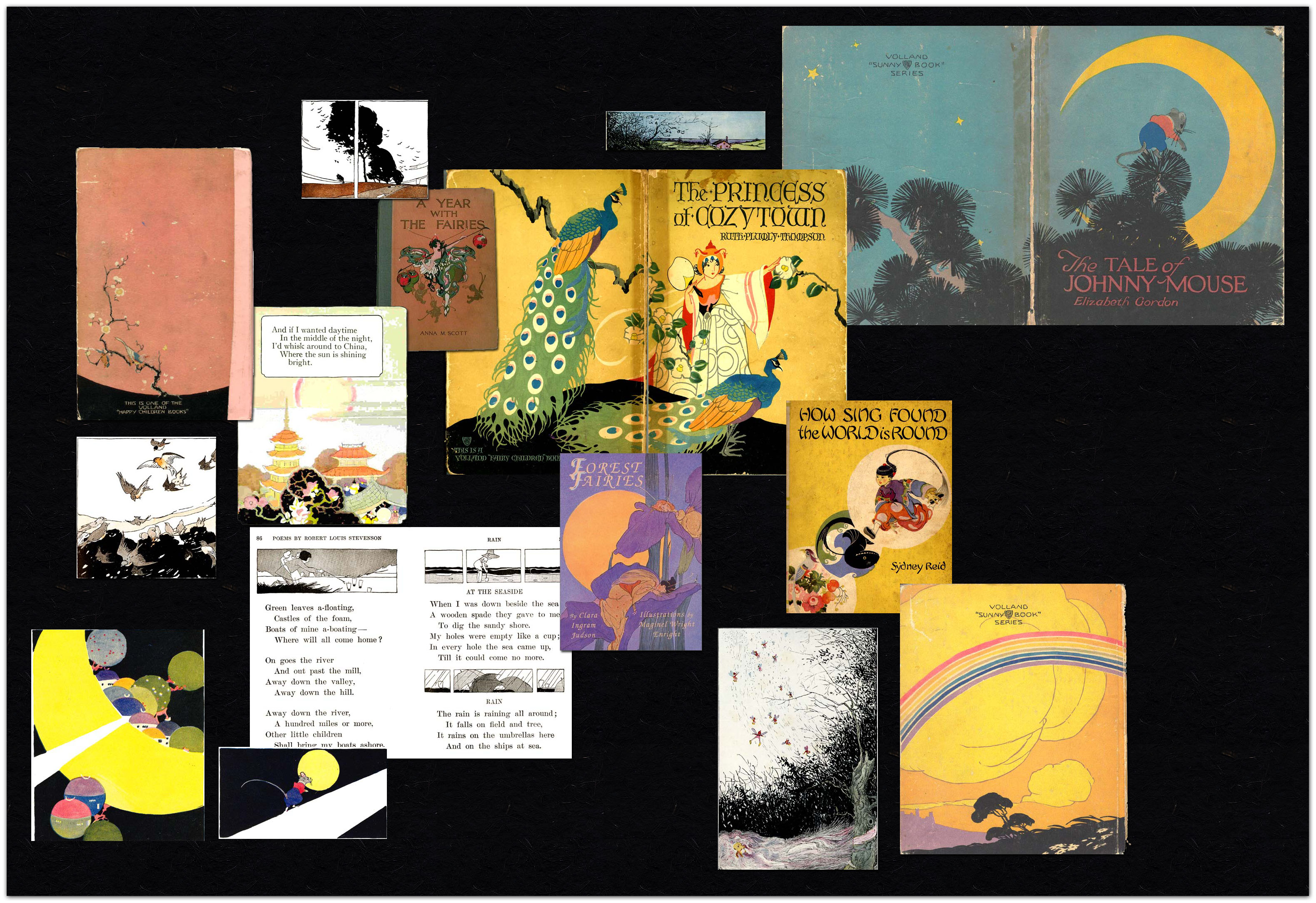
all of this from one publisher, from the early part of the last century. there are varying stories about volland's history, but someone there was extraordinarily wise and very tuned in to the design pulse of the moment.

i don't think there were any other publishers who featured such undiluted japonisme on such a regular basis, and thank goodness for them.

illustrators featured:

maginel wright enright
janet laura scott
m t "penny" ross
johnny gruelle (of raggedy ann fame)
katharine sturges dodge

find the whole books for many of these (and many more) here. just do a search for 'volland' in the publisher space.

Labels: , , , , , ,

newer posts older posts