japonisme

08 August 2007

on realities and illusions

let us be clear. this is what the real mikado looked like at the time of the mikado. emperor at 15, emperor meiji stressed the importance of wearing western clothing, as he is wearing here, in his 20s.

right around that same day, had you been seeing a new operetta back in new england, you might have gotten the idea that a mikado looked like this, where actually it is Frederick Federici.

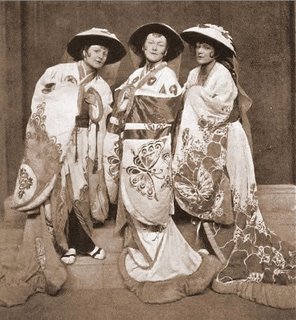
through the following decades, you might have seen something near to this model; here ...

or here ...


or maybe here....


or maybe even here....

interesting, though, this was not a point of conflict.

perhaps moreso (though who cannot relate?) were his 'punishments to fit the crime":

All prosy dull society sinners,
Who chatter and bleat and bore,
Are sent to hear sermons
From mystical Germans
Who preach from ten till four.
The amateur tenor, whose vocal villainies
All desire to shirk,
Shall, during off-hours,
Exhibit his powers
To Madame Tussaud's waxwork.
The lady who dyes a chemical yellow
Or stains her grey hair puce,
Or pinches her figure,
Is painted with vigour
And permanent walnut juice.
The idiot who, in railway carriages,
Scribbles on window-panes,
We only suffer
To ride on a buffer
In Parliamentary trains.
1

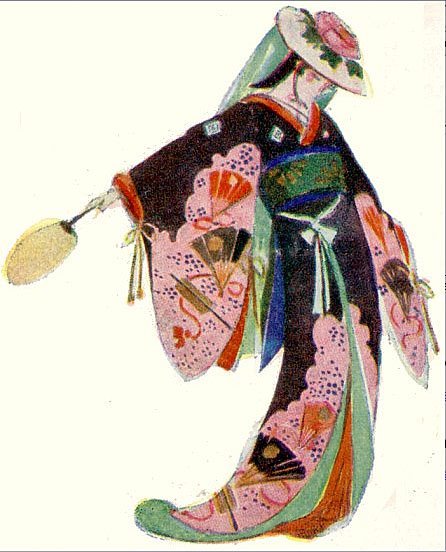
what caused a major uproar among trad- itionalists were the wonderful, new, 1926 designs charles ricketts devised for the d'oyly carte production.

The admitted refurbishing consisted of new scenery, new dresses, and new properties designed by Mr. Charles Ricketts, which in the mass made a highly effective scheme of colour. The Mikado dressed like that may or may not be more Japanese than the old setting; it is certainly less English. Again, the faithful may complain that it is less "Gilbertian," that Yum-Yum and her companions should remain pretty girls according to thoroughly Western notions, whatever their dresses may be, and that the Japaneseness should not be allowed to go further than the bric-à-brac of the mid-Victorian drawing-room. 2

even punch lampooned the changes.

what more serious conflicts did occur, at the time, and over the years in response are covered very interestingly here.

Labels: , ,

05 May 2007

where the lanterns glow

At the beginning of the century, during the 'Meiji' era in Japan, Japan exported many singers and musicians to the west, who had a great deal of influence on turn-of- the-century composers, especially in Europe (Puccini, Ravel and Debussy being the most prominent.) In the U. S., music with "oriental" titles began to appear, but in most cases, this was an excuse to produce staccato notes in the upper register of the piano.

["Yo-San, A Japanese Intermezzo Two Step"] is the exception, and actually echoes a Japanese popular song of the era (which itself had been influenced by American music of thirty years before). [note the various different songs with similar or exact titles. note the 'half-will- bradley-half-kimono dress.]

The end of the nineteenth century and the beginning of the twentieth saw a great deal of interest in Japanese culture in the arts. Puccini wrote "Madame Butterfly", Gilbert & Sullivan wrote "The Mikado" and singers and dancers from Japan toured America and Europe to tremendous critical acclaim.

The popular arts were not immune from this interest: prior to 1905 the musical play "The Mayor of Tokio" played all over the country to large crowds, and the overture was recorded by Vess Ossman, playing banjo for Columbia Records. There was even a popular candy-bar called "Sa-Yo" with the picture of a Japanese maid on the wrapper. This ragtime excursion into orientalia shows the tremendous breadth of Henry Lodge's talent. Starting with themes from "The Mikado" he quickly develops a gentle syncopation which manages to sustain the oriental feeling while becoming a robust rag. (more)

in fact, much of what was written, of what is shown here (just a begin- ning), is a fine combination of ragtime from the african south, "tin pan alley" from the eastern european northeast, and, well.... japonisme -- the asian west coast. immigrants celebrating diversity.

Labels:

23 September 2006

the mikado


while the mikado, 1885, fanned the flames of japonisme, as much as it was itself a flame, it had not dimmed throughout the twentieth century.
the wonderful artist, designer, and maker of books, charles ricketts, designed a whole new costume scheme in the mid-twenties, right about the time when w. russell flint did the breathtaking illustrations.

this is interesting to me because we have entered a different realm here; not sure i know how to talk about it yet, but i'll try: these are not examples of artists being inspired, informed, by the newness of what they're seeing but rather maybe by the novelty. i'm not lumping this in with using women in kimono to sell corsets or whatever; here there are truly artistic results. but it is a place where "the japanese" is "the other" that we can use on "us."

nor am i selling this as politically incorrect. i for one have been grateful most of my life for what the japonisme creators brought into the world. but it is one thing to be moved by something implicit in a culture's culture, and to elaborate upon something external is something else.

it's been called the punch version of japonisme.

Labels: , ,

26 June 2008

the japonisme timeline

AN EVOLVING, SUBJECTIVE TIMELINE of JAPONISME

1788
utamaro produces his series on insects in the garden;

1803
issa writes haiku about plovers

1831

hokusai paints 'the great wave' as part of '36 views of mt fuji';

1853
U.S. Commodore Matthew Calbraith Perry sails into Tokyo Bay, opening Japan to the West.;

1855
walt
whitman's 'leaves of grass' is published;

1856
felix bracquemond discovers hokusai's manga at his printer's shop.;

1857
hiroshige produces plum tree print.;

1859
Charles Darwin, The Origin of Species, published.;

1863
whistler discovers japanese prints in london and becomes an emissary for japonisme in europe;

1864
whistler paints a friend in a kimono looking at japanese prints

1867
paris universal exposition introduces japanese art more widely to the west

1868
manet paints zola with japanese prints on his wall

1870
monet discovers japanese prints in holland;

1874
first impressionist exhibition in paris

1875
Morris & Co. established, promoting arts and crafts movement.

1876 monet paints his wife in a red kimono

1877 morse goes to japan and discovers japanese pottery

1878 whistler sues ruskin

1879 Thomas Edison demonstrates the electric light.;

1883monet moves to giverny and begins to create the japanese garden he will paint for the rest of his life.

1885
gilbert and sullivan produce the mikado;
yoshitoshi begins moon series;

1886 sargent paints 'carnation, lily, lily, rose';
john la farge visits japan;
van gogh
first sees japanese prints.

1887 van gogh paints hiroshige's plum tree print;
pierre loti writes 'madame chrysantheme'

1888 s. bing starts magazine 'artistic japan' to foster interest in japanese arts and crafts.;Arts and Crafts Exhibition Society founded in London.
1890 van gogh dies;
lafcadio hearn moves to japan.

1891arthur wesley dow establishes his art school; first lautrec music-hall posters;
mary cassatt completes her mother & child prints, inspired by those of utamaro;

1892 Tiffany Glass and Decorating Company established.;

1893 munch paints 'the scream';
Aubrey Beardsley design published in the first issue of the magazine The Studio.;

1894
mucha's first art nouveau poster, gismonda with sarah bernhardt;

1895
S. Bing opens his gallery/shop L'Art Nouveau.

1898 john luther long writes short story 'madam butterfly' based on loti's 1887 novel;

mackintosh begins his school in glasgow;

1899 René Lalique designs Dragonfly woman corsage ornament;

1900 Sigmund Freud, The Interpretation of Dreams, published.;

1901 lautrec dies; gauguin dies;
Queen Victoria dies;
stickley starts the craftsman magazine.
1902riviere produces set of prints '36 views of the eiffel tower' based on hokusai's '36 views' series; note that the tower is almost always shown with no top, so it resembles fuji.
1903 whistler dies;
the
wiener werkstatte is founded.

(i'll continue to work on this, only re-publishing after significant changes. it seems, i'm noticing how the year 1900 really did seem an important marking point. i'm going to start part II of this timeline when i feel satisfied enough -- for the moment -- with part I. I'll reproduce the items from 1900 on in that topic.

Labels: , ,

14 August 2007

learning to print

tadamasa hayashi came to paris to assist and translate in the setting up of the paris universal exhibition of 1878.


at the time that he came, wood- block prints were quite devalued in japan, so he quickly realized that he could fill his cases with them, and sell them as art,
at art prices, in france.

thus were many people in paris introduced to japanese prints, and began collecting them.


one of these was henri riviere.


he not only bought from hayashi, but they became close friends, and hayashi became a patron for riviere.


the friendship included instruction of a sort as to printmaking methods, but it also included the recognition that riviere had,

without knowing it, revived ancient japanese printmaking methods for his own work.


when, after a close friendship of fifteen years, hayashi returned to japan, and died soon thereafter, riviere gave up printmaking.


yes, many others, as we've discussed, embraced what japan had to teach.


but to my eyes, henri riviere was japonisme's mikado.


(don't miss the wonderful photogravure site; the hiroshige site that has a permanant place in the sidebar; and the comprehensive henri riviere site.)

Labels: , , , , ,

10 April 2007

Studio: Boulevard Berthier, Paris

"This is Sargent's studio at 41 Boulevard Berthier, Paris. He moved here in June of 1883. On the 23rd of that month Vernon Lee visited and then wrote to her mother regarding the place. The studio did have some history to it as it had previously been occupied by Alfred Stevens (Belgian painter in Paris, 1823–1906).

The photo was probably taken right before the Salon of 1884 (though I'm guessing). His painting of Madame X is to his left and appears ready for show. On the easel which he faces, is the painting of his sister he did in January called The Breakfast Table. Behind Madame X, and hanging on the wall, is Dwarf with a Mastiff, which was a copy after Velázquez's painting which he made at the Prado in Madrid. The porcelain dolls sitting on the mantel over the doorway and the tapestries are reflective of Sargent's taste in the modern movement and attitudes prevalent in Paris at the time for all things Japanese -- especially prints. This profoundly influenced the Impressionists (the influence was called Japonisme)." 1

john singer sargent has been mentioned here before. (interestingly, it's one of the most often searched-for pages.) but today i revel in the discover of the john singer sargent heartland.

run by "natasha the ex-seamstress," clearly a woman with a deep connection to the mikado, the site is an astonishing, comprehensive, and wonderful encyclopedia on sargent, which will take me quite a long time to learn everything there is to learn from it.


so far, among other things, i've found another hammock, this time by giovanni boldini.

Labels: ,

older posts