japonisme

10 November 2006

ruskin the wounded walrus
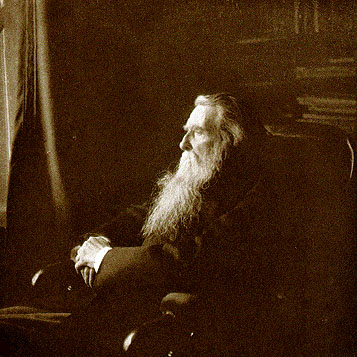
perhaps because his father wanted him to be a poet and his mother wanted him to be a bishop in the evangelical church, john ruskin compromised and became a fire and brimstone art critic, a combination of john leonard, pauline kael and michiko kakutani in influence and breadth of reign. his word could make or break an artist, and ruskin was never one to hold his tongue.
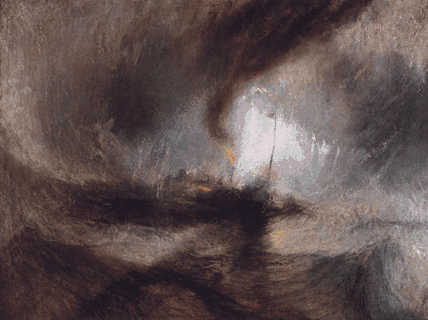
where others critiqued turner's 'snowstorm' as a mess of 'soap suds and whitewash,' ruskin declared it one of the best depictions of the sea ever painted. when ruskin declared that after raphael, painting in england had gone off-track, an entire movement, the pre-raphaelites, was born.
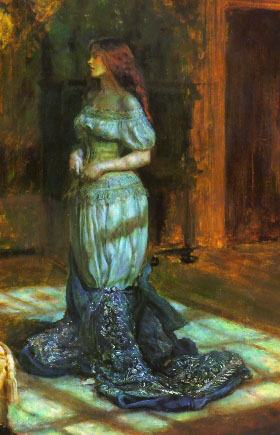
though ruskin was perhaps closest to millais, reviewing his work most favorably, all of the pre-raphaelites became ruskin's family symbolically. literally, euphemia chalmers gray became his wife. this peaceful moment, however, was not to last.
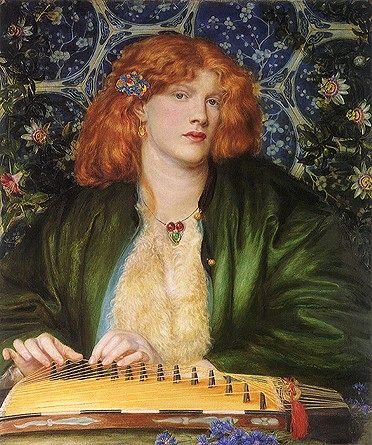
whistler had begun to become close with the artists in the pre-raphaelite group himself, though whistler held no particular sway to ruskin. he, but not only he, began to introduce the japanese senses of art and design to rossetti and the crew, and it had begun to have an influence. it was early, so the profound influences upon western art were still to come, but see in this 1865 painting, 'the blue bower,' by dante gabriel rossetti, both the japanese ume in the tiles in the back, but also the japanese musical instrument. (it has further been suggested that the langourous poses and flowing gowns of the women in the paintings might have their genesis in the japanese art as well.)

though he had reputedly written of his appreciation for japanese art, when it began to 'invade his territory' ruskin began to decry it. the bitter depressions and madness that were to fully take over his later life began.
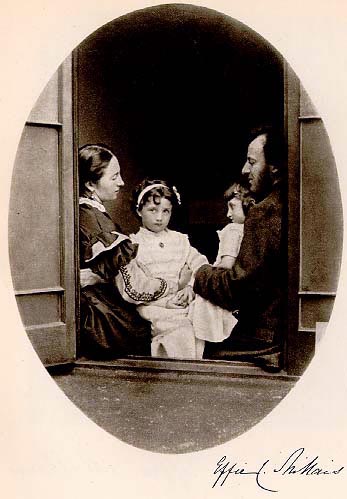
after six years of marriage, his wife divorced him due to his incurable impotence. they had never consummated the marriage. and then she married millais! ruskin began to savage millais' work in reviews (though, as he's thought to be the most popular of the pre-raphaelites, this apparently didn't have the effect ruskin might have hoped). (photo of millais and family by lewis carroll)
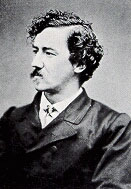
one wonders what it was that whistler did to him personally, though perhaps his slow yet persistent influence over artists that ruskin felt he used to 'rule' (particularly millais, whose 'eve of st agnes,' above, was said to be influenced by whistler's 'white girl') was enough. perhaps he simply did not pay 'the great man' the homage he felt he deserved.

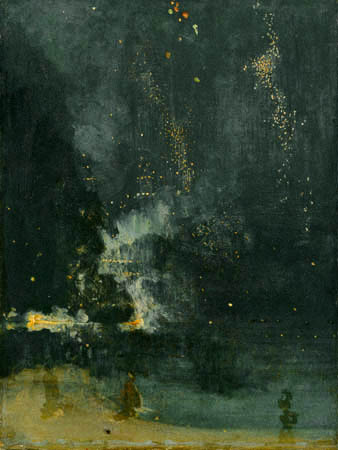
in any case, and in spite of having declared turner a genius for many of the same characteristics, ruskin wrote in his review about whistler's 'nocturne in black and gold: the fire rocket' this:

[the "eccentricities" of such art] "are almost always in some degree forced; and their imperfections gratuitously, if not impertinently, indulged. For Mr. Whistler's own sake, no less than for the protection of the purchaser, Sir Coutts Lindsay ought not to have admitted works into the gallery in which the ill-educated conceit of the artist so nearly approached the aspect of willful imposture. I have seen, and heard, much of Cockney impudence before now; but never expected to hear a coxcomb ask two hundred guineas for flinging a pot of paint in the public's face"1

whistler sued, and won in court (ruskin was too ill to attend), but he won but a farthing, leaving him bankrupt. both he and ruskin were exhausted and destroyed by the battle, ruskin abandoned to a life of manic-depression, hallucinations, and heartbreak (having fallen in love with a 10-year-old girl), whistler needing to begin his life anew, with nothing.

Labels: , , ,

09 November 2006

the old is new again

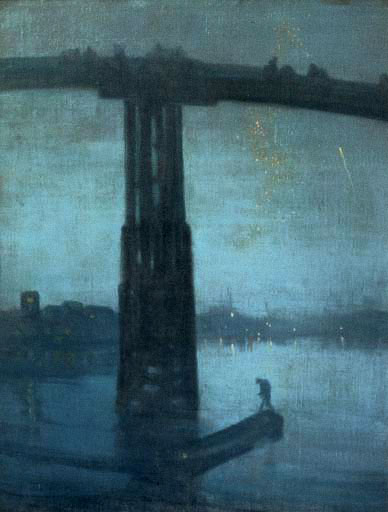
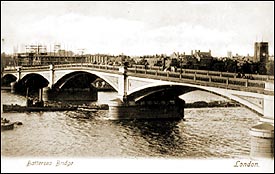
i started thinking, hmmm--whistler's painting does say old battersea bridge... maybe the one in the photo is the 'new' one. sure enough, in this print made in 1840 by thomas dugdale, we see the old battersea bridge, replaced in the 1880s.

THIS DOES NOT LOOK ANY MORE LIKE WHISTLER'S PAINTING
THAN THE NEW ONE DOES!


please forgive my shouting, but...
am i the only one who has noticed this?

starting with the fireworks

it's by whistler, of course; 'nocturne in black and gold: the falling rocket'. 1875

there will be much more about this, but that comes later. i'll take this story one man at a time.

whistler the painter became enamored with the art and craft of japan to such an extent that he became one of the influencing factors in the lives of many european painters and collectors.


in his own work, in addition to the standard featuring of women in kimono, before screens, holding fans, he embraced


what he saw as the essence of the japanese ideal: a rootedness in nature, and 'art for art's sake.' a battle had raged in europe over whether or not art must be moralistic. whistler said no.


the very naming of his paintings for forms of music, symphony, nocturne, reveals this in that he hears the lights and darks, the forms and the flow of line and pigment, and this is what's important (in this i assume that whistler, like nabokov, was a synaesthesic).


this second one (left, above) is called 'nocturne in blue and gold: old battersea bridge' and it was painted in 1873. but, in honor of this blog's topic, let's look at some other images, and their dates.

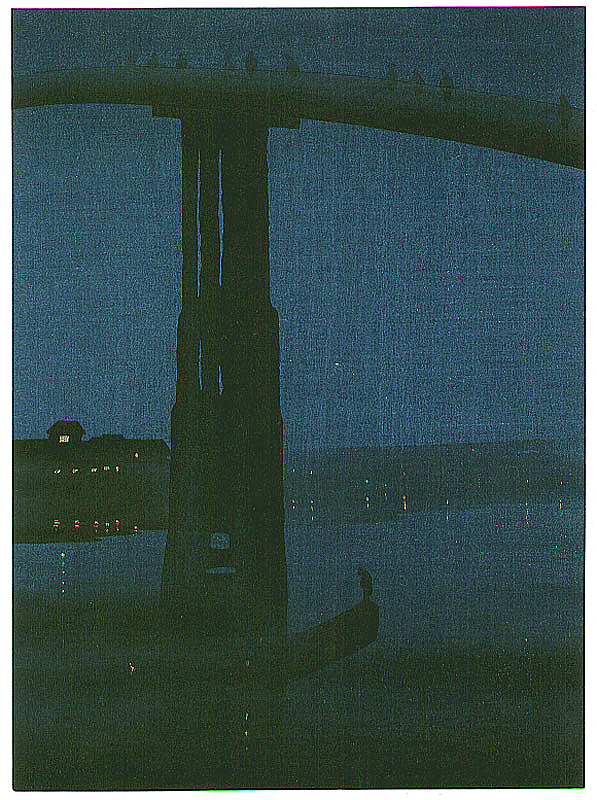
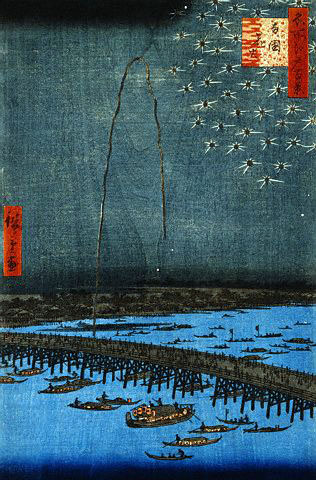
now the interesting thing is that the photo is the battersea bridge. and just below it is the kyo bridge, in a print made by hiroshige in ca. 1857! it is also suggested that this hiroshige print, 'fireworks at ryogoku' inspired whistler in these images as it would nordfeldt in 1906.

the whistler painting itself was inspiration for the next generation of japanese printmakers.

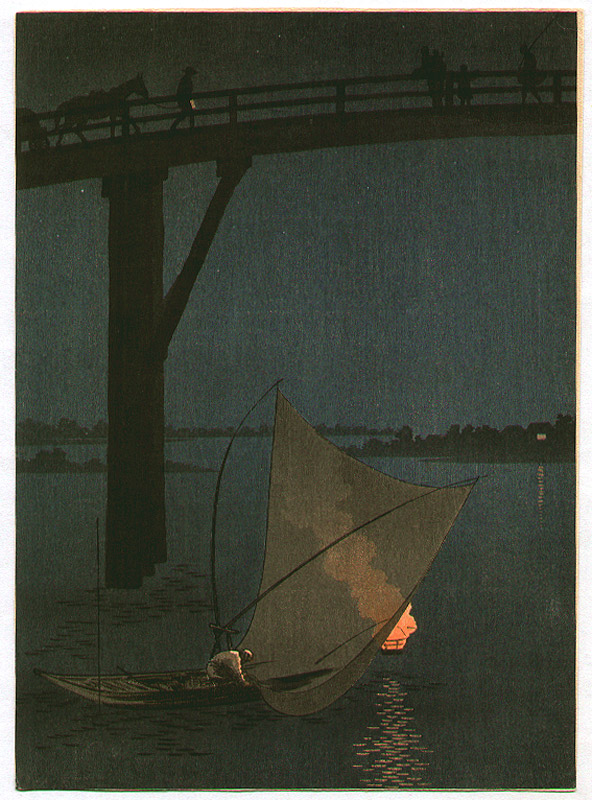
'misty bridge at night' was done by an anonymous printmaker in the 1930s, the same decade that yoshimune arai produced his 'fishing boat,' (right) .

but in a way, it with was the painting with which we began that was whistler's finest achievement, and it was also his downfall. (more in part ii)

Labels: , , ,

07 November 2006

aesthetically speaking

what is called 'the aesthetic movement' intrigues me. it's primarily an 'anglo' phenomenon, ie great britian and the united states. and in part, it flourished in the us because of a brit (who was wilde).

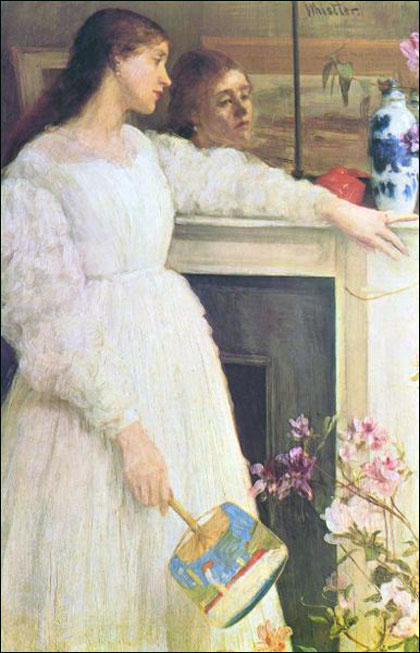
it does get complicated when one begins to discuss personalities, with wilde, ruskin, whistler, and more, and i do want to get into that--it's fascinating. but for the moment let's look at these artifacts.


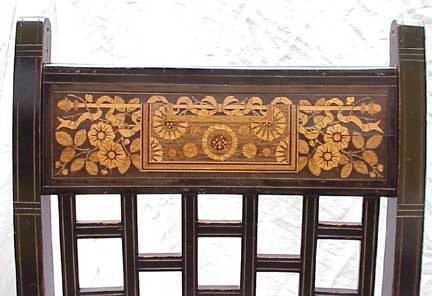
what we see is, as the chicago museum of art says, 'the floral designs emulate Japanese paintings and lacquer, but

the overall
form is West- ern.'

both countries did go into art nouveau, but in both it was embraced a little later; here we


have, essentially, victorian design with japanese symbols (fans, cranes, the japanese symbol for the chrysanthemum's) on it. none of the fluidity of line and form that would enrich the world of arts in the next few years is yet seen, and yet... it's really interesting.

(whistler 'symphony in white #2'; herter brothers chair; royal crown derby; 'aladdin' by walter crane)

Labels: , , , ,

06 November 2006

woodblock foto: bird bath

autumn comes to berkeley,
california

the look of the light

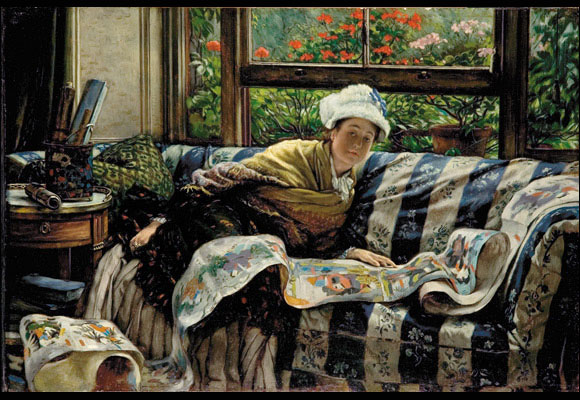
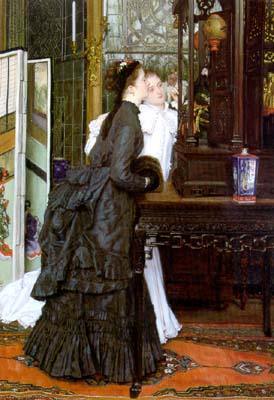
while he is less well-known than his two close friends manet and degas, james jacques tissot gave us something important in these two of his paintings: the dawn. while all three artists were avid followers of the japonisme craze, none of the the three featured the work in their own as much as did, say, whistler, monet or van gogh.

much of tissot's work was of upper-crust society, the wondrousness of costume, the vapidness of content, and of the love of his life, a one mrs. newton (divorced) with whom he lived for only 6 years until she died of a consumptive suicide at the age of 28 (after which tissot spent the rest of his life painting some 700 illustrations of the bible). still, in much of it one sees the strong diagonals of the japanese prints. and to the extent that the japanese prints often featured ladies in the latest extravagant fashions, perhaps this is a corollary as well. further, upon occasion tissot (as well as his friends) would sneak a hung-on-the-wall example of ukiyo-e into a portrait.

but i don't recall any other painter offering us a glimpse into that moment of discovery: the first sighting of lady liberty over the bow of the ship, as the west discovered the wonders of the east.

featured here are 'the japanese scroll,' and 'young ladies admiring japanese objects.'

in one description of degas' portrait of tissot, it said that it was tissot's own 'ukiyo-e' that hung on the wall behind him, but i could find no other reference to it.

Labels: ,

05 November 2006

oranges

i am very lucky, living in california, for many reasons, including its having been an area of great creative activity during the 'arts and crafts movement.' i put that in quotes because there is a tendency to block off all of these 'movements' into separate parts, as though they were truly distinct, without their tendrils and roots all tangled together, which of course they were.

in barcelona, they were called 'modernistas'! whatever they were called, an exhibition honoring them will be happening at the cleveland museum of art from october 15th 2006 until january 7 2007 (and from march 5 2007 to june 3 2007 at the metropolitan museum of art in new york). on the cma webpage i found this vase.

created in 1907 by antoni serra, one of catalonia's leading 'modernista' ceramists, this vase reminded me of something.

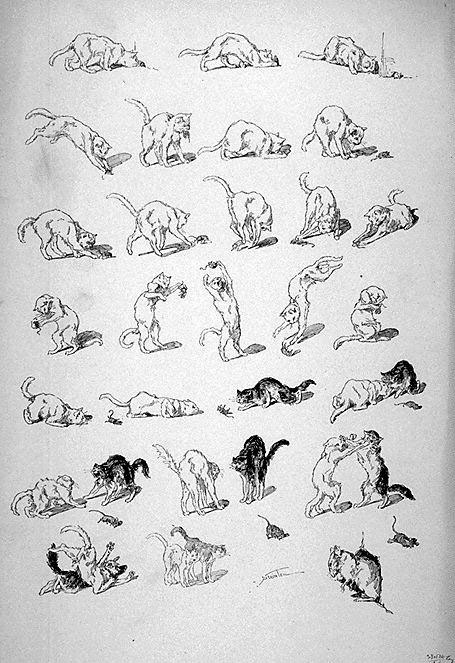
at the oakland museum in california is perhaps the world's best collection of california arts and crafts from this era. while they have an extraordinary tonalist painting collection (due in part to the work of harvey l jones, just retiring), they also have the largest collection of the work of arthur and lucia k mathews, and will be exhibiting it this year, october 28 2006 to march 25 2007. (pomegranate is putting out a mathews calendar as well.)

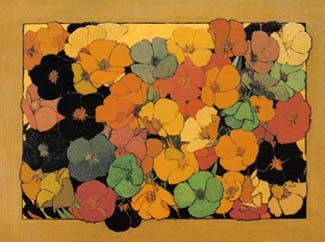
i think this is a huge and wondrous coincidence, because when i looked at that vase, i immediately thought of arthur and lucia mathews! the colors, the oranges, the leaves, these are exactly what you see on some of the work of the mathews, and i realized again how strongly what you find on these arts is what you find where they are made. this is why there are individual temperaments in the "different" movements, not because they are different, but because they are so wonderfully diverse.
Labels: , ,

04 November 2006

remembrance

the building on the left is in detroit. the building on the right is in timisoara, romania. both were built in times when design was magnificent.


but the styles were devalued.

by the time we reembrace them (click on the photos to see more), it is often too late. many of them have already been lost.

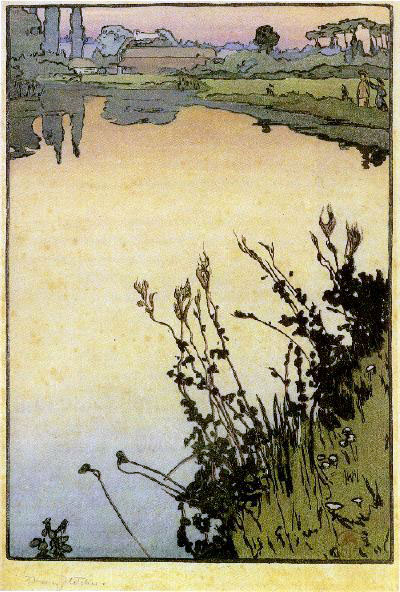
meadowsweet

frank morley-fletcher was born in england but moved to california and created some of the most important woodblock prints of early california. he was one of bjo nordfeldt's most important teachers of the woodblock process.

morley-fletcher's 1916 instructional manual, 'woodblock printing by the japanese method,' is entirely online here.

the whole woodblock.com is jam-packed with woodblock printing information. find also another manual on this by hiroshi yoshida.

Labels: ,

03 November 2006

serendipity

i'd talked about my trip to japan, france, and new york (with rutgers thrown in), but i didn't mention that it was in october of 1989--a date which may hold meaning for other san francisco bay area residents too: the loma prieta earthquake. remember? middle of a baseball game? the "big one"?

i also didn't mention the quandry that put me in, because there i sat in my nyc hotel room, watching bits of san francisco burning on the tv, but there was still one stop in man- hattan i really wanted to make.... and i did end up making it.

i went to the hirschl adler gallery to see their arts and crafts show, since immortalized in their book, 'from architecture to object.' and there i saw for the first time the work of b.j.o. nordfeldt.

it was a print called 'the long wave' which took my breath away, still does. i can't find it online, and will try scanning it in, but there are others i've found since that do as well.

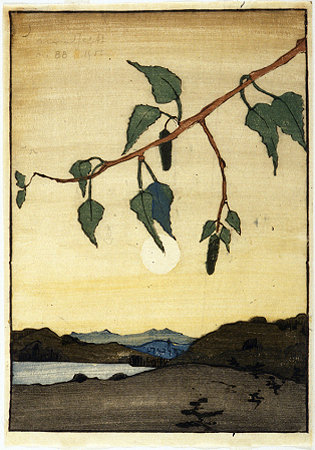
in particular, 'the branch,' above.

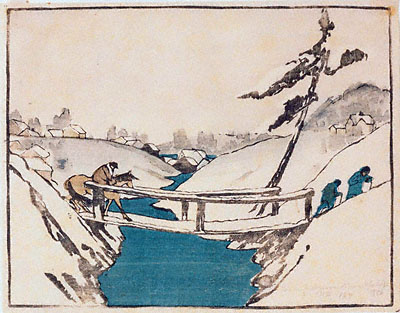
nordfeldt was primarily a painter, but i know him mostly by his very few woodblock prints. most of these were done in 1906, the year he saw frank lloyd wright's collection of hiroshige prints at the chicago museum of art. while there's no knowing for sure which images inspired which, i've suggested some, aided a bit by the book 'japonisme comes to america,' by julia meech and gabriel weisberg.

Labels: ,

02 November 2006

purely Japanese character

mortimer menpes spent the final years of his life as a farmer, growing fruit and carnations.1 but before he retired to the country, his life was the stuff of dreams (though, in truth, perhaps the farm was a dream as well).
after moving to england from australia, menpes was swept into the japonisme craze. he became whistler's apprentice and helper. but unlike whistler, menpes actually went to japan, and he went more than once.

In his paintings of Japanese daily life, Menpes explores the subtleties of Japanese art, emulating the balance and perfection which he saw all around him and describes in some detail in his notes accompanying his illustrations in Japan A Record in Colour. Menpes admired the Japanese painters who would ponder for hours and sometimes weeks over the placing of every last object in their paintings. The proper placing of objects is not only an exact science, but also it forms almost a religion with the Japanese. When you just arrive in Japan you are at once impressed with the perfect placing of everything about you."2

The dining room at 25 Cadogan Gardens, Mr. Mortimer Menpes' House

The cabinets of purely Japanese character in the dining-room ... are charming in their frank simplicity, and greatly to be preferred to the over-elaborated and decorated cabinets with their carved ivory and pearl inlays which have been made in recent years by the Japanese for the European market.3


one of menpes' trips to japan was deliberately to work with craftspeople to manufacture things for his home. menpes felt much western work was shoddy and was seeking the fine hand craftsmanship of japan.4 unfortunately, whistler (not uncharacteristicly) blew into a rage and fired menpes for having stolen japonisme ideas from him!

Labels:

tale or no tale

(kuniyoshi, steinlen)

Labels: , ,

01 November 2006

she stoops to conquer?

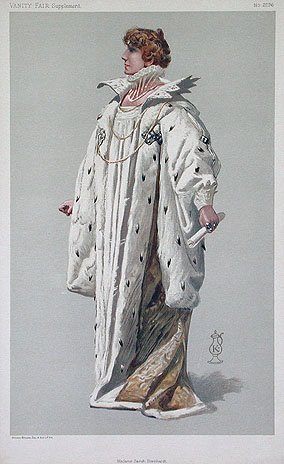
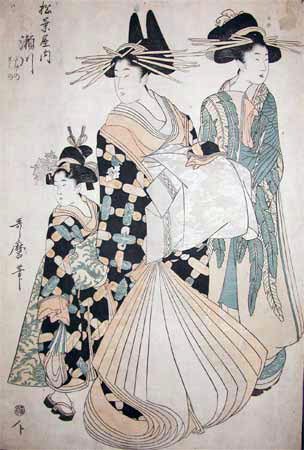
david wondered at the artists of the day portraying dancers, loie fuller, josephine baker, in so much artwork. so what else is new? these are the superstars, the sex-goddesses. it was always thus. and here we are again with sarah bernhardt. and courtesans, the more combs and layers the better. whom other do we have without tv and rock videos?

some fascinating differences that i noticed, though. it was difficult to find any image of sarah bernhardt without her head held high. pride? arrogance? i think we'd probably be surprised to find her bowed.

but we find the geisha, the bijin, the courtesan-poets almost no other way.

beautiful woman in the west stands tall and smiles. beautiful woman in the east does neither. does this legacy hold? i doubt it. but this is what the artists recorded for several centuries in japan. it's hard for me to see it except through western eyes. what does it mean?

Labels: , , , , , ,

seeing the moonlight

seeing the moonlight
spilling down
through these trees,
my heart fills to the brim
with autumn.

ono no komachi


see the charming website 'crackle mountain' in which japanese and chinese folk tales are illustrated with images choices that span the ages.

(poem from 'the ink dark moon,' translations by jane hirshfield and mariko aritani. top left artwork by hiroshige. top right artwork by walter j phillips.)

Labels: , ,

31 October 2006

too many legs

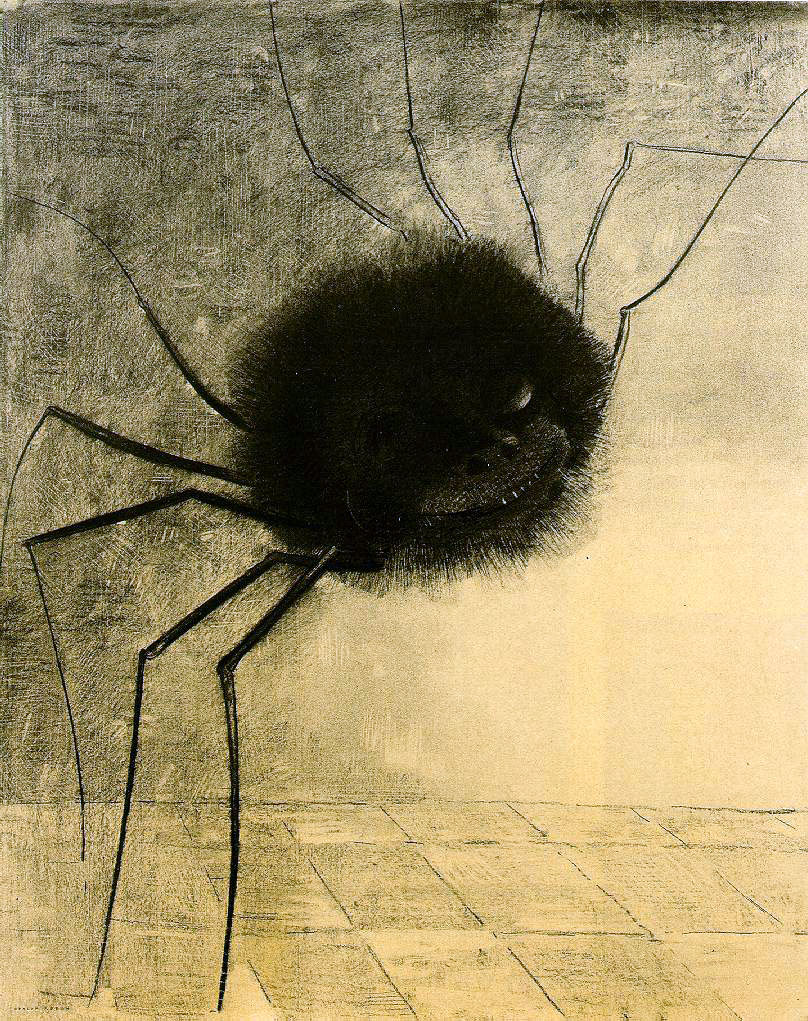
the earth was filled with demons in the 12th century; just ask anyone who has been there. demons who shape-shift. demons who can take just the form that will most beguile you. demons who will mis-deliver your email (no--wait. different spelling)

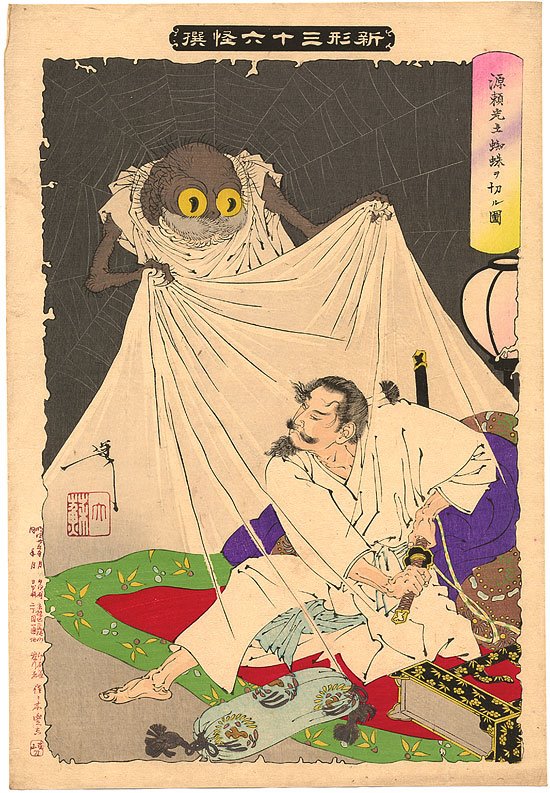
the brave warrior was awoken one night by the most beautiful of all women, but he did not notice she was hanging by a silken thread from the ceiling! she began to work her magic, to tantalize, entrance and entice him. he nearly lost his manly spirit!

at the last moment his faithful manservant noticed that, on the wall behind her was
THE SHADOW NOT OF A WOMAN, BUT OF A SPIDER!!

he smote (smited?) the spider and everyone lived happily ever after. but when the little spider in your corner calls out to you tonight, ignore it, pretend you don't hear, turn your face to the wall and
turn up your ipod.

and if you wake with someone that you don't remember, be careful. they just might have six too many legs.

happy halloween!

('smiling spider' by odilon redon; 'raiko and the spider' by yoshitoshi tsukioka)

Labels: ,

fantastic impressions


i struck out for a new and method of work which was founded on japanese art quite original in the main... fantastic impressions treated in the finest possible outline with patches of 'black blot.'
AUBREY BEARDSLEY


taking freely all that the japanese art could give him, that release from the bondage of what we call real things, beardsley made the world over again in his head, as if it existed only when it was thus re-made... in black line on a white surface,
in white line on black surface.


ARTHUR SYMONS, fortnightly review, may 1, 1898

(quotes from 'beardsley, japonisme, and the perversion of the victorian ideal'; zatlin; columbia university press 1997)

upper print from a hokusai manga

Labels: ,

newer posts older posts